
The Story: $1.8 Billion in Debt, $21 Million in Cash
In April 2019, CVC Capital Partners — one of the world’s most decorated private equity firms — took IT services company ConvergeOne private in a buyout valued at $1.8 billion. The Bloomington, Minnesota-based company had over $1.5 billion in annual revenue, thousands of enterprise clients, and a credible growth story in cloud infrastructure and cybersecurity services. On paper, it looked like a textbook PE acquisition.
Five years later, ConvergeOne filed for Chapter 11 bankruptcy.
By the time it reached the US Bankruptcy Court for the Southern District of Texas in April 2024, ConvergeOne carried approximately $1.8 billion in secured debt and had just $21.4 million in cash on hand — a staggering imbalance for a company still generating over $1.5 billion in revenue. The CFO’s declaration to the court said it plainly: the company had been forced to divert increasing amounts of cash to rising interest payments, and “a highly leveraged capital structure has become unsustainable in the current interest rate environment.”
This was not a company that ran out of customers, product-market fit, or talent. It was a company that ran out of financial oxygen — the slow suffocation of a balance sheet engineered for a low-rate world that no longer existed.
The Decision: Leverage as a Financial Engineering Tool, Not a Business One
When CVC acquired ConvergeOne, the deal followed the standard PE LBO playbook: buy a cash-flowing company, load it with acquisition debt, and use the company’s own earnings to service that debt while operational improvements drive enterprise value toward a lucrative exit. The thesis is elegant in a stable rate environment. The risk is catastrophic when rates rise faster than operating improvement.
The capital structure that emerged from the buyout included a term loan exceeding $1 billion due in 2026, alongside additional debt tranches totaling nearly $1.8 billion. Annual interest expense increased by approximately $55 million between 2022 and 2023 alone — a direct consequence of floating rate exposure meeting the Federal Reserve’s most aggressive rate-hiking cycle in four decades.
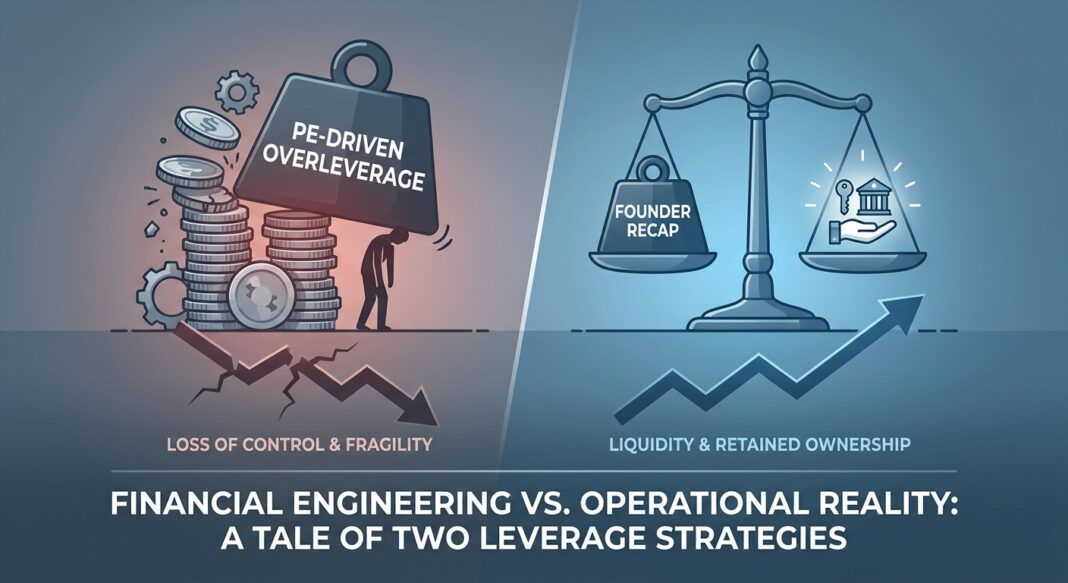
Contrast this with the alternative a founder-operator controls. A leveraged recapitalization — where an owner-operated business takes on structured debt to fund a partial shareholder payout — is initiated by and for the operator, not imposed by an outside financial buyer with a fund lifecycle to manage. The debt multiple is typically 3x to 5x EBITDA, the management team stays intact, and the owner retains operational control. The purpose of the debt is personal liquidity and wealth diversification — not fee extraction or IRR amplification for a limited partnership.
These two uses of leverage look similar on a spreadsheet. In execution, they are philosophically opposite.
The Outcome: Lenders Became the Owners
ConvergeOne’s restructuring plan, confirmed in May 2024, told the full story of what PE-driven overleverage does to a founder’s — or in this case, an operator’s — equity. The plan exchanged approximately $1.6 billion of debt for equity, effectively transferring roughly 96% of ConvergeOne’s ownership to its senior lenders. The company’s original PE sponsor was effectively zeroed out. Employees and customers absorbed the operational disruption of a bankruptcy process. The company that had posted $1.5 billion in revenue the prior year had to be handed to creditors simply to survive.
This story is not unique to ConvergeOne. According to S&P Global Market Intelligence, bankruptcy filings by US companies backed by private equity and venture capital climbed to 110 in 2024 — the highest annual total on record since S&P began tracking the metric. Consumer discretionary and healthcare companies accounted for more than half of those filings. The throughline in most cases: debt structures engineered during a low-rate era that became unserviceable when rates normalized.
Now run the counterfactual. A founder-owned business generating $30 million in EBITDA pursues a leveraged recap at 4x EBITDA, borrowing $120 million and distributing $100 million to themselves as a tax-efficient dividend — diversifying personal wealth without selling a share. They retain 100% ownership, the management team doesn’t change, and the debt is sized to the business’s actual cash generation. Annual debt service on a 5-year term at SOFR + 450 bps — roughly 9% all-in at current levels — runs approximately $10.8 million per year. The business generates $30 million. Coverage is nearly 3x. There is no liquidity crisis. There is no bankruptcy court. There is no fund exit pressure.
The founder kept the company. The founder kept their wealth. The founder kept control of the story.
The Lessons: It’s Not the Debt — It’s Who the Debt Serves
The ConvergeOne story, and the record wave of PE-backed bankruptcies it represents, is not an argument against leverage. It is an argument against leverage deployed in service of financial engineering rather than operational reality.
The structural distinction matters. In a PE LBO, the debt is sized to maximize the return on the sponsor’s equity — often regardless of whether the underlying business can comfortably service it through an economic cycle. Management incentives are reset around a 3–5 year exit timeline. The fund’s carry mechanism creates pressure to transact, not to steward. When rates rise 500 basis points and the exit window closes, the misalignment becomes existential.
In a founder-led leveraged recap, the debt is sized to the operator’s comfort with risk. The owner who will lie awake at night servicing that debt is the same person who sets the borrowing level. Incentives are perfectly aligned. There is no fund lifecycle, no LP distributions to manage, no carried interest clock ticking. The business can breathe.
The market data supports disciplined use of the tool. LBO financing reached $81 billion in 2025 — the highest level on record — while average leverage ratios averaged 4.9x EBITDA. Private credit financed approximately 85% of leveraged buyouts in the US in 2024. The capital is available. The question is always: in whose hands does the leverage create value, and in whose hands does it create fragility?
A Framework for the Decision
- Cash flow coverage first. Any leverage structure that leaves less than 2x EBITDA coverage of annual debt service is a vulnerability, not a strategy. Model it at today’s rates, not the rates at signing.
- Know who the debt serves. Founder recap debt serves the operator. PE LBO debt serves the sponsor’s IRR. These are not the same thing.
- Size to survive a cycle. Businesses go through recessions. The capital structure should be able to absorb one without a bankruptcy filing.
- Preserve optionality. A leveraged recap where the founder retains majority control and 100% operational authority preserves every future option — growth, acquisition, sale, or succession — that a full PE buyout forecloses.
- Use debt for liquidity, not control transfer. The most powerful use of a founder recap is personal wealth diversification. Getting liquid on earned value without ceding the board room is the purpose of the instrument.
Key Insights
- 📌 Leverage is a tool, not a strategy. ConvergeOne’s $1.8 billion in debt did not fail because of the business — revenue grew. It failed because the capital structure was built for a rate environment that no longer existed. Debt sized to sponsor returns, not business fundamentals, is the real risk.
- 📌 The record speaks for itself. PE and VC-backed bankruptcies hit 110 in 2024 — an all-time high since records began in 2010. The common denominator: overleveraged structures meeting a higher-for-longer rate environment that exposed the misalignment between sponsor incentives and operational reality.
- 📌 Founder-led leveraged recaps are structurally different — and structurally superior for operators. A recap at 3x–5x EBITDA, initiated by and for the owner, delivers personal liquidity, preserves operational control, retains full future upside, and eliminates the fund-lifecycle pressures that destroy PE-backed companies in downturns.
- 📌 Alignment is the true underwriter. In a founder recap, the person setting the debt level is the same person living with the consequences. In a PE LBO, that person is a fund manager managing carry across a portfolio. The incentive gap is the hidden risk that rate charts cannot capture.
- 📌 The private credit market is deep and accessible for the right borrowers. With direct lending now dominating middle-market financing — representing the majority of leveraged loan volume for companies with EBITDA between $10 million and $75 million — disciplined owner-operators have access to flexible, non-dilutive capital at scale. The window is open. The question is whether to use it to build, or to borrow your way into a lender’s hands.
Sources: ConvergeOne Chapter 11 filings (US Bankruptcy Court, S.D. Texas, April 2024); S&P Global Market Intelligence, “PE-backed company bankruptcies in US reach record high in 2024” (January 9, 2025); McKinsey Global Private Markets Report, “Private Credit in 2025”; PGIM/ABF Journal, “Middle Market Debt Capacity in a Volatile 2025 Economy”; White & Case, “European Leveraged Finance 2026 Sponsor Focus”; Leveraged recap structure benchmarks via Sofer Advisors and CT Acquisitions (2025–2026).


