
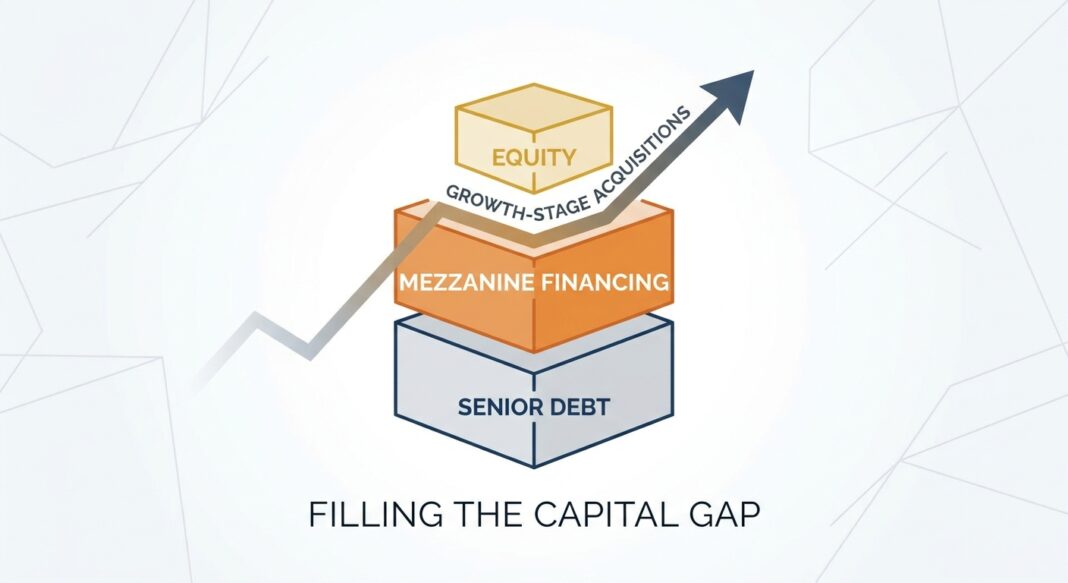
The Growth-Stage Financing Gap: When Senior Debt Runs Out and Equity Costs Too Much
You run a profitable lower-middle-market business generating $8 million in EBITDA. You have identified a bolt-on acquisition priced at $40 million. Your relationship bank will stretch to 3.5x leverage — roughly $28 million — leaving a $12 million gap between what senior debt can cover and what the deal requires. You could sell equity to fill it, but at 25–30% IRR expectations from a growth equity fund, that capital is expensive, dilutive, and comes with governance strings. You do not want to give away a board seat to fund a single acquisition.
This is the defining financing problem of the growth stage: the company is too profitable to need venture capital, too leveraged for incremental bank debt, and too early — or too control-sensitive — for a full equity raise. The instrument purpose-built for this gap is mezzanine financing: subordinated debt that sits junior to senior lenders, carries a blended cash-and-PIK coupon, and often includes a modest equity kicker in the form of warrants. Used correctly, mezzanine capital lets an operator complete an acquisition, preserve majority ownership, and defer full dilution until a future exit or refinancing.
Understanding when mezzanine works, how it is priced, and how to negotiate its terms is one of the highest-leverage skills in middle-market capital strategy.
Structure Breakdown: The Three Pillars of a Mezzanine Instrument
Mezzanine capital is a hybrid instrument that combines characteristics of both debt and equity. Structurally, it sits junior to senior debt but senior to common equity in a company’s capital stack, creating a distinct risk-return profile that serves both the growth-oriented borrower and the yield-seeking investor. Its anatomy has three core pillars:
1. Cash-Pay Coupon
The base interest component, paid quarterly in cash. In 2026, the cash pay coupon on lower-middle-market mezzanine debt typically runs 8–12% annually, reflecting the subordinated position and lack of first-lien collateral. This component services current income for the mezzanine fund and is tax-deductible to the borrower.
2. Payment-in-Kind (PIK) Toggle
The deferred interest component, which accretes to the principal balance rather than being paid in cash. PIK usage has risen notably in private credit in recent years, and is increasingly appearing not just in mezzanine but in senior secured documentation as well. A mezzanine lender in 2026 typically structures 1–3% of the coupon as PIK, bringing total yield to 11–14% all-in on a cash-plus-PIK basis. PIK preserves the borrower’s near-term free cash flow — critical during an integration period following an acquisition.
3. Equity Kicker (Warrants)
Mezzanine lenders frequently attach a warrant package granting the right to acquire a small percentage of the company’s common equity — typically 1–5% — at a nominal or formula-based strike price. The warrant is the mezzanine lender’s participation in the upside if the company performs and exits at a higher multiple. It is the structural mechanism that bridges mezzanine returns from debt-like (12–14%) to equity-like (15–18% net IRR) if the company exits well.
Illustrative Example: $48M Acquisition of a Regional Services Business
Consider a growth-stage B2B services company with $8M EBITDA acquiring a $48M enterprise value target. The capital stack might be structured as follows:
| Layer | Amount | Leverage Multiple | Pricing (2026) | Features |
|---|---|---|---|---|
| Senior Unitranche (First Lien) | $28M | 3.5x EBITDA | SOFR + 550 bps (~10.0% all-in) | 5-yr term, bullet, 1 maintenance covenant |
| Mezzanine (Second Lien / Subordinated) | $10M | 1.25x EBITDA | 11% cash + 2% PIK = 13% total | 6-yr term, PIK toggle, 3% warrant coverage |
| Equity (Sponsor / Rollover) | $10M | — | 25–30% target IRR | Common equity, board representation |
| Total | $48M | 4.75x EBITDA | — | — |
In this structure, the operator retains majority control, the mezzanine lender receives a contractual 13% yield plus modest equity participation, and the senior lender holds a first-priority lien. The $10M mezzanine tranche is the gap filler — the capital that makes the deal possible without a dilutive equity recapitalization.
How Mezzanine Compares: The Cost-of-Capital Spectrum
No instrument exists in isolation. Choosing mezzanine requires a clear-eyed comparison across the full spectrum of gap-filling alternatives.
Mezzanine vs. Unitranche (All-In Senior)
A unitranche facility consolidates senior and subordinated debt into a single credit agreement with a single blended rate, typically structured at 4–6x EBITDA with pricing of SOFR + 500–700 bps in 2026. Unitranche wins on simplicity and speed — a single lender, one credit agreement, one set of covenants — and is the dominant structure for acquisitions in the $25M–$200M enterprise value range. However, unitranche lenders in 2026 are increasingly disciplined at 4.5–5.0x leverage ceilings, meaning companies that need stretch capital above that threshold must layer in mezzanine or preferred equity anyway.
Mezzanine vs. Preferred Equity
Preferred equity sits below debt but above common in the capital stack, and typically carries a 6–10% coupon plus liquidation preference, with no warrant dilution. It is the instrument of choice when a company cannot or will not service additional debt — preferred does not trigger debt covenants, and lenders in a senior facility may not count it as indebtedness. The trade-off: preferred equity investors often demand consent rights over major corporate decisions, making it more governance-invasive than mezzanine.
Mezzanine vs. Growth Equity
Growth equity minority investors expect 25–30% target IRR, take 20–45% dilution, and typically require board representation and information rights. Mezzanine at 11–14% all-in is structurally cheaper, preserves more ownership, and does not require a valuation negotiation. The key constraint: mezzanine requires EBITDA to service the cash coupon, making it inappropriate for pre-profitability or negative-cash-flow situations where equity is the only viable instrument.
When Mezzanine Is the Right Answer
Mezzanine is optimal when: (1) the business generates stable, predictable EBITDA sufficient to service a blended debt stack; (2) the operator wants to preserve control and avoid equity dilution above ~25%; (3) the use-of-proceeds is a defined, near-term value-creation event — an acquisition, a facility build-out, or a technology integration — rather than open-ended growth spending; and (4) the company expects a liquidity event or refinancing within 5–7 years that will repay or recapitalize the mezzanine tranche.
Current Market Terms: Mezzanine in 2026
The mezzanine market in 2026 is active, competitive, and increasingly influenced by the expansion of private credit into the junior debt layer. Here are the current structural benchmarks practitioners should reference:
- All-in yield target: Mezzanine lenders are pricing to 11–14% total return in 2026, split between cash pay coupon and PIK accretion, per market data tracked by S&P Global LCD. Equity participation via warrants is expected to contribute an incremental 2–8% to total realized IRR depending on exit multiple.
- Leverage capacity: A lower-middle-market business in 2026 can raise roughly 3.0–5.5x EBITDA in senior debt and an additional 1.0–2.0x in mezzanine, for a total leverage ceiling of approximately 5.5–6.5x EBITDA on a sponsored acquisition.
- PIK prevalence: PIK usage has risen meaningfully in private credit, with public BDCs now receiving an average of 8% of investment income via PIK. Once limited to mezzanine and subordinated debt, PIK is increasingly appearing in senior secured loan documentation — a signal that the market is accommodating borrowers’ cash flow management preferences.
- Covenant design: In the lower and core middle market (EBITDA under $100M), maintenance covenants continue to be more prevalent than cov-lite structures. Mezzanine lenders in particular continue to demand quarterly maintenance testing — typically a maximum leverage ratio and minimum fixed-charge coverage — as a condition of subordinated lending. Lenders with maintenance covenants gain negotiating rights when a borrower misses a quarterly test, well before a payment default occurs, allowing intervention while enterprise value is still intact.
- Covenant evolution for growth-oriented borrowers: For software and recurring-revenue businesses, market practice has evolved to incorporate alternative metrics such as an annual recurring revenue (ARR) covenant focused on revenue durability and liquidity runway rather than near-term EBITDA profitability.
- Warrant coverage normalization: Warrant packages of 1–5% of common equity are standard at the lower end of the middle market. For larger or more competitive situations, warrants may be reduced or eliminated in exchange for a higher cash coupon.
- Lender universe: The private credit market now extends beyond senior loans to include junior lending with equity upside, mezzanine financing, and hybrid structures. Leading mezzanine-focused managers active in the $5M–$50M tranche market include Audax Mezzanine, NewSpring Capital, and Golub Capital, among others. Larger structures above $50M tap Apollo, Ares, and Blue Owl capital solutions platforms.
The Gap Capital Playbook: Structuring, Running the Process, and Negotiating
Step 1 — Quantify the Gap
Start from the use-of-proceeds and work backward. Define the total capital need precisely: purchase price plus transaction costs plus integration reserve plus pro-forma working capital. Then calculate the maximum available senior debt using a conservative EBITDA multiple (3.5–4.0x on a combined basis, post-acquisition). The remainder is your gap. This number determines whether you need $5M or $25M of mezzanine — and that size will determine which lenders you approach and at what cost.
Step 2 — Prepare the Materials
Mezzanine lenders underwrite to free cash flow, not just EBITDA. Your financing memorandum must present: (a) a clear use-of-proceeds with acquisition rationale; (b) a three-year pro-forma model showing combined entity EBITDA, debt service, and free cash flow after debt service (FCADS); (c) a leverage walk showing total debt / pro-forma EBITDA at close, Year 1, and Year 3; and (d) a debt service coverage analysis at both the cash coupon and the PIK-inclusive all-in rate. Mezzanine lenders will stress EBITDA by 15–25% to validate that the cash coupon is serviceable even in a downside scenario.
Step 3 — Run a Competitive Process
Do not accept the first term sheet. In the $5M–$50M mezzanine market, a properly structured process should generate 3–5 competitive indications. The key variables to stress-test across proposals are: total yield (cash vs. PIK split), warrant percentage and strike mechanics, covenant headroom on the leverage test, prepayment premiums, and PIK toggle optionality. The choice among capital sources is not a matter of taste — it is a matter of cost-of-capital math, control preservation, and time-to-close constraints.
Step 4 — Negotiate the Structure
The highest-leverage negotiating points for a mezzanine borrower are:
- PIK toggle optionality: Push for a voluntary PIK toggle rather than mandatory PIK, so management can choose to defer interest in lean quarters without triggering a default event.
- Warrant strike price and anti-dilution: Negotiate a fixed-price strike rather than a formula-based strike, and ensure the warrant does not include broad-based anti-dilution ratchets that expand the lender’s ownership in future financing rounds.
- Covenant headroom: The leverage maintenance covenant should be set with at least 20–25% EBITDA headroom versus the pro-forma close model — meaning if your combined entity closes at 4.75x leverage, the maintenance covenant should test at 5.75–6.0x maximum. This buffer absorbs seasonality, integration-period softness, and one-time costs without triggering a technical default.
- Prepayment flexibility: Standard mezzanine documents include a call premium schedule (often 2–3% in Year 1, declining to par by Year 3). If you anticipate a refinancing or sale within 18–24 months, negotiate a make-whole call or a shorter call protection window.
- Permitted acquisitions basket: Ensure the mezzanine credit agreement includes a defined basket for future add-on acquisitions that does not require lender consent for transactions below a specified threshold, preserving strategic flexibility without triggering covenant renegotiation.
Key Takeaways
- Mezzanine fills the gap between senior debt capacity and equity cost. When a growth-stage company exhausts its 3.5–4.0x senior debt ceiling, mezzanine adds 1.0–2.0x of EBITDA-based capacity at 11–14% all-in — far cheaper than growth equity’s 25–30% IRR hurdle — while preserving majority ownership and operational control.
- The instrument has three components, each negotiable. Cash coupon (8–12%), PIK accretion (1–3%), and warrant coverage (1–5% of common equity) are the three value levers. Each is independently negotiable, and shifting the mix — e.g., more PIK in exchange for a smaller warrant — can significantly change the total cost and dilution profile.
- Covenant design is the hidden risk variable. Maintenance covenants in mezzanine agreements are lender-protective tripwires: a borrower that misses a quarterly leverage or coverage test hands the mezzanine lender negotiating power before a payment default. Negotiating adequate headroom — at least 20–25% above the closing leverage multiple — is as important as negotiating the coupon.
- PIK usage is rising across the capital stack, not just in mezzanine. As PIK increasingly appears in senior secured structures, borrowers should understand that PIK accretion compounds against them. A $10M mezzanine tranche accreting 2% PIK annually grows to $11.04M by Year 3 before any cash repayment — a balance sheet reality that must be modeled in any serious exit scenario analysis.
- The 2026 capital stack default for a sponsored LMM acquisition is increasingly standardized. The prevailing structure pairs 3.5x senior or unitranche with 1.0–1.5x mezzanine or preferred and a 20–25% common equity check — giving the operator 55–65% of common equity at close. Operators who internalize this template, and know which variables are flexible versus fixed at each layer, will negotiate faster and better than those who approach each raise from scratch.


