
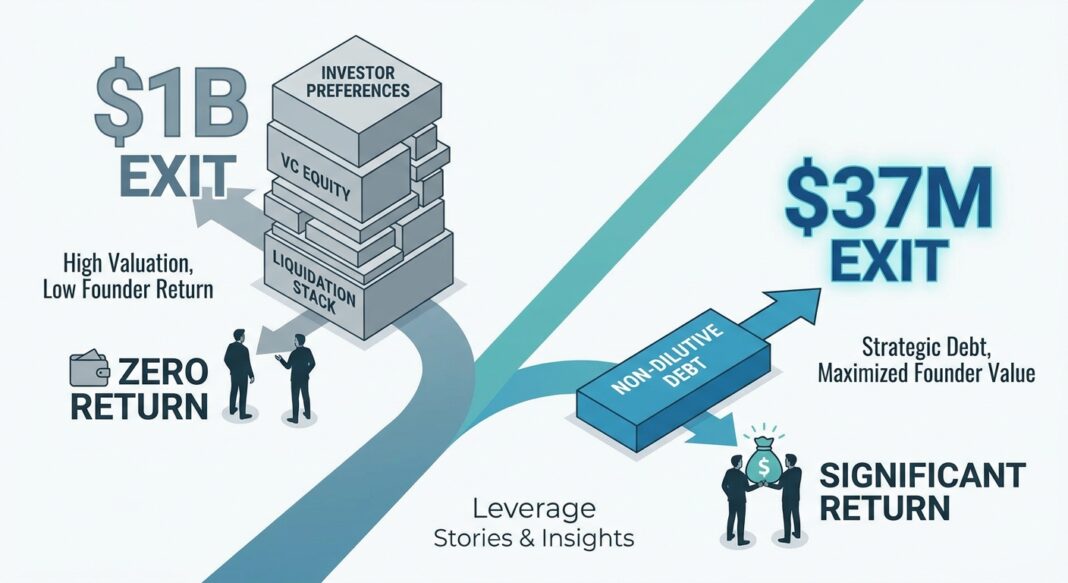
The Story: Two Companies, One Number, Two Very Different Endings
In January 2025, a rent-to-own proptech startup sold for approximately $1 billion. The founders received $0.
Divvy Homes — once a darling of Silicon Valley, backed by Andreessen Horowitz, Tiger Global, and GGV Capital, and last valued at $2.3 billion in 2021 — was acquired by Maymont Homes, a division of Brookfield Properties, in what was widely described as a distressed transaction. CEO Adena Hefets wrote in a letter to shareholders that after repaying outstanding debt, covering transaction costs, and fulfilling liquidation preferences for preferred shareholders, neither common shareholders nor founders’ preferred stock would receive any proceeds. A billion dollars in. Nothing out. For the people who built it.
Now rewind to September 2022, roughly 1,400 miles southeast of Silicon Valley. In Florida, a father-son entrepreneurial team named Greg and Timothy Holifield — veterans of four startups — had a growing problem at their latest venture, SafePointe. SafePointe specialized in intelligent weapons detection technology with roots in U.S. military defense programs. Unlike bulky legacy metal detectors, its AI-based solution was designed for high-traffic, high-security environments requiring frictionless access in a low-profile form factor. The technology was compelling. The contracts were coming in. But fulfilling them required cash to finance physical hardware — and the Holifields refused to hand equity to a venture investor to get it.
Founded by the father-son duo Greg and Timothy Holifield, SafePointe engaged TIMIA Capital in September 2022 for a $1 million USD debt facility. No board seats. No warrants. No preferred liquidation stack. Just structured debt against durable, recurring-revenue contracts. Twelve months later, they walked away from their fourth successful exit with meaningful returns for every stakeholder involved.
Same era. Same macro environment. Two radically different capital decisions — and two radically different outcomes.
The Decision: The Fork Every Founder Eventually Faces
Divvy’s capital strategy was the textbook Silicon Valley playbook. Founded in 2016, the once-buzzy startup had raised more than $700 million in debt and equity from well-known investors such as Tiger Global Management, GGV Capital, and Andreessen Horowitz. Divvy’s last known funding occurred in August 2021 — a $200 million Series D led by Tiger Global Management and Caffeinated Capital. Each round bought growth. Each round also bought a deeper, more complex liquidation preference stack — a hierarchy of claim holders who would stand ahead of founders and employees at any exit event.
Then the macro turned. The company ran into hiccups when mortgage interest rates began to surge in 2022, conducting three known rounds of layoffs in a year’s time. The business model — buying homes and renting them back to aspiring homeowners — was acutely rate-sensitive. When the Fed moved, the model broke. The equity investors who had funded Divvy’s growth also held the liquidation preferences that would consume the proceeds first. The math was brutal: a $1 billion sale price minus approximately $735 million in debt repayment, minus transaction costs, minus liquidation preferences for preferred shareholders. Before the founders ever got to the table, the money was gone.
SafePointe’s decision was structurally different in every way. By 2022, SafePointe had modest recurring revenue but a critical problem: as a hardware-enabled SaaS business, winning new government contracts required financing the upfront cost of physical equipment. Two options sat on the table: raise a venture round and accept dilution, a preferred structure, and a growth-at-all-costs mandate — or borrow against the recurring revenue the business was already generating.
The Holifields chose debt. With TIMIA’s investment — taken in three separate disbursements — SafePointe could invest in the hardware required to serve new customers and significantly boost its market penetration and operational capabilities. The facility carried no equity component, no warrants, no board representation requirements. Greg Holifield reflected directly on the math: “When there are no warrants associated with debt, it is truly fantastic money — and much cheaper than equity.”
The structural contrast between the two companies could not be cleaner. Divvy accumulated equity investors who held senior economic claims. SafePointe accumulated a lender whose claim was fixed, finite, and subordinate to the founders’ equity at exit.
The Outcome: Numbers That Tell the Whole Story
For Divvy, a $1 billion sale to Brookfield in January 2025 — in nominal terms, a significant transaction — produced nothing for its founders, its employees, and the majority of its equity investors. A company that once had a $2.3 billion valuation, that raised from a16z and Tiger Global, that helped 2,000 families become homeowners — sold for a billion dollars and the people who spent years of their lives building it walked away with nothing. The preference waterfall consumed every dollar before reaching the common stakeholders at the bottom.
For SafePointe, the math ran in the opposite direction. The strategic decision to use non-dilutive debt allowed them to propel SafePointe to triple its monthly recurring revenue by the time of its acquisition. SoundThinking, Inc. (NasdaqCM: SSTI) completed the acquisition of SafePointe for $37.1 million on August 18, 2023. SoundThinking acquired 100% of the membership interests for $11.4 million in cash and $11.2 million in the form of company stock, with an additional earnout of up to $11.5 million based on SafePointe’s revenues through 2025.
The $1 million TIMIA facility — drawn in three tranches and sized to what the business could realistically service — was repaid from operating cash flow and exit proceeds. TIMIA’s debt cost was a small, fixed, and finite fraction of the total value created. The equity investors who came in alongside TIMIA reportedly made 10x their investment in nine months. The founders, unburdened by a deep preference stack, participated in the full upside of what they built. The acquisition marked the Holifields’ fourth successful exit since their entrepreneurial journey began in 2010, showcasing their strategic use of non-dilutive capital to accelerate business growth and maximize valuations and founder value.
The comparison is not about company size. It is about capital architecture. A $37 million exit where founders win is categorically superior to a $1 billion exit where they receive nothing. The structure of the cap table — not the headline number — is what determines who gets paid.
The Lessons: A Framework for the Capital Decision
The SafePointe and Divvy stories illuminate a set of durable principles that any founder, operator, or capital allocator should carry into every financing decision.
1. Model the waterfall before you accept the term sheet.
Divvy’s founders did not fail because their business was fraudulent or their team was incompetent. They failed to protect their economic position because multiple rounds of preferred equity created a liquidation preference stack that consumed the entire exit before common shareholders could participate. Every equity raise is a bet that the exit will be large enough to clear all the preferences ahead of you. Non-dilutive debt creates no such preference — its claim is fixed and repaid, not stacked against the founder’s equity.
2. The cost of debt is not just the interest rate.
A startup that raises an additional $1 million in equity at a $20 million pre-money valuation gives up about 5 percent of the company. A $1 million venture debt loan, on the other hand, might require only 0.10 to 0.25 percent dilution through warrants. That difference compounds over time — and preserving even a few percentage points today can translate into tens of millions more at exit. The founders who argue that debt’s interest rate is “too expensive” are often failing to account for the compounding cost of the equity it displaces.
3. Size debt to the business, not the opportunity.
SafePointe drew $1 million against a hardware-enabled SaaS business with government contract visibility. The facility was sized to what the company could service and what the expected exit would easily clear — not to the maximum addressable market or a hockey-stick growth scenario. Debt that outstrips a business’s cash flow becomes an anchor. Debt calibrated to fundamentals becomes an accelerant.
4. Non-dilutive capital is a structural shift, not a niche.
This is no longer a contrarian strategy. 2024 marked a record-breaking year for U.S. venture debt deals, which reached $53.3 billion in investments. According to PitchBook’s NVCA Venture Monitor, the dramatic increase in venture debt funding — up 94% from 2023 — was driven by evolving venture capital dynamics. The following year accelerated further: after a record year in 2024, venture debt kept up the momentum and reached $62.4 billion in deal value in 2025, according to the latest PitchBook-NVCA Venture Monitor. Founders are not choosing debt as a fallback — they are choosing it as a primary strategy. The broader private credit market that powers this ecosystem was estimated at $2.1 trillion in 2025 and is expected to grow at a CAGR of 10.7% between 2026 and 2035, giving founders access to capital sophistication once reserved for the largest PE-backed companies.
5. Equity investors and founders have different exit incentives — always.
Equity investors invest based on the goal of companies being acquired or going public within a relatively short time period. As a result, founders are subject to forced liquidity timelines, which is a problem of the VC model from an entrepreneur’s perspective. Other factors that feed into loss of control include board seat requirements and shareholder agreement requirements. Non-dilutive lenders have one objective: get paid back. That alignment is simple, transparent, and founder-friendly in a way that equity structures, by definition, cannot be.
Key Insights
- Headline exit value means nothing without cap table architecture. Divvy sold for $1 billion. Founders got $0. SafePointe sold for $37 million. Founders won. The structure of what sits above you in the waterfall is the most important number in any deal.
- Non-dilutive debt is categorically cheaper than equity in most growth-stage scenarios. When structured without warrants, the all-in cost of debt — even at double-digit interest rates — is almost always lower than the equity value surrendered through dilution and liquidation preferences.
- The venture debt market has gone institutional and founder-friendly at scale. U.S. venture debt hit $62.4 billion in 2025 — a second consecutive annual record — reflecting a structural shift in how sophisticated founders think about capital, not a financing fad.
- Debt sized to business fundamentals is an accelerant; debt sized to ambition is an anchor. SafePointe drew $1M calibrated to contract visibility and exit likelihood. The capital did exactly what capital should do: it created more value than it cost.
- The right capital decision depends on understanding your own exit waterfall before you sign anything. Founders who model the distribution of proceeds at multiple exit scenarios — before accepting any term sheet — will make better decisions. Those who don’t are trusting hope over math.


