
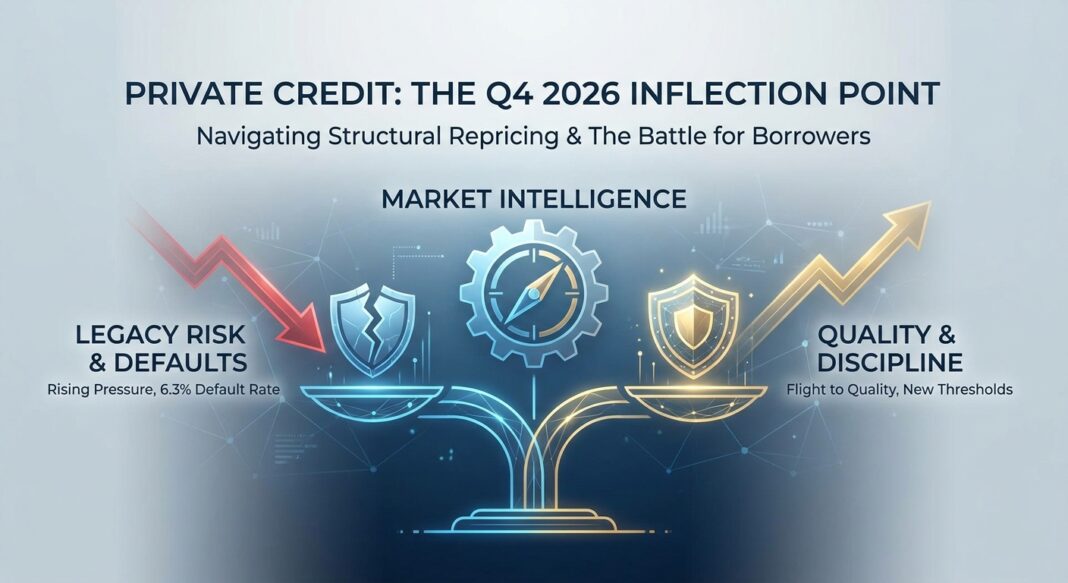
Private Credit at an Inflection Point: Default Pressure, Structural Repricing, and the Battle for Quality Borrowers
As default rates hit record highs and BDC non-accruals surge, the market is undergoing a structural reset — one that is rewarding disciplined lenders, repricing risk at the lower end of the credit spectrum, and demanding entirely new underwriting thresholds from borrowers seeking capital.
Market Headline: A Cycle Turn Hiding in Plain Sight
The private credit market entered Q4 2026 under sustained stress that is accelerating a structural reckoning. Fitch Ratings reported that the U.S. private credit default rate reached a record 6.3% on a trailing twelve-month basis through August 2026 — a figure that has climbed steadily from 6.0% in April, 6.1% in July, and now stands at its highest level since Fitch began tracking the metric. Simultaneously, Morningstar and PitchBook LCD data show that aggregate non-accrual rates across the ten largest public BDCs rose to 3.95% at amortized cost in Q2 2026, with an adjusted rate — counting all debt tranches of any borrower with even one impaired instrument — at 5.95%.
These pressures are not uniformly distributed. They are concentrated in 2021 and 2022 vintage loans, where lower base-rate assumptions, aggressive leverage, and optimistic EBITDA projections have collided with a higher-for-longer rate environment. VRC Q3 2026 data documents that coverage ratios for these cohorts have deteriorated to approximately 1.7x–1.8x interest coverage, materially below the 2.2x–2.3x recorded for 2024–2026 vintages. More recent issuance reflects a tighter, more disciplined posture — but the legacy book is now the dominant risk story in the market.
Meanwhile, the broadly syndicated loan (BSL) market is aggressively reclaiming higher-quality private credit borrowers. PitchBook LCD reports that $12 billion of direct-lending deals were refinanced into the syndicated market in Q3 alone — a record high since LCD began tracking this data in early 2022 — already exceeding the $7.2 billion refinanced across all of H1 2026. This selective migration is reshaping lender competitive dynamics and tightening the quality bar for private credit deal origination.
Quantitative Market Snapshot
📊 Key Market Metrics — Q3/Q4 2026
| Metric | Current Value | Prior Period | Change | Source |
|---|---|---|---|---|
| MM Unitranche Coupon Spread | SOFR + 500–575 bps | SOFR + 475–550 bps (YE 2025) | +25–50 bps | VRC Q3 2026 |
| All-In Unitranche Yield (MM) | ~9.2%–9.5% (spot) | ~8.9% (YE 2025) | +~43 bps YTD | VRC / Lord Abbett |
| HY Bond OAS (ICE BofA Index) | 315 bps (Oct 8, 2026) | ~275 bps (YE 2025 est.) | Widening from tight levels | FRED / ICE BofA |
| Private Credit vs. HY Spread Premium | ~150–200 bps | ~350 bps (2019) | −150 bps compression over 7 years | Owners.pe / BNY |
| Fitch U.S. Private Credit Default Rate | 6.3% (Aug 2026, TTM) | ~2–2.5% historical avg | Record high; >2x historical norm | Fitch / Yardeni |
| Top-10 BDC Non-Accrual Rate (adj.) | 5.95% (Q2 2026) | 5.41% (Q1 2026) | +54 bps QoQ | PitchBook LCD |
| Median Portfolio Net Leverage (MM) | 6.0x–7.0x Debt/EBITDA | ~5.0x–6.0x (2024) | Rising; 5–6x still common in new deals | VRC / FSB May 2026 |
| Median Interest Coverage (ICR) — 21–22 Vintages | 1.7x–1.8x | 2.2x–2.3x (2024–26 vintages) | Materially below new-issue standards | VRC Q3 2026 |
The spread picture is bifurcated. VRC confirms that traditional middle-market unitranche coupon spreads held steady at SOFR + 500 to 575 bps in Q3 2026, unchanged from Q2, though all-in yields rose approximately 35 bps quarter-over-quarter as the forward SOFR curve shifted upward. The Fed held its target range at 3.50% to 3.75% at its July 29 meeting, with three members preferring an increase, signaling that rate relief is not imminent. Meanwhile, the illiquidity premium that historically justified private credit over public high yield has compressed significantly — from approximately 350 bps in 2019 to just 150–200 bps today, according to market analysis — forcing a reexamination of risk-adjusted return assumptions across institutional portfolios.
The lower middle market (LMM, $5M–$25M EBITDA) remains a notable exception to large-cap spread compression. Avante Capital Partners reports that the LMM spread premium over large-cap widened to 232 basis points in Q3 2025 and has continued to widen as the capital wave that compressed upper-market spreads has not reached the lower end — creating a differentiated value proposition for allocators with the infrastructure to operate at smaller deal sizes.
Sector Analysis: Capital Rotation and Structural Shifts
⚡ Healthcare: The New Dominant Sector — With Caveats
Healthcare has displaced technology as the single largest sector for U.S. direct lending. PitchBook LCD data shows healthcare accounting for 22% of all direct lending issuance year-to-date through March 2026, up from 18% in 2025, while technology’s share dropped to 14% from 18% over the same period. Healthcare’s appeal rests on non-cyclical demand characteristics, demographic tailwinds, and predictable cash flows. Octus data shows healthcare was the only major sector to avoid significant year-over-year price tightening in 2025, with spreads landing at approximately SOFR + 500 bps in Q4 2025.
However, the sector carries rising credit risk. Morgan Stanley Investment Management maintains a significant underweight to healthcare, citing it as the leading sector for loans placed on non-accrual over the past year. Operators and lenders must distinguish between defensive subsectors (e.g., behavioral health, post-acute care) and those facing reimbursement pressure or payor mix deterioration.
💻 Technology & Software: Structural Caution Persists
The AI-disruption repricing that began in Q1 2026 has persisted. VRC Q1 2026 data showed software spreads widening by approximately 200 basis points from year-end levels, with lenders applying an additional risk premium of roughly 75 basis points under risk-off conditions. New software issuance in the BSL market fell to just 9% of all loans in H1 2026 — the lowest share since 2013 and roughly half the 2025 total, per Fidelity’s Q2 2026 leveraged loan review. VRC Q3 2026 confirms that software sector new issuance in private credit also remains limited, with rating agencies reporting elevated defaults and restructurings among 2021–2022 software vintage loans.
VRC data shows that software and technology credits continue to price 50 to 100 bps wider than broader market levels, reflecting sustained lender caution even for high-quality issuers.
🏭 Industrials, Infrastructure & Energy: Emerging Opportunity
Capital is rotating toward sectors with tangible asset backing, domestic policy tailwinds, and lower AI-disruption exposure. Paul Weiss identifies energy infrastructure, digital infrastructure, defense and national security, and next-generation manufacturing as priority sectors for institutional capital in 2026. These verticals benefit from extended development timelines that align well with patient private credit structures, and hybrid instruments — including convertible preferred and subordinated debt — are gaining traction as execution tools for sponsors navigating leverage constraints.
🏠 Commercial Real Estate: Selective Easing at the Margin
The Fed’s July 2026 SLOOS showed banks easing standards for nonfarm nonresidential and multifamily CRE lending — the most significant easing in that category since early 2022 — while construction and land development (CLD) standards remain at the tighter end of the 20-year historical range. Demand for C&I loans from large and middle-market firms strengthened modestly, with approximately 16% of banks reporting stronger demand from large businesses versus just 4% for small firms, underscoring the bifurcated access to bank capital that continues to drive middle-market borrowers toward private credit solutions.
Strategic & Operational Implications
For Borrowers & Operating Executives
The underwriting bar has risen materially and is no longer primarily anchored to trailing EBITDA multiples. VRC Q3 2026 data confirms that lenders are now underwriting to forward-looking Fixed Charge Coverage Ratios (FCCR) stress-tested against rate shocks, with 2024–2026 vintage deals exhibiting median coverage of 2.2x–2.3x — the new market standard. Operators should model FCCR sensitivity to a 100 bps rate increase and treat any ratio below 1.1x as a likely deal-stopper in the current environment.
EBITDA add-back treatment is under intense scrutiny. Lord Abbett’s midyear intelligence is explicit that free cash flow — not adjusted EBITDA — is what supports interest payments in a lender’s credit committee analysis, and that loan-to-value is becoming a primary underwriting gating criterion alongside leverage multiples. Borrowers seeking capital at competitive spreads should arrive with auditable free cash flow documentation, conservative add-back schedules, and proactive maturity planning, particularly if originated pre-2023.
Blackstone’s March 2026 portfolio data illustrates the vulnerability at the tail: approximately 7% of BCRED’s private debt investments carried interest coverage ratios below 1.0x as of March 31, 2026 — a critical signal for any borrower near or below that threshold as they approach lender reviews or refinancing conversations.
For Institutional Investors & Lenders
The compression of the private credit illiquidity premium to 150–200 bps over public high yield — from 350 bps just seven years ago — is forcing genuine portfolio reappraisal. BNY Investments (September 2026) notes that all-in yields on high yield corporates, at approximately 7.3%, offer a potentially compelling entry point relative to private credit for new marginal allocations — particularly given the structural quality improvement in the HY market, where BB-rated bonds now constitute 55% of the index versus 34% in 2000.
PwC’s 2026 Global Private Credit Survey found that 67% of managers cite greater competition as the primary driver of performance pressure, followed by defaults and credit losses (64%), with 93% expecting flat or lower returns in 2026. The dispersion between top-quartile and median managers is widening, reinforcing the case for manager due diligence centered on vintage concentration, sector exposure, non-accrual trajectories, and the quality of covenant documentation rather than headline AUM or brand.
Forward-Looking View: Liquidity & Lending Dynamics, Q4 2026 – Q2 2027
The near-term outlook is defined by four converging forces. First, a looming maturity wall: VRC Q3 2026 flags that private credit maturities from the 2021–2022 origination cohort are driving a significant increase in restructurings, amendments, and refinancing activity through 2027. Issuers with weak or declining EBITDA, elevated leverage, and approaching maturities face heightened restructuring risk. Second, the BSL market is selectively recapturing the best private credit names, which simultaneously narrows the quality of the remaining private credit deal universe and increases the origination bar for lenders seeking to replace repaid assets. PitchBook LCD notes this BSL migration is confined to higher-quality, B/B+ rated borrowers — the very names private credit platforms most want to retain.
Third, redemption pressure at semi-liquid vehicles — where non-traded BDC fundraising collapsed 82% year-over-year to $2 billion in Q2 2026 per Yardeni/BDC Briefs, the lowest since 2020 — is constraining dry powder deployment and incentivizing cash conservation over new origination at several platforms. Fourth and most consequentially, the Federal Reserve has begun formally pressing large U.S. banks and insurers to disclose their private credit exposure, signaling that regulatory scrutiny of interconnectedness and opaque valuations will intensify — a structural headwind for leverage at the fund level and a catalyst for improved transparency standards across the asset class.
The constructive case rests on deal activity recovery. VRC transaction-related assignments were approximately 25% higher year-to-date through August 2026, supported by improving tariff visibility, significant private equity dry powder, and pressure to monetize aging portfolio investments. For disciplined lenders with strong origination infrastructure, covenant-rich documentation practices, and concentrated exposure to non-cyclical sectors, the current environment is generating deal flow at spreads and structural terms not seen since the post-2022 tightening cycle.
⚡ 5 Key Market Insights — Bond Capital Intelligence Desk
- Default risk is real and concentrated in legacy vintages. The Fitch U.S. Private Credit Default Rate at 6.3% (August 2026 TTM) and the 116 bps single-quarter spike in BDC non-accruals in Q1 2026 are not broad-based deterioration signals — they are concentrated in 2021–2022 originations underwritten to lower rates and aggressive leverage. New-vintage underwriting at 2.2x–2.3x coverage is structurally sounder; legacy books require granular stress-testing now.
- Forward-looking FCCR is the new primary underwriting gating criterion. Lenders are structuring Fixed Charge Coverage Ratio floors on a forward, rate-stress-adjusted basis, incorporating a minimum 100 bps rate shock scenario. Borrowers unable to demonstrate 1.1x+ FCCR under this stress test will face significantly constrained access to capital or meaningfully wider spreads to compensate for the perceived coverage risk.
- The private credit illiquidity premium has compressed to its narrowest point in a decade. At 150–200 bps over public high yield (versus 350 bps in 2019), institutional allocators evaluating marginal capital deployment must now account for liquidity optionality, redemption risk, and valuation opacity when calibrating private credit versus high yield bond allocations — particularly as HY all-in yields approach 7.3%.
- Sector rotation has fundamentally reshaped deal flow. Healthcare (22% of direct lending YTD) has supplanted technology (14%) at the top of the sector table, but healthcare itself is bifurcated between defensive subsectors and reimbursement-exposed operators. Software new issuance is at a 13-year low share in BSL markets; lenders demanding 50–100 bps premiums even for quality tech credits reflects a structural repricing of AI-disruption risk, not a temporary volatility episode.
- The BSL market’s record recapture of private credit deals is a quality signal, not a threat. The $12 billion of direct-lending deals refinanced into BSL markets in Q3 2026 alone signals that the highest-quality private credit borrowers now command optionality between markets. For private credit managers, this is a portfolio quality improvement dynamic — but it requires accelerated origination discipline and sharper sourcing infrastructure to replace repaid assets with comparable credit quality at competitive economics.


