
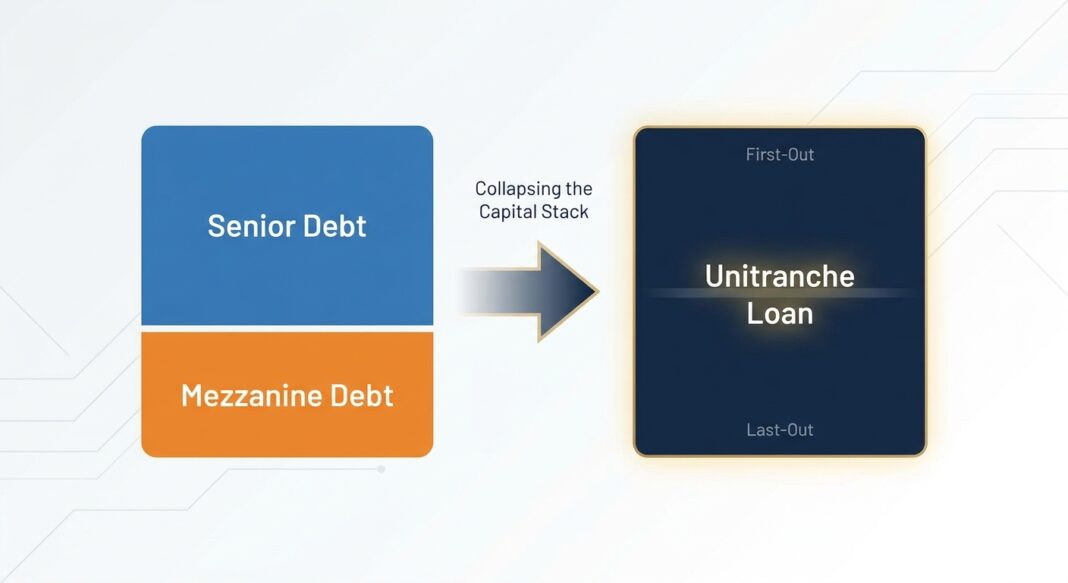
One Loan, One Rate, One Relationship — But It’s More Complex Than It Looks
Walk into a middle-market leveraged buyout in 2026 and there is a good chance the entire debt structure fits on a single term sheet. No senior bank. No mezzanine fund. No intercreditor agreement requiring months of negotiation. Just one lender — or a small club — writing one check under one set of documents at one blended interest rate. That instrument is the unitranche loan, and it has quietly become the signature product of the private credit market.
The private credit market reached roughly $1.7 trillion in global assets under management at the start of 2026, up from $970 billion in 2019, according to Preqin’s 2026 Global Alternatives Report. Much of that growth has been built on the unitranche structure. Understanding how it actually works — and the hidden mechanics operating beneath the surface — is essential knowledge for both investors evaluating private credit funds and business owners weighing their financing options.
What a Unitranche Loan Actually Is
A unitranche is a single-tranche debt facility that blends senior and subordinated debt into one instrument with a single set of terms, one interest rate, and one lender group — defined as a single-facility debt structure that combines what would traditionally be separate senior and subordinated debt layers into one loan with one set of documents, one interest rate, and one lender relationship.
In the traditional capital stack, a borrower would negotiate separately with a senior bank lender and a junior or mezzanine fund. Each lender demanded its own credit agreement, its own covenants, and an intercreditor agreement establishing who got paid first in a default. Two agreements, two lender groups, two negotiations. The process was time-consuming, expensive, and often subject to last-minute friction between lenders with competing interests.
A unitranche deletes the layering. It is a single term loan that spans the entire quantum a senior-plus-mezzanine structure would have covered, at one blended interest rate, under one credit agreement, from one lender or a small club of direct-lending funds. It became dominant because it gives private equity sponsors speed, certainty of close, and confidentiality — not because it is cheaper or safer.
The Hidden Architecture: First-Out / Last-Out
Here is where the structure becomes more sophisticated than its clean exterior suggests. What the borrower sees and what the lenders actually hold are two different things.
While the borrower sees a single facility, lenders often bifurcate the economics among themselves. In an Agreement Among Lenders (AAL), the unitranche is privately divided into a “first-out” tranche and a “last-out” tranche. The first-out lender receives priority of payment and lower risk, similar to a traditional senior lender. The last-out lender absorbs more risk and earns a higher spread, similar to a mezzanine position.
The borrower is largely shielded from this internal arrangement. Their loan agreement is with the combined lending group as a whole, and they make payments as if it were a single unified facility. The splitting of those payments between first-out and last-out lenders is an internal matter.
The AAL governs far more than just payment priority. This internal document is called an agreement among lenders, and it determines how payments flow between the first-out and last-out holders, what happens in a default scenario, and who has the right to make decisions about the loan on behalf of the lending group.
A Concrete Example with Numbers
Consider a private equity sponsor acquiring a manufacturing company with $10 million in EBITDA for a purchase price of $60 million (6x EBITDA). The deal requires $40 million in debt and $20 million in equity.
Under the traditional two-layer structure:
- Senior term loan: $25 million at SOFR + 300 bps (~7.7% all-in)
- Mezzanine loan: $15 million at a fixed 13%–14%
- Blended cost of debt: approximately 10.0%–10.5%
- Timeline to close: 12–16 weeks; two separate negotiations
Under the unitranche structure:
- Single unitranche facility: $40 million at SOFR + 500 bps (~9.2%–9.7% all-in)
- One credit agreement, one lender relationship
- Timeline to close: 6–8 weeks
The blended rate is modestly higher than pure senior debt but lower than the blended cost of a two-layer stack — and the simplicity premium is real. Behind the scenes, the unitranche lender may split the $40 million into a $15 million first-out piece (earning SOFR + 350 bps) and a $25 million last-out piece (earning SOFR + 600 bps), with the weighted average matching what the borrower actually pays. This structure lets multiple lenders with different risk appetites participate in the same deal without creating complexity for the borrower. The borrower makes one payment, but behind the curtain, the economics are allocated according to the AAL waterfall.
Current Market Conditions: Spreads, Scale, and a Shifting Environment
Unitranche structures continue to dominate new issuance, with coupon spreads generally ranging from 4.75% to 5.50%, nearly 25 basis points higher than year-end levels, and original issue discounts holding steady between 98.75 and 99.25 for standard transactions, according to Valuation Research Corporation’s Q2 2026 Private Markets Trends report.
In practical terms, spreads have widened by roughly 50 to 100 basis points higher since late 2025, according to PitchBook. That shift matters for both sides of the table: lenders are capturing better economics, while borrowers who locked in tighter spreads during 2024’s competitive environment are now watching the window close.
The bank lending backdrop continues to create a structural tailwind for private credit. According to the April 2026 Federal Reserve SLOOS, survey respondents reported, on balance, tighter lending standards for commercial and industrial (C&I) loans to firms of all sizes over the first quarter of 2026. As of July 2026, banks reported that the levels of standards are currently at the tighter end of the range for all loan categories except C&I loans. Banks also reported that lending standards for all queried types of NDFI loans — including loans to private equity funds — are at the tighter ends of their historical ranges.
At the same time, competition among private lenders has kept pressure on pricing. Direct lending activity moderated further in early Q2 2026, with both deal count and volume cooling as sponsors stayed cautious amid macro uncertainty and a higher-for-longer rate backdrop. Refinancings cushioned the decline, while LBO financing slipped to a multi-year low. Spreads showed early signs of widening across credit markets, with direct lending leading the move, according to PitchBook’s April 2026 US Private Credit Monitor.
| Metric | Value (2026) | Source |
|---|---|---|
| Global private credit AUM | ~$1.7 trillion | Preqin via CTA Acquisitions, 2026 |
| Unitranche spread (new-issue, Q1 2026) | ~525 bps over SOFR | PitchBook LCD via CTA Acquisitions, 2026 |
| Unitranche all-in coupon range (Q2 2026) | 4.75%–5.50% spread + SOFR | Valuation Research Corporation, Q2 2026 |
| Spread widening since late 2025 | ~50–100 bps | Lord Abbett / PitchBook, Midyear 2026 |
| Banks tightening C&I standards (Q1 2026) | Net tighter for all firm sizes | Federal Reserve April 2026 SLOOS |
Decision Framework
For Investors Evaluating Private Credit Funds
When assessing a fund’s unitranche exposure, investors consider several structural questions beyond the headline yield. Lenders often first show improvements in loan structure before meaningful spread widening appears — fewer PIK requests, less aggressive leverage, more covenants, and stronger documentation. These are early indicators worth monitoring in fund portfolio reports.
- First-out or last-out exposure? A fund holding primarily last-out positions carries meaningfully more credit risk than its headline yield may suggest. The AAL waterfall determines recovery, not just the loan-to-value ratio.
- Covenant quality: Competition between banks and private debt funds has resulted in lower spreads and looser covenants, or restrictions placed on borrowers to protect lenders. Evaluate whether a fund’s recent vintages have maintained meaningful maintenance covenants.
- Lender-friendly reset: For new capital, the setup appears better than it was six months ago. M&A activity appears to be creating more opportunities to lend, capital has become more selective, and spreads are wider.
For Business Owners and Operators Evaluating Financing Options
Unitranche financing is worth considering when speed, simplicity, and confidentiality matter more than achieving the absolute lowest blended cost of debt. Operators evaluate this structure across three dimensions:
- Execution certainty: A single lender relationship eliminates the intercreditor risk that can derail a two-lender closing. For time-sensitive acquisitions, this premium is frequently worth paying.
- All-in cost comparison: Direct lending continues to generate high single-digit unlevered asset returns — an attractive premium relative to public credit markets. Operators should model the true all-in cost including OID and fees before concluding that a syndicated structure is cheaper.
- Relationship flexibility: A single lender can be easier to approach for amendments, waivers, or add-on financings. With two-lender stacks, both parties must agree, creating coordination friction at exactly the wrong moments.
Key Takeaways
- Unitranche collapses the capital stack into one instrument — one rate, one agreement, one lender relationship — but the internal first-out/last-out split means the risk is still stratified. The borrower’s simplicity is the lenders’ private complexity.
- The Agreement Among Lenders (AAL) is the real document that matters. It governs payment waterfalls, default control rights, and recovery allocation. Investors in private credit funds should understand how their manager positions itself within AAL structures.
- Spreads are widening after years of compression. With unitranche spreads roughly 50–100 basis points wider than late 2025 and bank lending standards remaining tight, the current environment is increasingly tilting toward lenders.
- Speed and certainty carry a price. Unitranche all-in pricing is typically above a comparable pure senior bank loan but below the blended cost of a layered senior-mezzanine stack. Operators should evaluate what that execution premium is worth in each specific transaction context.
- Scale concentration is real. The top 10 private credit managers control approximately 62% of the global market as of Q1 2026. Understanding which manager originates, holds, or syndicates a unitranche affects both pricing leverage and long-term relationship dynamics for borrowers.


