
One Loan to Rule the Stack
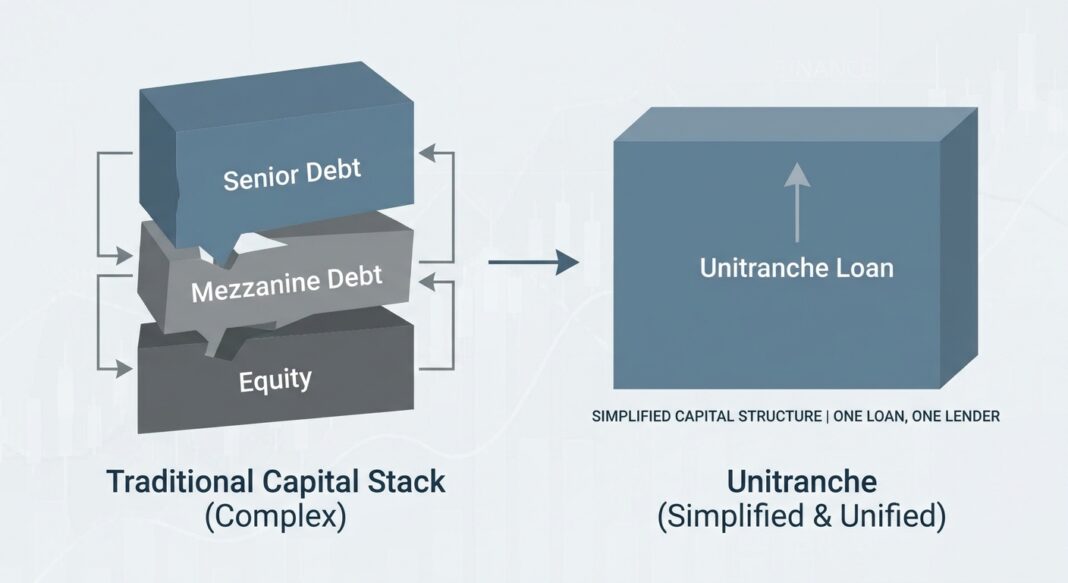
For decades, a middle-market borrower financing an acquisition faced a familiar ritual: negotiate a senior secured bank loan, layer in mezzanine debt from a separate lender, manage two intercreditor agreements, and hope both parties remained aligned through the life of the deal. The process was slow, expensive, and administratively heavy.
Then came the unitranche loan — and it changed almost everything about how companies between $25 million and $500 million in enterprise value access acquisition financing.
Today, unitranche is not an exotic structure. It is the default. Roughly 70 to 80 percent of lower middle-market acquisitions in that size range are financed with at least partial unitranche funding, according to market data tracked by lenders active in the space. Understanding how this structure works — and why it has displaced the traditional stack — is foundational knowledge for any investor evaluating private credit or any operator considering a sponsored transaction.
This article teaches the unitranche mechanism from the ground up, walks through a concrete example, and connects the concept to verifiable market data from mid-2026.
What Is a Unitranche Loan?
A unitranche facility is a single-tranche, senior secured term loan that combines what would traditionally be two separate instruments — a first-lien bank loan and a subordinated mezzanine note — into one credit agreement with one lender (or a club of lenders operating under unified documentation).
The key mechanics:
- Single credit agreement: One set of covenants, one administrative agent, one intercreditor relationship. The borrower deals with a single counterparty.
- Blended pricing: Because the unitranche lender absorbs both senior and subordinated risk, the interest rate is set at a blend — higher than a pure first-lien rate, lower than a combined senior-plus-mezz cost.
- First-Out / Last-Out (FOLO) splits: Internally, some unitranche facilities split between a “first-out” portion (which receives priority repayment) and a “last-out” portion (which absorbs first losses). As Goldman Sachs’s own BDC SEC filings describe, “unitranche loans are first lien loans that extend deeper in a borrower’s capital structure than traditional first lien debt and may provide for a waterfall of cash flow priority between different lenders.”
- Floating rate: Pricing is typically expressed as a spread over SOFR (Secured Overnight Financing Rate), meaning the borrower’s cost adjusts with the base rate environment.
The structure was pioneered in the mid-2000s and accelerated after the 2008 financial crisis, as bank retrenchment created space for direct lenders to offer speed and certainty that syndicated markets could not match.
How the Math Works: A Concrete Example
Consider a private equity sponsor acquiring a manufacturing business with $10 million in EBITDA at a 7x enterprise value multiple — a $70 million transaction.
Traditional Structure (Pre-Unitranche):
- Senior Bank Debt: $30M at SOFR + 300 bps (~6.7% all-in)
- Mezzanine Note: $20M at 13–15% fixed (cash + PIK)
- Equity: $20M from the sponsor
- Two credit agreements. Two lender groups. Intercreditor negotiation adds 4–8 weeks to close.
Unitranche Structure (2026 Market):
- Unitranche Loan: $45M at SOFR + 500–525 bps (~9.0–9.5% all-in)
- Equity: $25M from the sponsor
- One credit agreement. One lender. Close in 4–6 weeks versus 10–14 weeks.
The blended cost appears higher than the senior-only tranche, but the weighted average cost of the traditional two-tranche stack — factoring in mezzanine rates of 13–15% — is often comparable or higher once fees and arrangement costs are included. The unitranche borrower pays for simplicity and execution certainty.
Leverage in this example sits at 4.5x EBITDA, well within the typical unitranche range. The equity cushion of $25 million represents approximately 36% of total enterprise value — a meaningful buffer protecting the lender in a downside scenario.
Current Market Conditions: Unitranche in Mid-2026
Unitranche is not just the dominant structure in theory — the data confirm it is the dominant structure in practice.
Pricing & Spreads: According to Valuation Research Corporation’s Q3 2026 Private Credit Update, unitranche new issuance coupons are generally ranging from 4.75% to 5.75% over base rates, with original issue discounts (OIDs) stable at 98.75 to 99.25 for standard transactions. That translates to all-in yields of approximately 9.00% to 9.75% — a decline of roughly 250 basis points from late-2023 peak levels, per VRC’s underlying data.
Software/Tech Premium: According to VRC’s Q3 2026 update, software and technology credits continue to price 50 to 100 basis points wider than broader market levels, reflecting ongoing lender caution in that sector.
Market Size Context: According to Preqin’s 2026 Global Alternatives Report (via CTA Acquisitions), the global private credit market reached approximately $1.7 trillion in AUM at the start of 2026, up from $970 billion in 2019. Direct lending — the home of unitranche — accounts for the largest single sub-strategy slice of that total.
Bank Lending as Context: According to the Federal Reserve’s July 2026 SLOOS, bank C&I lending standards were broadly unchanged in Q2 2026 and, notably, easier than the midpoints of their historical ranges — a meaningful shift from the tightening cycle of 2022–2024. This normalization has increased competition between bank lenders and direct lenders on quality credits, moderating the spread premium private lenders can charge.
Spread Trajectory: According to Northleaf Capital’s Q2 2026 Market Update, new issue pricing for U.S. sponsor-backed middle-market transactions widened by approximately 25 basis points through Q2 2026, reflecting higher market volatility — a reminder that private credit pricing is not immune to macro disruption even if it adjusts more slowly than syndicated markets.
| Metric | Current Level | Source |
|---|---|---|
| Unitranche spread (new issue) | SOFR + 475–575 bps | VRC, Q3 2026 |
| All-in unitranche yield range | ~9.00%–9.75% | VRC, Q2 2026 |
| Typical leverage range | 4x–6x EBITDA | CTA Acquisitions, 2026 |
| Global private credit AUM | ~$1.7 trillion | Preqin via CTA, 2026 |
| Bank C&I lending standards (Q2 2026) | Unchanged; easier than historic midpoint | Federal Reserve SLOOS, July 2026 |
Decision Framework: Investors and Operators
For Investors Evaluating Unitranche Exposure
Investors considering allocation to direct lending funds with heavy unitranche exposure should evaluate several dimensions:
- Structural seniority is real — but relative. A unitranche loan is first-lien secured, but it extends deeper into the capital structure than a traditional first-lien bank facility. Investors should understand where the “last-out” subordination risk lives within their fund’s portfolio.
- Spread compression is a cycle signal. The ~250 bps decline in all-in yields from 2023 peak levels indicates a more competitive lending environment. Investors should assess whether current entry yields adequately compensate for credit risk — particularly in stressed sectors like software.
- Lender quality and origination access matter. According to market data, the top 10 private credit managers control approximately 62% of AUM, with Blackstone (~$370B), Apollo (~$350B), and Ares (~$305B) dominating origination pipelines. Access to proprietary deal flow determines credit quality more than the structure label alone.
- Floating-rate income is a feature — and a risk. Unitranche loans reprice with SOFR. In a declining rate environment, income compresses. With the Fed holding its target range at 3.50–3.75% as of mid-2026, per FOMC data (July 2026), base rate trajectory remains a key variable.
For Operators Considering a Unitranche Facility
- Speed and certainty have real value. In competitive auction processes, a direct lender’s ability to underwrite and commit without a syndication risk is worth meaningful negotiating leverage. This is particularly relevant for transactions in the $25M–$200M enterprise value range.
- Compare weighted average cost of capital honestly. Don’t compare the unitranche rate to a senior-only rate. Compare it to the fully loaded cost of a senior-plus-mezz structure, including arrangement fees, PIK components, and coordination costs.
- Covenant structure differs from bank debt. Many unitranche facilities include a single maintenance covenant — typically a leverage test — rather than a full covenant package. This creates more operational flexibility but also means lenders may move quickly on covenant breaches.
- Consider the refinancing window. With all-in yields near 9–9.75% and a potential rate-cut cycle ahead, borrowers with improving credit profiles may find refinancing into the broadly syndicated market or competitive re-pricing in 12–24 months an attractive option.
Key Takeaways
- Unitranche is the market standard. For middle-market acquisitions between $25M and $200M in enterprise value, unitranche from a direct lender is the dominant financing structure in 2026, valued for execution speed and documentation simplicity.
- Blended pricing reflects blended risk. The all-in rate on a unitranche loan is higher than a pure senior bank loan because the lender is absorbing risk that mezzanine capital would traditionally carry — investors should price that risk layer explicitly.
- Current yields have compressed materially. From peak levels near 12% in late 2023 to approximately 9–9.75% today, spread compression has reduced income potential but also signals a maturing, more competitive asset class.
- Bank re-entry is reshaping competition. The July 2026 SLOOS shows bank C&I standards easier than historical midpoints — a trend that is moderating the pricing power of private credit lenders on high-quality credits and pushing direct lenders toward more complex or larger transactions where banks cannot compete.
- The internal FOLO architecture matters. For investors in BDCs or direct lending funds, understanding whether a fund holds first-out or last-out positions within a unitranche facility is essential to accurately assess downside risk — two funds may both hold “unitranche” loans with meaningfully different loss-absorption profiles.


