
Why the Old Capital Stack Broke Down
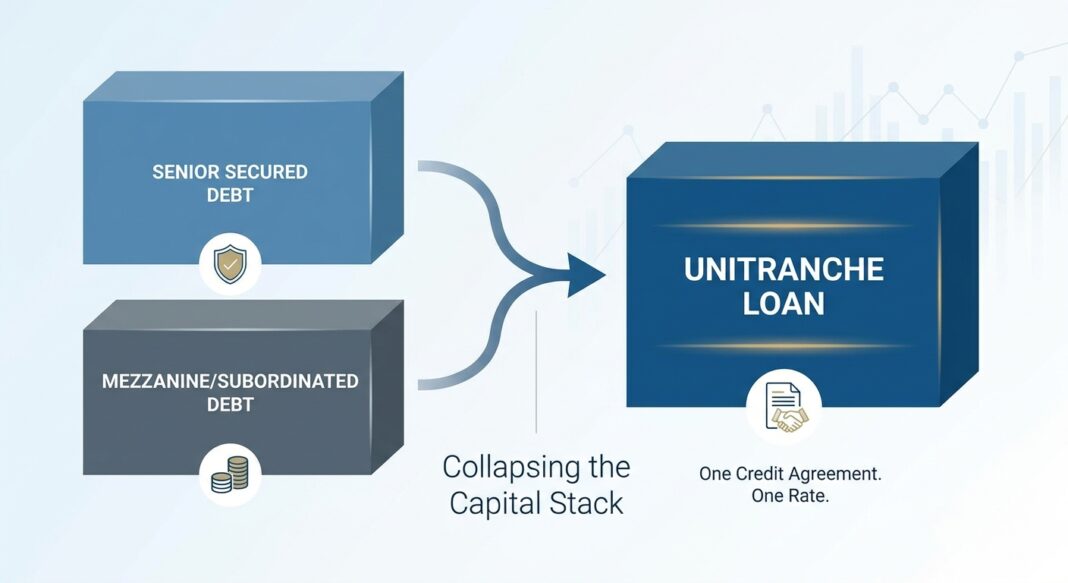
For decades, a company seeking acquisition financing had to navigate two separate lending relationships at the same time. A senior secured lender provided the bulk of the debt at a lower rate, claiming first priority on assets. A mezzanine or subordinated lender layered in additional capital behind them, at a higher rate, under a separate credit agreement, with its own lawyers and covenants. Two closings. Two creditor groups. One intercreditor agreement governing who gets paid first when things go wrong.
For private equity sponsors racing to close competitive buyouts, that structure created friction at precisely the wrong moment. Speed, certainty, and confidentiality are the currencies of M&A. The traditional senior-plus-mezzanine model burned all three.
The solution that emerged from the private credit market is the unitranche loan — and it has become the dominant deal structure in middle-market lending. Understanding how it works, what it costs, and when to use it is foundational knowledge for anyone evaluating private credit as an investor or considering it as a source of capital.
What a Unitranche Loan Actually Is
A unitranche loan is a hybrid credit facility that combines senior secured debt and subordinated debt into a single instrument, governed by one credit agreement and one security package. The borrower pays a single blended interest rate rather than separate rates on each layer, and manages one lender relationship rather than a syndicate with competing priorities.
The term is descriptive by design: uni for single, tranche for a layer of debt. As described in public BDC filings, unitranche loans combine both senior and subordinated debt, generally in a first-lien position — meaning the lender holds a claim on company assets that ranks ahead of equity holders in any default or restructuring scenario.
Here is the mechanic that most borrowers never see: inside many unitranche facilities, lenders privately divide their exposure into two tiers through an Agreement Among Lenders (AAL). The first-out tranche receives priority repayment and carries a lower yield. The last-out tranche absorbs first loss and demands a higher spread in return. The borrower signs one document, deals with one administrative agent, and never referees a fight between creditor classes. The internal risk-splitting is invisible to them.
This structure — often called first-out/last-out (FOLO) — is how large private credit funds can deploy billions efficiently while allowing co-investors with different return targets to participate in the same facility at different points in the risk spectrum.
How Unitranche Pricing Works: A Concrete Example
Consider a private equity sponsor acquiring a manufacturing business with $10 million of EBITDA at a 7x multiple — a $70 million enterprise value. The sponsor contributes $30 million in equity (roughly 43% of the capital structure) and needs $40 million in debt financing.
Under the traditional structure, this might look like: a $25 million senior secured term loan at SOFR + 300 basis points, plus a $15 million mezzanine note at SOFR + 850 basis points — two separate credit agreements, two sets of legal fees, and an intercreditor negotiation that could take weeks.
Under a unitranche structure, a single private credit fund provides the full $40 million as one facility. The all-in cost is built from several components:
- Base rate: 3-month Term SOFR (approximately 3.69% as of June 2026, per Valuation Research Q2 2026)
- Credit spread: 475–650 basis points for a first-lien unitranche in the middle market, per Coyote Wealth 2026
- Original issue discount (OID): 1.0–2.0 points paid at funding, adding roughly 25–50 bps of effective annual yield
- Fees: Closing fee of 1.0%–2.0%, undrawn revolver commitment fee of 25–50 bps, and prepayment protection (typically 102/101 in years one and two)
At a spread of SOFR + 600 bps in the current environment, all-in cost lands at approximately 9.5% — one rate, one document, one counterparty. The sponsor closes in weeks, not months. The tradeoff versus a traditional two-tranche structure is roughly 38 basis points annually on the equity check — a modest premium most sponsors willingly pay for execution certainty.
Current Market Reality: Data From Q2–Q3 2026
The unitranche market is large, liquid, and actively re-pricing. Here is what the data shows right now:
| Metric | Value (2026) | Source |
|---|---|---|
| Global Private Credit AUM | ~$1.7 trillion | Preqin via CT Acquisitions, 2026 |
| Unitranche coupon spread range (new issuance) | SOFR + 475–550 bps | Valuation Research Q2 2026 |
| Unitranche all-in yield range | ~9.00%–9.75% | Valuation Research Q2 2026 |
| Premium of private credit over syndicated loans | ~162 bps (Aug 2026) | Kadenwood Group / PitchBook LCD, Sept 2026 |
| Cliffwater Direct Lending Index return (2025) | 9.3% | Angel Investors Network / Cliffwater, 2026 |
| C&I bank lending standards, Q3 2026 (net % tightening) | 0.0% (unchanged) | Federal Reserve SLOOS via FRED, Q3 2026 |
A few dynamics are worth noting. Valuation Research’s Q2 2026 Private Markets Update notes that unitranche yields of 9.00%–9.75% represent a decline of roughly 250 basis points from the late-2023 peak near 11.5%–12.5%, yet remain well above pre-2022 historical ranges of approximately 7%–8%. Spreads have compressed, but the asset class still offers a meaningful premium to public credit.
Meanwhile, the Federal Reserve’s July 2026 SLOOS reported that C&I bank lending standards were essentially unchanged in Q2 — a neutral backdrop that neither pushes borrowers toward private credit nor pulls them back toward banks. However, the same survey noted that for most loan categories other than C&I, standards remain at the tighter end of their historical range since 2005, preserving the structural gap that private credit has long filled.
At the large end of the market, a real-world example illustrates scale: PitchBook reported in early 2026 that WWEX Group completed a $4.815 billion unitranche loan supporting a Thoma Bravo buyout, priced at SOFR + 575 bps in Q1 2026 — a transaction that would have been unthinkable in the bank market a decade ago.
Decision Framework: Investors and Operators
For Investors Evaluating Unitranche Exposure
Investors considering unitranche through a BDC, direct lending fund, or interval fund evaluate the following:
- Position in the FOLO structure: First-out positions carry lower yield (typically 150–200 bps less) but recover first in a default. Last-out positions carry more junior risk inside a first-lien wrapper — the premium is compensation for that subordinated risk, not just complexity.
- Leverage multiples at origination: Unitranche facilities typically range from 4.0x to 5.5x EBITDA. Deals above 5.5x compress the equity cushion protecting the lender and are scrutinized closely by experienced credit managers.
- Covenant quality: Unlike broadly syndicated loans, most middle-market unitranche facilities still include at least one maintenance financial covenant — commonly a maximum leverage ratio that steps down annually. This gives lenders an early-warning mechanism that covenant-lite syndicated loans do not provide.
- Manager differentiation: With over $1.7 trillion in global private credit AUM per Preqin’s 2026 data, not all managers underwrite with the same rigor. Origination sourcing, documentation quality, and workout capacity are decisive factors.
For Operators and Owners Seeking Capital
Business owners and CFOs evaluate unitranche when:
- Speed is a constraint: Unitranche facilities close in 4–8 weeks versus 10–16 weeks for a two-tranche bank syndication. In a competitive sale process, certainty of close has real dollar value.
- EBITDA is in the $5M–$75M range: This is the natural habitat of middle-market unitranche. Below $5M EBITDA, credit availability shrinks. Above $100M, the broadly syndicated loan market competes on price.
- Flexibility is valued: Unitranche lenders commonly include delayed-draw term loan tranches, revolving credit facilities, and acquisition accordion provisions in a single document — giving operators capital optionality without returning to market.
- All-in cost vs. total friction: The stated spread on a bank term loan may be lower, but operators weigh legal fees, syndication timeline, covenant complexity, and relationship fragmentation against that difference. For many, the unitranche premium is a rational trade.
Key Takeaways
- One loan, one rate, one relationship: Unitranche collapses the senior-plus-mezzanine capital stack into a single credit agreement, eliminating intercreditor friction and accelerating execution for both sponsors and operators.
- The blended rate reflects blended risk: The borrower’s single rate sits between what pure senior debt and pure mezzanine would have cost separately. Investors should understand whether their exposure is first-out or last-out — the economics are meaningfully different.
- Spreads have compressed but remain elevated vs. history: All-in unitranche yields of 9.00%–9.75% in mid-2026 are ~250 bps below the 2023 peak but still 150–200 bps above pre-2022 ranges, according to Valuation Research’s Q2 2026 data — representing a more normalized but still attractive risk-return profile.
- Covenants remain a structural differentiator: Middle-market unitranche facilities typically retain at least one maintenance covenant, giving lenders earlier default signals than the covenant-lite syndicated market. Investors should assess covenant quality alongside spread when comparing structures.
- Scale has arrived: The $4.8 billion WWEX unitranche (Q1 2026) and a global market exceeding $1.7 trillion in AUM signal that unitranche is no longer a niche middle-market tool — it now competes directly with the syndicated market at the upper end of the leverage finance universe.


