
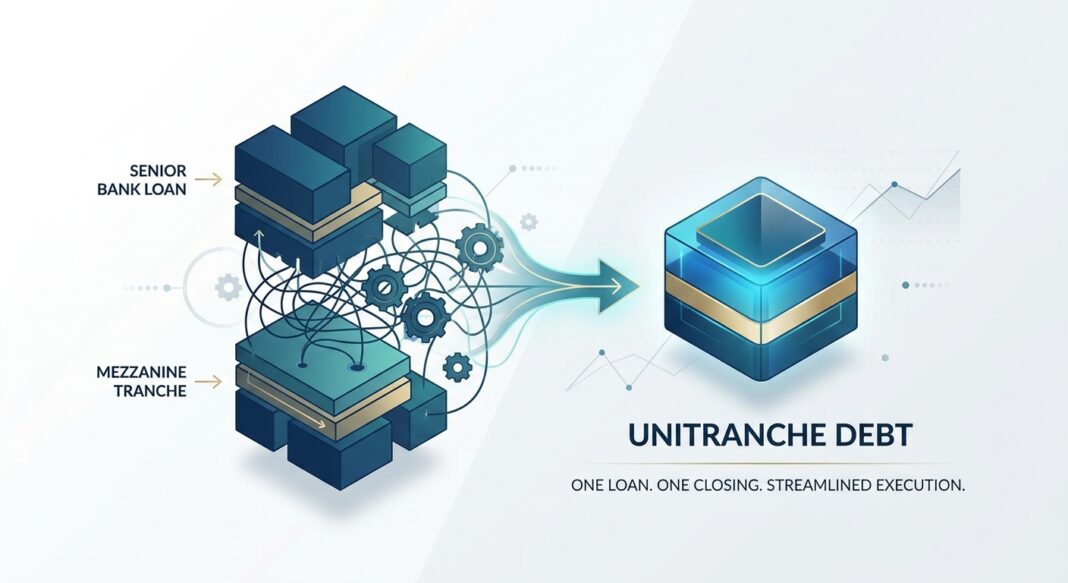
Why One Loan Changed Everything in Middle-Market Finance
Picture the traditional middle-market acquisition: a business owner or private equity sponsor stacks a senior bank loan at 4.0x EBITDA, then layers a mezzanine tranche on top at a second set of rates and terms, negotiates two separate credit agreements, navigates an intercreditor agreement that governs which lender gets paid first in a default — and hopes the deal doesn’t unravel during the three to four months it takes to close. For decades, that complexity was simply the cost of doing business in leveraged finance.
Then the private credit industry introduced the unitranche loan — and collapsed all of that into a single instrument. Today, unitranche is not a niche alternative. CT Acquisitions’ 2026 Unitranche Financing Guide describes it as the dominant structure for middle-market acquisitions, combining senior and subordinated debt into one tranche, one lender, and one closing process. For investors evaluating private credit and for operators seeking acquisition capital, understanding how the unitranche works is essential to understanding the entire asset class.
What the Unitranche Structure Actually Is
Unitranche debt is a single-tranche term loan that merges what would otherwise be a senior secured loan and a mezzanine or subordinated loan into one instrument governed by a single credit agreement. As described in Goldman Sachs Private Middle Market Credit II LLC’s Form 10-Q filed with the SEC (June 2026), “unitranche loans are first lien loans that extend deeper in a borrower’s capital structure than traditional first lien debt and may provide for a waterfall of cash flow priority between different lenders.”
The borrower pays a blended interest rate — one that sits between what pure senior debt would cost and what pure mezzanine would cost. What disappears is the structural friction: no separate intercreditor agreement battles, no parallel closing timelines, no competing lender constituencies in a workout scenario. According to Commercial Finance Partners (2026), senior debt is the cheapest, first-priority layer; mezzanine fills the gap between senior capacity and equity; and unitranche combines both into one loan at one blended rate — simplifying execution for everyone at the table.
Internally, some unitranche facilities do preserve an economic split through an agreement among lenders (AAL) — a private side-agreement that divides the loan into a lower-rate “first-out” piece and a higher-rate “last-out” piece. The borrower never sees this distinction; they deal with one lender, one document, one rate.
How Unitranche Pricing Works: A Concrete Example
Consider a sponsor-backed acquisition of a technology services business with $8 million in EBITDA and a purchase price of $56 million (7.0x). The sponsor wants to finance $40 million of the purchase with debt. Here is how the two structures compare in 2026:
Option A — Traditional Senior + Mezzanine:
- Senior bank term loan: $25 million at 4.0x EBITDA — pricing at approximately SOFR + 300 bps (~7.7% all-in at current SOFR)
- Mezzanine tranche: $15 million at 5.1x total leverage — pricing at 14–16%, often with equity warrants attached
- Two lenders, two credit agreements, one intercreditor agreement
- Estimated close timeline: 90–120 days
Option B — Unitranche:
- Single unitranche term loan: $40 million at 5.0x EBITDA
- Pricing: SOFR + 500–600 bps; at Term SOFR of approximately 3.69% (Q2 2026), blended all-in rate of approximately 9.0%–9.7%
- Original issue discount (OID): 98.75–99.25, meaning the borrower receives roughly $39.5 million at close but repays $40 million
- One lender, one credit agreement, one financial covenant
- Estimated close timeline: 45–60 days
The unitranche borrower pays a modestly higher headline rate than the senior-only tranche, but eliminates the mezzanine’s equity warrants (which dilute ownership), compresses legal costs, and gains the speed of a single-counterparty close. According to CT Acquisitions (2026), comparing the two options over a five-year hold period, the total interest cost difference is approximately $1 million — often more than offset by the value of closing a deal four to six weeks faster and avoiding equity dilution from warrant coverage.
Current Market Reality: Where Unitranche Sits in 2026
The unitranche structure has moved decisively from middle-market workhorse to large-cap financing vehicle. The market data as of mid-2026 tells a clear story:
| Metric | Data Point | Source |
|---|---|---|
| Unitranche all-in yield range (Q2 2026) | ~9.00%–9.75% | Valuation Research Corp., Q2 2026 |
| Avg. new-issue private credit spread (3 months to Aug 2026) | 502 bps over SOFR | Kadenwood Group / PitchBook LCD, Sept 2026 |
| Private credit premium over syndicated loans (Aug 2026) | 162 bps | Kadenwood Group / PitchBook LCD, Sept 2026 |
| Global private credit AUM (2026 est.) | ~$1.7 trillion (Preqin) to $3.5 trillion (DLA Piper/PitchBook) | DLA Piper Private Credit Pulse, Q1 2026 |
| Direct lending volume, full-year 2025 | $247 billion (2nd-busiest year on record) | PitchBook LCD via DLA Piper, Q1 2026 |
| Typical middle-market unitranche leverage | 4.0x–5.5x EBITDA | Coyote Wealth, 2026 |
Critically, the gap between private credit and the syndicated loan market has widened. Kadenwood Group, citing PitchBook LCD data (September 2026), reports that the private credit premium over syndicated loans reached 162 basis points through August 2026 — roughly 39 basis points wider than in Q1 2026. On a $25 million debt package, that premium equates to approximately $405,000 in additional annual interest cost. Operators and sponsors evaluating unitranche financing need to weigh that spread against the structural and execution advantages the structure delivers.
The Federal Reserve’s July 2026 SLOOS provides important context: bank standards for C&I loans are currently easier than the midpoint of their historical range since 2005 — suggesting that for larger, investment-grade-adjacent borrowers, bank financing has become more accessible. For middle-market companies below the large-cap threshold, however, private credit’s structural advantages in speed, flexibility, and covenant structure remain compelling.
Decision Framework: Investors and Operators
For Investors Evaluating Private Credit Exposure:
- Yield-versus-risk positioning: Unitranche all-in yields of 9.0%–9.75% (Q2 2026) represent a meaningful premium over investment-grade bonds, but investors evaluate whether the illiquidity premium, leverage levels (4.0–5.5x), and covenant package justify the return differential.
- First-out vs. last-out exposure: Some private credit funds hold the last-out piece of a unitranche AAL structure, earning a higher rate in exchange for absorbing first-dollar loss after the first-out lender. Understanding which position a fund holds is critical to assessing its actual risk profile.
- Covenant quality: Unitranche facilities for deals under $50 million EBITDA typically include one or two maintenance covenants — an important protection. Larger deals may achieve covenant-lite terms as lender competition increases.
- Manager concentration: The top 10 private credit managers control approximately 62% of AUM, with firms like Apollo (~$350–600B in credit AUM) and Ares (~$305–464B) dominating origination flow. Investors consider manager selection as carefully as structure selection.
For Operators and Sponsors Evaluating Unitranche Financing:
- When unitranche wins: Acquisition timelines where speed matters; situations where equity warrant dilution from mezzanine providers is unacceptable; businesses with predictable cash flows that can service 9%–10% all-in debt comfortably.
- When traditional structures may compete: For borrowers with strong bank relationships and larger deal sizes, the July 2026 SLOOS indicates C&I bank standards have eased — meaning a senior bank loan at SOFR + 250–350 bps may be achievable for the right credit, with the 162 bps private credit premium representing real cost.
- OID and fee awareness: The all-in cost of a unitranche includes not just the coupon but the OID (typically 75–125 bps of annualized cost), a closing fee of 1.0–2.0%, and prepayment protection of 102/101 in the first two years — items that operators evaluate carefully when modeling refinancing flexibility.
Key Takeaways
- Unitranche is the dominant middle-market structure: One loan, one lender, one closing — replacing the old senior-plus-mezzanine stack that required parallel negotiations and intercreditor agreements.
- All-in yields are 9.0%–9.75% in Q2 2026, down roughly 250 basis points from 2023 peaks but still above pre-2022 historical ranges of 7%–8%, according to Valuation Research Corporation.
- The private credit premium over syndicated loans has widened to 162 bps as of August 2026 (PitchBook LCD) — a material cost difference that operators weigh against unitranche’s structural and execution advantages.
- Leverage and covenant terms vary by deal size: Middle-market unitranche typically includes maintenance covenants at 4.0–5.5x EBITDA; larger deals trend toward covenant-lite as competition among direct lenders intensifies.
- The asset class has scaled significantly: Full-year 2025 direct lending volume hit $247 billion — the second-busiest year on record per PitchBook LCD — confirming that unitranche and direct lending have moved well beyond niche status into the mainstream of corporate finance.


