
Bond Capital — Market & Sector Intelligence | October 6, 2026
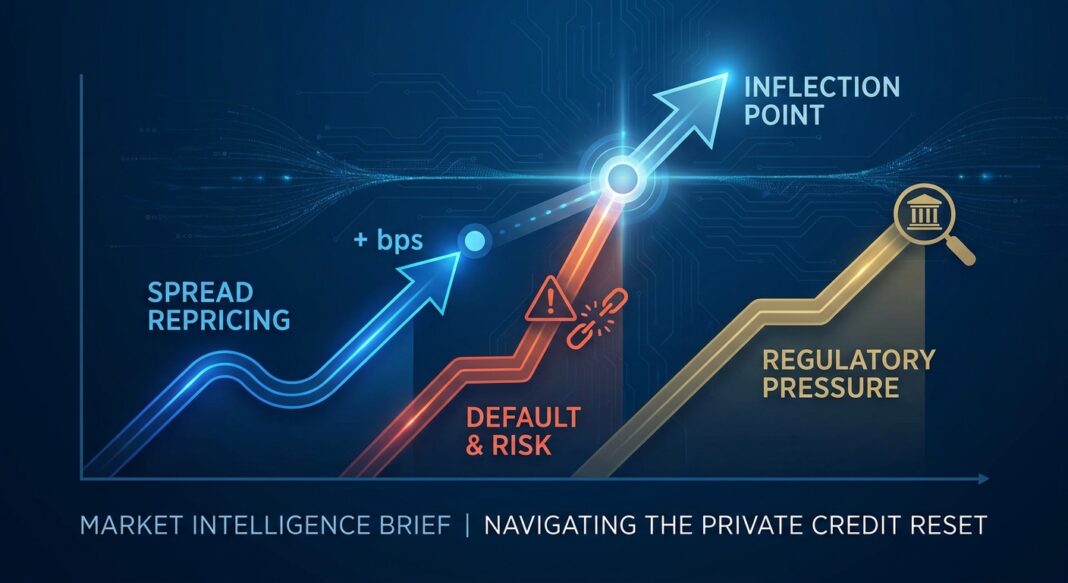
Private Credit at an Inflection Point: Spreads Reprice, Defaults Rise, and Regulatory Pressure Intensifies
The $2 trillion private credit market is navigating a simultaneous repricing of risk, a deterioration in borrower fundamentals, a slowdown in deal flow, and a sweeping multi-agency regulatory investigation — all at once. What this means for borrowers, lenders, and institutional investors.
📊 Market Headline: The Lender-Friendly Reset Is Underway — But Not Without Risk
After years of spread compression, elevated competition, and borrower-friendly documentation, private credit markets entered 2026 in a materially different posture. Northleaf Capital confirmed that while U.S. base rates remained broadly flat in Q1, new loans began pricing approximately 25 basis points higher, with broadly syndicated and high yield spreads widening by 15–30 bps on new issues quarter-over-quarter as the market re-entered price discovery mode.
By Q2 2026, Valuation Research Corporation (VRC) observed that conditions in the direct lending market had stabilized — but at a higher cost basis. Expected yields increased roughly 50 bps during Q2, reflecting a continued upward shift in the forward SOFR curve, which sat approximately 50 bps above year-end 2025 levels. Market projections now imply an average base rate of ~3.5% over the remainder of 2026 through 2028.
Three converging macro forces are reshaping the credit landscape simultaneously: (1) persistent inflation and a Federal Reserve on hold, complicating the rate path; (2) AI-driven disruption concerns that triggered a sharp selloff in software and tech-exposed credits and a wave of investor redemptions from semi-liquid vehicles; and (3) geopolitical escalation in the Middle East, which added upward pressure to inflation through energy channels. VRC’s Q1 update described these as collectively pushing credit markets into a “renewed phase of price discovery.”
The macro-to-micro read is clear: lenders with pricing discipline and selective deployment are positioned advantageously, while borrowers with AI-exposed software revenue stacks, elevated leverage, or near-term refinancing needs face materially higher all-in costs and tighter lender scrutiny.
📋 Quantitative Market Snapshot
The table below synthesizes the most current available data across private and public credit markets as of Q2–Q3 2026.
| Metric | Current Value (Q2–Q3 2026) | Prior Period | Source |
|---|---|---|---|
| Middle Market Unitranche Spreads (core market) | S + 475–550 bps | S + 450–525 bps (Q4 2025) | VRC Q2 2026 |
| Lower Middle Market Unitranche Spreads | S + 500–700 bps | S + 475–650 bps (Q4 2025) | ABF Journal, May 2026 |
| Unitranche All-In Yield (traditional middle market) | ~9.00%–9.75% | ~11.5%–12.5% (peak, late 2023) | VRC Q2 2026 |
| US Middle Market Direct Lending Volume (1H26) | ~$46 billion | ~$66 billion (1H25) | StepStone Group, Aug 2026 |
| BDC Net Flows (Q2 2026) | Net Negative ($6.4B redemptions vs. $3.6B subscriptions) | Net Positive through Q3 2025 | StepStone Group, Aug 2026 |
| C&I Bank Lending Standards (Large & Mid-Market, Net % Tightening) | +8.1% (Q2 2026) / 0.0% (Q3 2026) | +5.3% (Q1 2026); +6.5% (Q4 2025) | Fed SLOOS, July 2026 |
| Weighted Avg. Net Leverage (Middle Market BDC Portfolio) | 5.20x (Nuveen Churchill, Q2 2026); 4.4x (Kayne Anderson BDC, Q1 2026) | 5.0x–6.0x competitive range (high-quality deals) | NCDL 10-Q / KBDC 10-Q (SEC EDGAR) |
| Weighted Avg. Interest Coverage Ratio (Middle Market BDC) | 2.46x (Nuveen Churchill, Q2 2026); 2.4x (Kayne Anderson, Q1 2026) | 2.27x (Nuveen Churchill, Q1 2026) | NCDL 10-Q / KBDC 10-Q (SEC EDGAR) |
| Private Credit Default Rate (range by methodology) | 2.51% (Proskauer, Q2 2026, excl. extensions); 6.0% (Fitch, April 2026, incl. distressed exchanges) | 2.73% Proskauer Q1 2026; 1.84% Q3 2025 | Kaden Wood Group / Proskauer / Fitch, Aug 2026 |
| Private Credit vs. High Yield Spread Premium | ~150–200 bps (private credit over HY); HY all-in yield ~7.3% | ~350 bps premium (2019); compressed steadily since 2022 | Owners.pe, Apr 2026 / Private Markets Insights, Oct 2026 |
Note: Term SOFR 3-month reference rate was approximately 3.69% as of June 2026 (VRC). All spread data reflects new issue pricing; secondary spreads remain wider on a YTD basis.
KPI Focus: Coverage Ratios and the FCCR Signal
Interest coverage ratios across tracked middle-market BDC portfolios have remained above 2.0x in Q2 2026 — a headline that masks significant intra-portfolio dispersion. KBRA’s Q2 2026 Middle Market Compendium flagged that Q2 2026 recorded the largest quarter-over-quarter decline in EBITDA growth on record across its nearly 1,000-company assessment universe, suggesting that the EBITDA tailwinds that have historically buffered coverage ratios are fading. Fixed charge coverage ratios (FCCR) for upper middle market borrowers — particularly those carrying 5.0x–6.0x leverage at current SOFR levels — are under elevated pressure, with some deals exhibiting FCCRs in the 1.1x–1.2x range, leaving minimal headroom before technical default thresholds.
🏭 Sector Analysis: Where Lenders Are Leaning In — and Pulling Back
✅ High Conviction: Healthcare, Infrastructure & Digital Assets
Octus data shows healthcare led all sectors in private credit direct lending volume in 2025, accounting for 19% of all deals, and that momentum is extending into 2026. Healthcare’s recurring revenue profile, regulatory barriers to entry, and essential-service characteristics make it the most consistently underwritten sector across lender types. Paul Weiss’ 2026 outlook identifies energy infrastructure, digital infrastructure (data centers, fiber), and defense and national security as priority sectors requiring patient institutional capital.
Chambers & Partners notes that private credit is actively leading financing structures for large-scale AI-related infrastructure, with deals such as Hg Capital’s $6.4 billion take-private of OneStream and a $3 billion unitranche facility to refinance Covetrus illustrating the continued appetite for large, high-quality credits. Renewable energy and data center credits are seeing some of the tightest spread conditions in the current market, reflecting strong lender competition for investment-grade-adjacent collateral-backed assets.
⚠️ Under Pressure: Software / Technology Services
The sharpest repricing in H1 2026 occurred in software and technology services. VRC’s Q1 review documented that secondary spreads widened materially on technology and software-exposed credits following concerns that AI tools could disrupt existing software business models. Cambridge Associates noted that most software deal flow in direct lending has been concentrated in the upper middle market, “precisely where aggressive lending practices and weaker” underwriting standards have been most prevalent.
Credit Benchmark’s 2026 review of 20 major US private credit funds found that Technology, Business Services, and Healthcare remain the top-three sector concentrations, with 64% of borrowers sitting in the ‘b’ credit category — a quality band that is increasingly bifurcating as AI disruption separates durable software moats from vulnerable revenue stacks.
🔄 Structural Rotation: Capital Flowing to Asset-Based Finance
One of the most consequential structural shifts of 2026 is visible in fundraising data. Manhattan Private Credit, citing PitchBook data via Wellington, reports that direct lending’s share of private debt fundraising fell from 58.4% in 2024 to just 31% by Q1 2026, with capital rotating into infrastructure debt, real estate credit, special situations, and asset-backed finance (ABF). With Intelligence notes that specialty finance fund launches rose from 23% to 34% of all funds in development between 2024 and 2025, with the top 10 specialty finance funds collectively targeting ~$35 billion. This rotation reflects both tighter underwriting in corporate direct lending and strong investor demand for collateral-backed, less rate-sensitive structures.
⚖️ The Regulatory Overhang: A Coordinated Multi-Agency Investigation
The regulatory environment has escalated materially in 2026. The SEC, Treasury, and Federal Reserve jointly launched a sweeping investigation into the private credit market in April 2026, probing asset valuations, disclosures, and systemic risks amid mounting redemption requests. The Financial Stability Oversight Council (FSOC) is actively discussing private credit risk factors at its meetings, and the Treasury has convened U.S. and global insurance regulators to address exposure concerns.
At the SEC’s March 4, 2026 Private Markets Roundtable, Chairman Paul Atkins stated the SEC has “an obligation to meet that demand with both openness and rigor” as private credit access broadens to retail investors. The SEC’s 2026 examination priorities explicitly call out private credit and private fund products with extended lock-ups, with examiner focus on valuation methodologies, fee disclosures, liquidity frameworks, and conflict-of-interest management. ACA Group described valuation practices as moving from “a back-office function into a front-line regulatory priority.”
🎯 Implications: What This Means for Borrowers, Lenders, and Institutional Investors
For Borrowers
- Higher all-in cost of capital is structural, not transitory. With Term SOFR hovering near 3.69% and unitranche spreads at 475–700 bps depending on deal size, middle-market borrowers are carrying interest burdens materially above pre-2022 historical norms. Businesses with thin EBITDA margins or high capital expenditure requirements are operating with FCCRs at or near lender covenant thresholds.
- Refinancing risk is elevated for 2021–2022 vintages. Loans originated at peak leverage in the zero-rate era now face significantly higher servicing costs upon refinancing. Borrowers with PIK provisions may find that deferred interest has eroded their equity cushion significantly by the time capital structures must be renegotiated.
- Documentation and covenant terms are tightening selectively. Lord Abbett’s midyear analysis notes that the most durable advantage for disciplined lenders may come from “better documentation, more conservative leverage, and the time to conduct stress analysis before capital is deployed.” Borrowers seeking the most favorable execution should expect to demonstrate EBITDA quality, cash flow durability, and covenant headroom.
For Lenders and Institutional Investors
- The illiquidity premium has compressed materially. The spread of private credit over comparable public high yield has narrowed from ~350 bps in 2019 to ~150–200 bps today. BNY Investments argues that once fees, credit losses, and liquidity costs are netted, the private credit premium for new allocations is functionally narrow. Investors adding credit exposure should model net-of-all-costs returns carefully before committing to illiquid structures.
- Default measurement methodology now determines your risk assessment. Proskauer’s index printed 2.51% for Q2 2026 while Fitch registered 6.0% for the same period — a gap driven almost entirely by whether maturity extensions are counted as defaults. KBRA projects the annualized private credit default rate rising from 1.5% in 2025 to 2.0% by year-end 2026. Investors should require portfolio-level transparency on distressed exchanges and PIK income as a share of total investment income.
- Sector selection is now the primary alpha driver. Cambridge Associates warns that the gap between stronger and weaker portfolios will become more visible as the year progresses, with performance driven by loss avoidance rather than yield capture. Healthcare, infrastructure, and asset-backed credit are structurally preferred over undifferentiated software and technology services exposure.
🔭 Forward-Looking View: Q4 2026 and Into 2027
StepStone Group’s August 2026 analysis notes that deal activity began recovering in late June and continued improving through July, suggesting a stronger pipeline heading into the second half of the year. However, Morgan Stanley Investment Management cautions that elevated redemptions from semi-liquid vehicles and a more hawkish rate outlook represent structural headwinds even as deal quality improves.
The regulatory investigation is unlikely to produce immediate structural disruption, but valuation practices, fee disclosures, and liquidity frameworks will face heightened scrutiny through at least H1 2027. Managers without robust third-party valuation processes, transparent covenant reporting, and clearly articulated liquidity policies face elevated examination and investor relations risk. With Intelligence expects asset-based finance to challenge direct lending’s structural dominance over the medium term, as banks continue to de-risk balance sheets and investors demand collateral-backed structures with more defined liquidity profiles.
The directional read for the next three to six months: spreads will hold or widen modestly on lower-quality credits; deal volumes will recover selectively, concentrated in healthcare, infrastructure, and sponsored M&A as the M&A pipeline rebuilds; and manager dispersion will widen, rewarding those with disciplined underwriting, covenant maintenance, and a track record across credit cycles. In a market where the illiquidity premium has compressed and default risk is rising, credit selection is the product.
⚡ Key Market Insights: 5 Actionable Takeaways
- Spreads are widening at the margin — and the lower middle market is priced most attractively. Core middle market unitranche spreads (S+475–550 bps) have risen approximately 25 bps since Q4 2025; lower middle market credits command S+500–700 bps with an additional 25–50 bps of widening anticipated. For lenders with origination capacity in sub-$25M EBITDA companies, the current environment offers the best risk-adjusted entry point in two years.
- FCCR and interest coverage ratios are the primary underwriting watchpoints. With SOFR near 3.69% and leverage multiples of 5.0x–6.0x still clearing on quality transactions, upper middle market FCCRs can compress toward 1.1x–1.2x — effectively covenant-floor territory. Lenders should stress-test coverage ratios at +50–100 bps SOFR scenarios and require minimum FCCR covenants of at least 1.15x.
- The default measurement gap is an actionable due diligence variable. The 350 bps range between Proskauer (2.51%) and Fitch (6.0%) default readings is almost entirely explained by treatment of maturity extensions. Institutional investors should require fund-level reporting that separately discloses covenant defaults, distressed exchanges, and outright payment defaults — and should assign material risk weight to PIK income as a share of total investment income.
- Capital is rotating from direct lending to asset-backed finance. With direct lending’s fundraising share falling from 58.4% to 31% in 18 months, the structural shift is confirmed. Investors seeking to maintain private credit yield premiums should evaluate infrastructure debt, equipment finance, and specialty receivables platforms that offer collateral backing, less AI-disruption sensitivity, and defensive FCCR profiles.
- Regulatory and valuation governance is now a portfolio construction risk. The coordinated SEC–Treasury–Fed investigation, active FSOC discussions, and DOJ warnings on portfolio marks mean that managers with opaque valuation practices face increasing risk of mandated restatements, investor redemption pressure, and examination findings. Before deploying capital into semi-liquid private credit vehicles, institutional investors should independently verify third-party mark processes, stress-scenario disclosure policies, and liquidity waterfall mechanics.
Bond Capital — Market & Sector Intelligence. Published October 6, 2026. All data sourced from publicly available institutional research, SEC EDGAR filings, and Federal Reserve publications. This article is for informational purposes and does not constitute investment advice.


