
The Gap That Senior Debt Cannot Fill
A growth-stage operator has identified a bolt-on acquisition at a $10M enterprise value. The target generates $1.2M in EBITDA, has defensible recurring revenue, and fits cleanly inside the buyer’s platform. The problem is structural, not strategic: a conventional senior lender will advance debt at 3.0x–3.5x EBITDA, funding roughly $3.6M–$4.2M of the purchase price. Equity from the sponsor covers another $3.5M. That leaves a $2.3M–$2.9M gap, real money that cannot be papered over with narrative or deferred to close.
This is the defining capital challenge at the growth stage: enterprise value has outpaced the debt capacity that senior lenders will support, but the business is not yet large enough to access the broadly syndicated loan market or investment-grade credit facilities. The capital stack has a structural hole, and filling it correctly (at the right price, with the right terms, and through the right process) determines whether the acquisition is accretive or merely expensive.
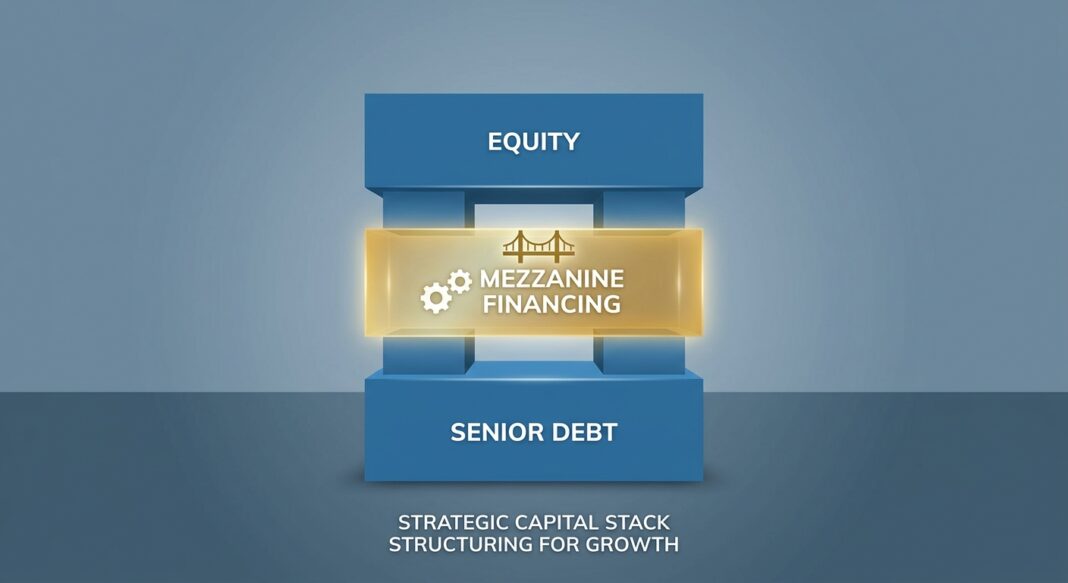
Mezzanine financing is the instrument designed for exactly this scenario. Understanding how it works, how it prices, and how to negotiate it is not optional for growth-stage operators. It is a core competency.
The Capital Stack: From Banks to Equity
Before mapping the solution, operators must understand the full cost-of-capital spectrum available at the growth stage. Each layer of the stack carries a different price, a different structural expectation, and a different risk tolerance from the provider:
- Senior secured bank debt: Lowest cost, typically priced at a spread over SOFR or at fixed rates in the 7%–9% range for growth-stage credits. Advance rates are constrained, 3.0x–3.5x EBITDA for cash-flow loans, or against specific asset collateral for asset-based facilities. Covenant packages are maintenance-heavy: quarterly leverage tests, fixed-charge coverage ratios, and borrowing base certificates. The bank is not a risk partner; it is a secured creditor with a short leash.
- Private credit / unitranche: Direct lenders can stretch to 4.0x–5.0x EBITDA on stronger credits, pricing in the 10%–13% all-in range as of mid-2026. Unitranche structures collapse senior and subordinated debt into a single facility, simplifying the inter-creditor dynamic but pricing that simplicity into the spread. Covenant packages vary, some direct lenders accept incurrence-only tests on high-quality borrowers; others impose quarterly maintenance covenants.
- Mezzanine / subordinated debt: The gap capital layer. All-in pricing typically ranges from 13%–18%, structured as a cash-pay coupon plus a PIK component and warrant coverage of 1%–5% of fully diluted equity. Subordinated to senior lenders but senior to all equity. Covenant packages are negotiated, some mezz providers accept incurrence-only covenants; others require maintenance tests tied to leverage or coverage ratios. The mezz provider is underwriting a five-to-seven-year hold and needs to see a clear exit pathway via refinancing or sale, as detailed in Bond Capital’s acquisition financing framework.
- Preferred equity: More expensive than mezz in coupon terms (often 15%–20% PIK or cash), but carries no scheduled amortization and no covenant package. Preferred equity providers sit below all debt in the capital structure and price that subordination accordingly. The trade-off is structural flexibility versus raw cost.
- Common equity: The residual layer. Most expensive in dilution terms, sized as whatever remains after debt capacity and seller participation are fully deployed. Minimizing equity contribution without over-levering the business is the central structuring objective of every acquisition.
Structuring the Mezzanine Layer: A Worked Example
Return to the $10M acquisition. The capital stack might be structured as follows:
- Senior secured term loan: $4.0M at 3.3x EBITDA, priced at SOFR + 350 bps (approximately 8.8% all-in), 5-year term, quarterly amortization of 5% per annum, maintenance covenant at 4.0x total leverage.
- Mezzanine facility: $2.5M subordinated, priced at 12% cash-pay coupon plus 3% PIK, 6-year term, bullet maturity, warrant coverage of 3% of fully diluted equity with a strike price at current enterprise value. No amortization. Incurrence covenant on additional indebtedness; one maintenance test, fixed-charge coverage ratio above 1.10x.
- Equity (sponsor): $3.5M common equity, representing 35% of enterprise value. Residual after debt layers are fully deployed.
The total sources equal $10M. The all-in cost of the debt stack (blending senior at 8.8% and mezz at 15% (12% cash + 3% PIK)) is approximately 11.2% before warrant dilution. The equity check is preserved at 35% of enterprise value rather than the 65%+ it would represent without the mezz layer. That is the structural value of filling the gap correctly.
The PIK component matters operationally. In years one and two, when integration costs are highest and free cash flow is tightest, the PIK accrual defers cash outflow without triggering default. This is not a feature to accept passively; it is a term to negotiate actively.
The Gap Capital Playbook: Quantify, Prepare, Run the Process
Identifying the gap is the first step. Filling it efficiently requires a disciplined process across three phases.
Phase 1: Quantify the Gap with Precision
Build a sources-and-uses schedule (not a narrative, but a line-item document) that maps every dollar from capital source to deployment. Identify the maximum senior debt advance based on realistic EBITDA and lender advance rates. Calculate the equity contribution based on available sponsor capital. The gap is the arithmetic residual. Do not estimate it; model it against two sensitivity variables: revenue growth and EBITDA margin compression. Providers need to see how much degradation the structure can absorb before covenants trip or cash runs short.
Phase 2: Prepare Three Deliverables
Approach gap capital providers with a use-of-proceeds memo, a three-year integrated financial model, and a management presentation. The use-of-proceeds memo must be precise: one page, every dollar accounted for, EBITDA accretion demonstrated. The financial model must include sensitivity tables. The management presentation must address customer concentration risk, competitive moat, and a clearly articulated exit pathway. Mezz providers are five-to-seven-year holders. They are underwriting the eventual refinancing or sale, not just the current transaction.
Phase 3: Run a Structured Process
Approach four to six gap capital providers simultaneously. Issue a structured term sheet request with a defined response window, typically 10 to 15 business days. Require each provider to specify pricing, PIK/cash split, warrant coverage, covenant package, and amortization profile. This forces comparability and prevents providers from anchoring on the most restrictive terms. Evaluate across all five dimensions simultaneously, not just on price. A lower-coupon facility with aggressive maintenance covenants can be structurally more constraining than a higher-coupon instrument with incurrence-only tests and no scheduled amortization. Total cost of constraint, not total cost of coupon, is the correct comparison metric.
Negotiation: Five Points That Move the Most Value
Once term sheets are in hand, negotiation focuses on five structural levers:
- PIK toggle flexibility: Negotiate the right, not the obligation, to PIK interest in years one and two. This preserves cash during the integration period without triggering default. A mandatory PIK is a lender feature; an optional PIK toggle is a borrower feature. They are not the same instrument.
- Warrant coverage and strike price: Warrant coverage of 1%–5% of fully diluted equity is standard. The strike price is negotiable, push for a strike at or above current enterprise value, not below it. A below-market strike is equivalent to a discounted equity issuance hidden inside a debt instrument.
- Covenant design: Maintenance covenants tested quarterly are operationally constraining. Incurrence covenants (which trigger only upon a specific action, such as additional debt issuance or a dividend) provide materially more flexibility. Push for incurrence-only packages on any covenant test where the business has a clear margin of compliance.
- Prepayment terms: Mezz facilities often carry call protection of 2%–3% in years one and two, stepping down thereafter. Negotiate the no-call period down to 12–18 months if possible. The ability to refinance the mezz layer into senior debt after the business scales is a direct value driver.
- Board observation rights: Mezz providers frequently request board observation rights. These are negotiable. An information rights package (quarterly financials, annual budget, officer certificate on covenant compliance) is a reasonable alternative that preserves governance clarity without adding a voice to board deliberations.
Key Takeaways
- The gap is arithmetic, not narrative: Quantify the difference between senior debt capacity and total purchase price before approaching any capital provider. The use-of-proceeds schedule is the foundation of every gap capital conversation.
- Cost of constraint exceeds cost of coupon: A lower-rate facility with aggressive maintenance covenants and no PIK flexibility can destroy more value than a higher-rate instrument with structural flexibility. Evaluate total terms, not headline price.
- PIK toggle is a borrower right, not a lender feature: Optional PIK in years one and two preserves integration-period cash flow. Mandatory PIK that accretes without limit is a lender-friendly structure masquerading as borrower flexibility.
- Run a competitive process with defined parameters: Four to six providers, a 10-to-15-business-day response window, and five required dimensions per term sheet. Competition creates comparability; comparability creates negotiating leverage.
- Mezz providers are underwriting the exit, not just the entry: The management presentation must articulate the refinancing or sale pathway clearly. A mezz provider who cannot underwrite the exit cannot price the risk, and will either decline or impose structural terms that reflect that uncertainty.


