
The Growth-Stage Financing Problem Nobody Warns You About
You have a target. You have a thesis. You have a signed LOI. What you do not have is a clean financing path.
This is the defining capital challenge of the growth stage: the business has outgrown venture equity terms but has not yet earned its way into broadly syndicated leveraged finance. Senior lenders will extend — but not far enough. The equity cost of filling the remaining gap is punishing. And the clock on your exclusivity window is already running.
The companies that close these deals do not find a better lender. They build a better capital stack — one that assigns each layer of capital to its correct risk tier, cost level, and structural role. Understanding how to design, sequence, and negotiate that stack is the core competency this article addresses.
Step 1: Map the Capital Stack Before You Approach a Single Lender
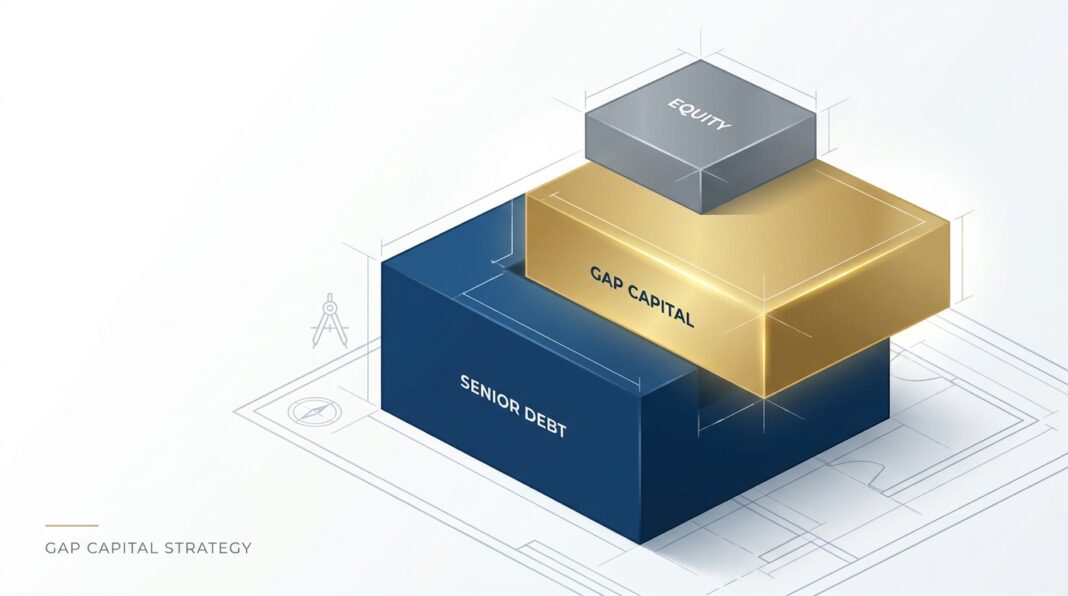
In a growth-stage acquisition, the capital stack typically comprises three to four distinct layers. Each carries a different cost of capital, a different set of structural expectations, and a different risk tolerance. Moving from most senior to most junior:
- Senior secured debt (banks or private credit): The lowest-cost layer. Priced off a base rate plus a spread — in the current environment, typically in the 7%–10% all-in range for direct lending at the growth stage. Sized against normalized EBITDA, generally to 3.0x–4.0x leverage for established cash flows, less for earlier-stage businesses. Carries the most restrictive covenant package and first lien on all assets.
- Mezzanine / subordinated debt: The gap capital layer. All-in pricing typically ranges from 13%–18%, often structured as a cash-pay coupon plus a PIK component and warrant coverage of 1%–5% of fully diluted equity. Subordinated to senior lenders, but senior to all equity. Covenant packages are negotiated — some mezz providers accept incurrence-only covenants; others require maintenance tests.
- Seller notes / earnouts: Frequently used to bridge valuation disagreements and reduce the upfront cash requirement. Subordinated to institutional debt, often with an interest rate in the 5%–8% range and a payment holiday in years one through two. Can anchor 5%–10% of total deal value.
- Equity (sponsor, rollover, or preferred): The most expensive layer in dilution terms. Sized as the residual once debt capacity and seller participation are fully deployed. Minimizing equity contribution — without over-levering the business — is the central structuring objective.
As the capital stack design framework outlined by vcbeast.com makes clear: the best stack is not the one with the most leverage or the smallest equity check — it is the one that matches cash flow durability, lender appetite, and the sponsor’s operating plan. Build the sources-and-uses schedule before approaching capital providers, not after.
Step 2: Quantify the Gap with Precision
The gap capital calculation is mechanical, but founders and operators consistently underestimate its importance. Here is the arithmetic for a representative growth-stage acquisition:
- Target enterprise value: $15M
- Senior debt capacity (based on 3.5x normalized EBITDA of $2.3M): ~$8M
- Seller note (negotiated as part of purchase price structure): $1M
- Remaining gap to close: $6M
That $6M is your gap capital quantum. It cannot be covered by the senior lender without breaching leverage limits. It cannot be covered by equity without unacceptable dilution. It requires a structured solution — mezzanine debt, preferred equity, or a blend of both.
Model three scenarios before committing to any structure, as detailed in Bond Capital’s own acquisition financing framework at bondtv.vaultai.ca: (a) fill with mezz debt, (b) fill with preferred equity, (c) blend both. For each scenario, stress-test your post-close Fixed Charge Coverage Ratio (FCCR), total leverage multiple, and pro-forma equity dilution. The target zone: FCCR above 1.20x, total leverage below 5.0x EBITDA, equity dilution below 15% of common. The scenario that meets all three thresholds in your base case — and survives in your downside case — is the optimal structure.
Step 3: Prepare the Four Materials That Move Gap Capital Providers
Gap capital providers — mezzanine funds, BDCs, family offices, and credit opportunity funds — underwrite to a fundamentally different thesis than senior lenders. Senior lenders underwrite to downside asset coverage. Mezz providers underwrite to enterprise value creation and equity coverage. Your materials need to speak to their framework.
The four documents that define a credible gap capital process, as reinforced by institutional capital best practices noted at bondtv.vaultai.ca:
- Use-of-proceeds memo: A precise, one-page document mapping every dollar from sources to uses and demonstrating how the acquisition creates EBITDA accretion. This is not a narrative — it is a schedule with line items.
- Three-year integrated financial model: Revenue, EBITDA, debt service, and free cash flow — with sensitivity tables on two variables: revenue growth rate and EBITDA margin compression. Providers want to see how much degradation your structure can absorb before covenants trip or cash runs short.
- Management presentation: Strategic rationale, competitive moat, customer concentration risk, and a clearly articulated exit pathway. Mezz providers hold for five to seven years and need to underwrite your eventual refinancing or sale.
- Clean cap table: Pre- and post-transaction ownership, fully diluted. Any ambiguity in the cap table extends diligence timelines significantly.
Step 4: Run a Competitive Process — Not a Sequential Search
The most common tactical error in gap capital raises is approaching providers one at a time. Sequential outreach eliminates price tension, extends timelines, and signals desperation to the market. The correct approach is parallel and structured.
Approach four to six gap capital providers simultaneously. Issue a structured term sheet request with a defined response window — typically 10 to 15 business days. Require each provider to specify five dimensions in their response, as detailed in Bond Capital’s acquisition financing framework at bondtv.vaultai.ca:
- Coupon structure: cash pay versus PIK split
- Warrant coverage or equity co-investment requirement
- Covenant package: maintenance versus incurrence
- Board observer rights or information covenants
- Change-of-control and prepayment provisions
Evaluate across all five dimensions simultaneously — not just on price. A 14% all-in mezz facility with 3% warrant coverage and quarterly maintenance covenants can be structurally more constraining than a 16% preferred equity instrument with no covenants and no scheduled amortization. Total cost of constraint, not total cost of coupon, is the correct comparison metric.
Step 5: Negotiate the Structure — Five Points That Move the Most Value
Once you have competing term sheets, negotiation becomes a matter of knowing which structural levers carry the most long-term consequence:
- PIK toggle flexibility: Negotiate the right — not the obligation — to PIK interest in years one through two. This preserves cash during the integration period without triggering default.
- Warrant strike price and coverage percentage: Warrants issued at a below-market strike meaningfully dilute common equity holders at exit. Push for above-market strikes or a hard cap on total warrant coverage as a percentage of fully diluted shares.
- Maintenance vs. incurrence covenant design: Maintenance covenants (tested quarterly against a financial ratio) create the most operational risk in a growth business with lumpy cash flows. Incurrence covenants (tested only when a specific action is taken) provide substantially more operating room. This is a binary negotiation — get it in writing in the term sheet, not just the definitive agreement.
- Prepayment penalties and call protection: Standard mezz facilities carry 2%–3% prepayment fees in years one through three, stepping down to zero thereafter. Negotiate a make-whole carve-out for change-of-control events initiated by the lender, not the borrower.
- Information rights and board observer triggers: Many gap capital providers require board observer rights as a condition of funding. Define clearly: what triggers the right, what information is shared in advance of board meetings, and what confidentiality protections apply to the observer.
Key Takeaways
- Build the stack before you build the story. Map every layer — senior, mezz, seller note, equity — against your EBITDA, leverage limits, and dilution tolerance before approaching any capital provider.
- Quantify the gap mathematically. The gap capital quantum is the residual after senior debt capacity and seller participation are fully deployed. Model it precisely, then stress-test it in your downside scenario.
- Gap capital providers underwrite to equity value creation, not asset coverage. Your materials need to demonstrate EBITDA accretion, free cash flow durability, and a credible exit pathway — not just collateral coverage.
- Run parallel, not sequential, provider outreach. Competitive tension is the primary tool for improving both price and structural terms. Sequential search eliminates it entirely.
- Negotiate on total cost of constraint, not just coupon rate. Covenant design, warrant structure, PIK flexibility, and prepayment terms collectively determine how much operational freedom the capital stack preserves after close.


