
A profitable company can reach a succession crossroads before it reaches a financing problem. An owner is ready to sell, management or an outside buyer wants to continue the business, and the purchase price exceeds what a bank will lend against normalized cash flow and collateral. The task is to fund the transfer without loading the company with debt service that restricts operations or forcing a sale of more ownership than the buyer intends.
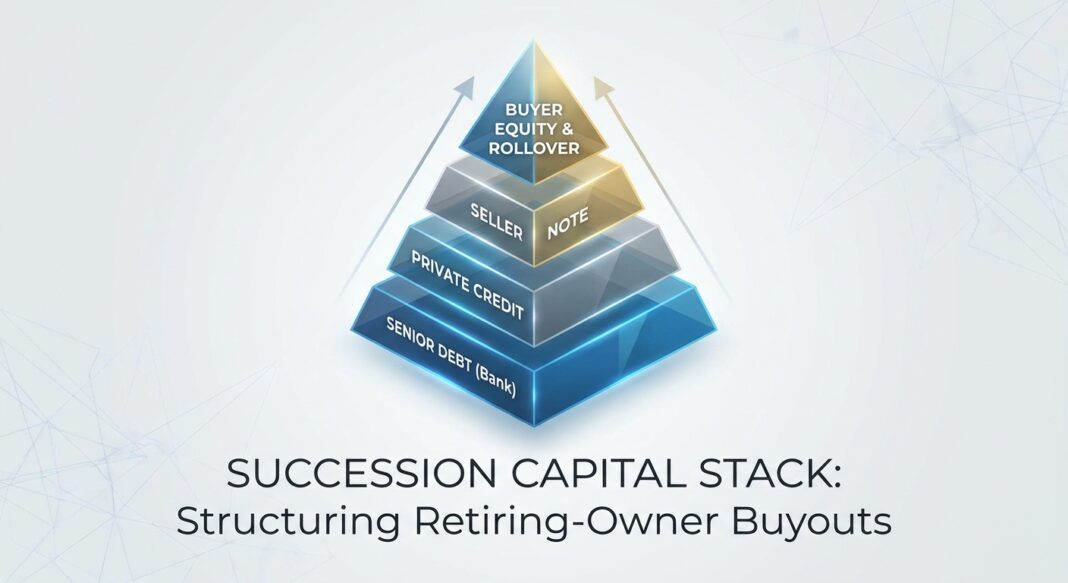
Succession financing is not one instrument. It is a sequence of claims matched to different risks: senior debt against predictable cash flow or assets, seller financing that bridges a valuation or funding gap, and buyer equity that absorbs first loss. The right mix depends on what the proceeds pay for, the company’s repayment capacity, and the seller’s willingness to remain exposed after closing. Working capital, equipment, add-on acquisitions, and owner liquidity should be separately identified rather than bundled into one unexplained request.
The same matching logic applies at each stage. Seed companies usually rely on founder capital and equity for uncertain product development. Early businesses may add venture capital or asset-backed facilities as receivables emerge. Growth companies can access bank debt, private credit, and preferred capital as cash flow and scale improve. Mature companies may use revolvers, public or private debt, or equity for refinancing, acquisitions, and recapitalizations. Succession adds a transfer-specific layer: seller notes, rollover equity, or a staged purchase can bridge buyer capacity and seller proceeds.
Build the succession stack around the proceeds
Start with a sources-and-uses schedule. Separate seller consideration, debt refinancing, transaction expenses, and post-close liquidity. Then align each use with a funding source and repayment profile.
- Bank senior debt: A term loan can fund the portion supported by sustainable cash flow; a revolver can support seasonal working capital. Asset-based borrowing may fit when eligible receivables or inventory provide stronger collateral support than earnings. Expect collateral, reporting, and covenant requirements.
- Private credit: A cash-flow loan or unitranche can provide a larger, more integrated commitment where bank capacity or execution certainty is insufficient. It generally comes with a higher total cost than bank debt, so compare fees, amortization, call protection, covenants, and closing certainty, not just the stated spread.
- Seller note: Deferred consideration can reduce cash required at closing and align part of the seller’s return with the business’s post-close performance. Its ranking, payment blockage, maturity, interest, and subordination to senior lenders must be negotiated and documented.
- Mezzanine or preferred capital: These can fill a residual financing gap when senior debt is capped. Mezzanine may combine cash interest with payment-in-kind interest or an equity feature; preferred equity generally has a negotiated return and priority over common equity. Both can be materially more expensive than senior borrowing.
- Buyer equity or rollover: Equity absorbs uncertainty that fixed-payment debt cannot. A seller rollover can preserve participation in future value, but it also requires clear governance, distribution, and exit terms.
The stack should not be sized to the seller’s desired headline price alone. It should be sized to debt service under a downside case, with a separately funded operating cushion. Avoid using short-term working-capital availability to fund permanent purchase consideration.
What recent disclosures show
The Federal Reserve’s October 2026 Senior Loan Officer Opinion Survey reported that standards for commercial and industrial loans to large and middle-market firms were basically unchanged in the third quarter, while standards tightened for small firms. Banks also reported tighter pricing premiums for riskier loans across company sizes and weaker net demand for C&I loans (October 2026 survey). That is a reason to test bank capacity early, not to assume a particular borrower will or will not qualify. Federal Reserve, October 2026 SLOOS.
A disclosed succession-related financing example is Teamshares, which acquires small businesses from retiring owners. On October 19, 2026, it announced repayment of a $150 million legacy facility using a new $130 million, four-year term loan and cash on hand. The company disclosed a 9.5% spread over SOFR on the new loan, said it planned to repay mezzanine debt, and described the refinancing as addressing a near-term maturity while retaining acquisition capacity. This is one borrower’s reported transaction, not a general market quote. Teamshares and Sound Point transaction announcement, October 19, 2026.
Recent public-company disclosures also show how proceeds can be separated by facility. On November 2, 2026, SS&C announced incremental term A loans, a revolver increase, and a launched term B loan syndication, with proceeds intended in part to refinance senior notes due in 2027. The structure illustrates maturity management and liquidity as distinct financing objectives, rather than a single undifferentiated loan. SS&C financing announcement, November 2, 2026.
The gap-capital playbook for a transition
Quantify. Build a sources-and-uses model that identifies purchase price, assumed or refinanced debt, fees, taxes where applicable, and minimum post-close liquidity. Calculate sustainable cash flow after maintenance capital expenditure, taxes, and working-capital needs. Run repayment and covenant headroom under a downside case. The gap is the residual after credible senior capacity and buyer equity, not a plug based on optimistic add-backs.
Prepare. Assemble monthly financials, tax returns, customer and supplier concentration, receivables and inventory aging, a quality-of-earnings analysis, forecast assumptions, and a transition plan for customer relationships and key employees. For seller financing, document the seller’s payment expectations and whether the seller can accept delayed cash proceeds or rollover ownership.
Run. Approach lenders with the same use-of-proceeds schedule, capital structure, and downside case. Compare commitment certainty, timing, collateral, covenants, amortization, maturity, mandatory prepayments, and total financing cost. Keep a bank-led option, a private-credit option, and a seller-note or equity bridge analytically distinct until their terms are comparable.
Negotiate for repayment capacity and transition flexibility
Borrowers should focus on covenant headroom, permitted acquisitions, additional-debt capacity, excess-cash-flow sweeps, prepayment penalties, and the treatment of seller notes. Define when a seller note is subordinated, whether interest can accrue during an initial transition period, and what remedies apply after a payment default. Confirm that the revolver remains available for working capital after closing.
Investors and lenders should test cash conversion, customer retention, management succession, collateral value, and whether the proposed capital structure still works if the seller’s operating role ends sooner than planned. The negotiated structure is sound when senior debt has a clear repayment source, junior capital is compensated for its additional risk, and the business retains enough liquidity to execute the transition.
Key takeaways
- Separate purchase consideration, refinancing, working capital, and growth spending in the sources-and-uses schedule.
- Size senior debt to downside cash flow or realizable collateral, not the seller’s valuation target.
- Use seller notes, mezzanine, preferred capital, or rollover equity to address a defined gap, and price their control and repayment terms explicitly.
- Compare financing on total cost, covenants, flexibility, and closing certainty, not headline interest rate alone.
- Protect post-close liquidity and build the seller transition plan into lender diligence and documentation.


