
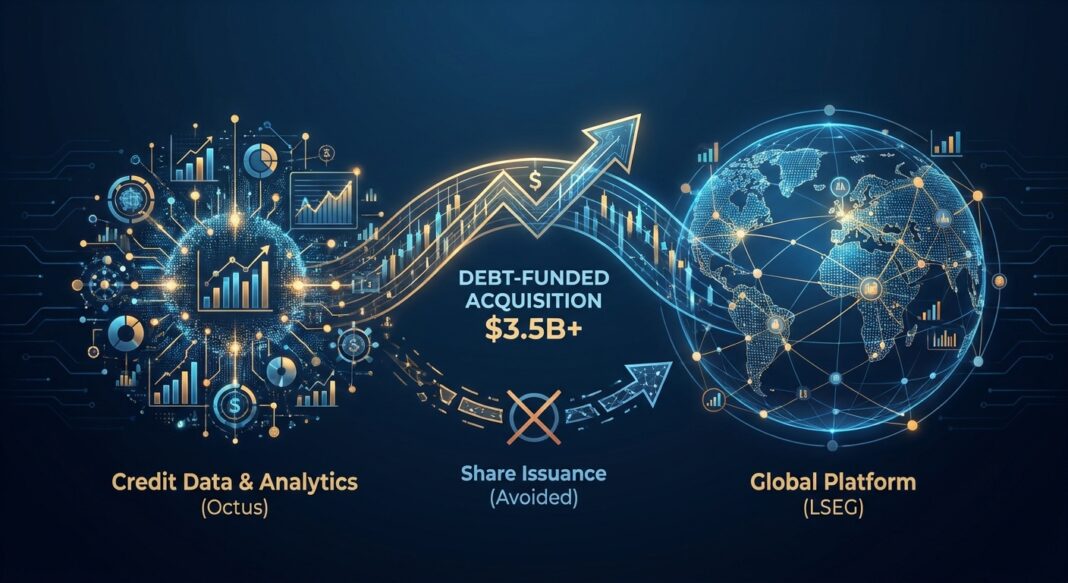
As of November 14, 2026, LSEG’s proposed acquisition of Octus is agreed but not closed. The transaction illustrates a precise use of leverage: fund strategic expansion with debt rather than issue new shares, while accepting a higher debt burden and execution risk.
The story: a credit data company meets a global platform
In 2013, founder Kent Collier started Octus as a provider of intelligence and data for credit markets. The company built its business around information that is difficult to assemble: loan documents, covenants, deal terms, and analysis across private, illiquid, and distressed credit. By October 22, 2026, Octus reported more than 900 employees, 750 customers, and over 40,000 users. LSEG said it expected Octus to generate more than $300 million of revenue in 2026, with an adjusted EBITDA margin of about 40%.
That profile made Octus strategically valuable to London Stock Exchange Group. LSEG already sold fixed-income data, pricing, and analytics, but Octus added proprietary information and workflow tools for private credit. LSEG’s stated thesis was that the combined products could serve customers across liquid and private credit, then use its larger distribution network to sell Octus products more broadly.
There was a second story inside the deal. Permira had invested in Octus in 2022 alongside Collier and management. During the approximately four-year holding period, Permira said Octus more than tripled annual recurring revenue, expanded its product range, and made acquisitions including FinDox, Sky Road, and LevPro. On October 22, 2026, LSEG agreed to buy the company from Permira funds and Octus management for $3.535 billion in cash. The founder’s next decision was not whether to raise another round. It was whether the company he had built should continue independently or join a larger platform, while he remained CEO of Octus after completion.
The decision: borrow for the purchase, not issue shares
LSEG’s disclosed choice was external debt. The company did not publish a detailed debt tranche, interest rate, maturity, or covenant package in its October 22 announcement, so those terms should not be assumed. The public structure is straightforward: a $3.535 billion cash consideration, funded with external debt, subject to regulatory approvals and a targeted close in the first half of 2027.
For LSEG shareholders, that decision avoids issuing new shares specifically to pay the purchase price. An equity-funded acquisition could have spread the purchase cost across a larger share count, reducing existing shareholders’ ownership percentage unless they participated in the issuance. Debt instead leaves the share count intact for the transaction, but creates contractual interest and repayment obligations. That is not cost-free capital. It trades potential dilution for fixed claims on future cash flow.
LSEG set out a leverage boundary alongside the deal. Including forecast cash flow, the Octus and Trumid acquisitions, and planned shareholder returns, it expected year-end 2027 leverage to be near the upper end of its 1.5x to 2.5x target range, then return toward the middle by the end of 2028. The same announcement said the acquisition was expected to be neutral to adjusted earnings per share in the first full year after closing, and accretive thereafter. These are company forecasts, not completed results.
Octus’s reported economics help explain the financing choice. LSEG was buying a subscription business with expected revenue above $300 million and an adjusted EBITDA margin around 40%, not a pre-revenue product whose payoff depended on distant adoption. Still, those figures alone do not prove debt capacity. Cash conversion, integration costs, interest expense, and customer retention determine whether accounting EBITDA can support debt service.
The outcome: a signed deal, not yet a realized return
As of November 14, 2026, the transaction remained pending. The outcome to date is therefore a contracted cash sale for Octus’s sellers and a committed strategic purchase for LSEG, not a completed integration or demonstrated investment return. Permira called the deal a full realization of its investment, but its announcement did not disclose the fund’s purchase price or investment multiple. There is no public basis to calculate Permira’s return or the proceeds received individually by Collier and other management holders.
For Octus, the announced terms put the company inside LSEG’s Data & Analytics division, with Collier expected to continue running the Octus businesses and reporting to division leaders. That is continuity of operating responsibility, not continued founder ownership or independent control. The cash sale converts seller equity into liquidity; it does not preserve the founder’s ownership stake.
For LSEG’s existing owners, the trade-off is clearer but unresolved. Debt funding avoids deal-specific share issuance, while leverage is forecast to rise toward the top of the company’s stated range. LSEG also said the deal should add to its 2027 subscription revenue growth guidance and leave its medium-term margin improvement outlook unchanged. A fair counterfactual is not “equity would have been worse.” Equity financing would have reduced leverage, but potentially diluted shareholders. Debt preserves their percentage ownership only if the acquisition creates enough cash flow and value to justify the obligations. The company has not yet reported the post-close result.
Lessons: match the financing to the asset and the balance sheet
The Octus transaction shows why strategic acquirers may prefer debt when they can buy a cash-generative asset and have room inside a defined leverage policy. LSEG paired the funding announcement with expected earnings effects, a leverage range, cash-flow forecasts, and a projected path back toward the middle of its range. Those guardrails make the financing thesis testable. They do not guarantee the synergy case.
The approach is weaker when earnings are volatile, cash conversion is poor, the purchase relies on optimistic synergy assumptions, or existing debt already restricts flexibility. In those conditions, equity may be expensive in ownership terms but more durable in a downturn. The relevant comparison is not debt versus “free” equity. It is the expected cost of interest and financial constraint versus the value of dilution avoided, under stressed operating assumptions.
For an operator considering a similar acquisition, start with the asset’s dependable cash flow, not the seller’s growth narrative. Size debt against a downside case that includes slower sales, customer churn, integration spending, and higher financing costs. Then assess maturity dates, amortization, covenant headroom, and available liquidity after closing. Finally, compare debt-funded and equity-funded outcomes at the same purchase price, including the ownership surrendered, debt service, and the cash left for investment.
Octus is a useful example precisely because the financing has not yet earned a victory lap. LSEG chose to protect existing share ownership at the cost of higher leverage, and the target brings strong recurring-revenue characteristics. The proof will come after closing, when actual cash generation and integration performance test whether the debt was sized to the business rather than to the strategic ambition.
Key insights
- Debt-funded acquisitions can avoid issuing new shares, but do not eliminate financing cost or risk.
- Octus’s $3.535 billion sale was agreed on October 22, 2026; it was not yet closed as of November 14, 2026.
- LSEG forecast leverage near the upper end of its 1.5x to 2.5x target range at year-end 2027, with a return toward the middle by year-end 2028.
- A founder who sells for cash may retain an operating role without retaining ownership or independent control.
- Underwrite debt to stressed free cash flow, then test the ownership and resilience trade-off against an equity alternative.
Sources: LSEG, acquisition announcement, October 22, 2026; Permira, sale announcement, October 22, 2026; LSEG, Q3 2026 trading update, October 22, 2026.


