
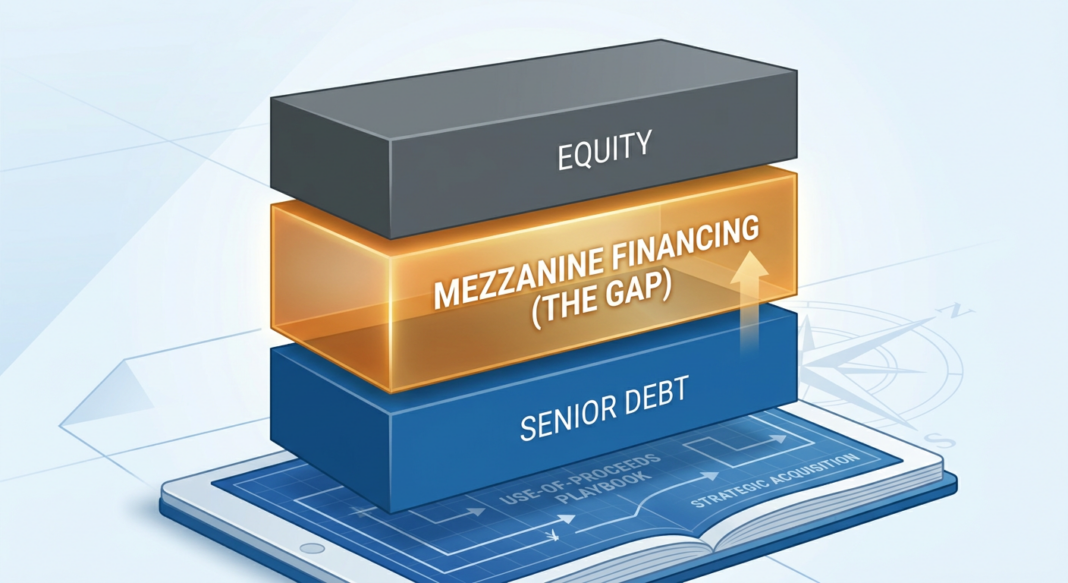
The Gap That Kills Otherwise Fundable Deals
A growth-stage company has identified a bolt-on acquisition at a $10M purchase price. Senior lenders will extend 3.0× EBITDA, call it $4.5M on $1.5M of normalized EBITDA. The sponsor wants to limit its equity contribution to protect returns. Between the senior debt ceiling and the equity check, there is a $3M–$4M layer that conventional lenders will not touch and that equity providers price at 25%–35% IRR. That layer is the gap. Mezzanine financing exists specifically to fill it.
Understanding when to deploy mezzanine debt (and how to structure it correctly) is one of the most consequential decisions in acquisition finance. Used well, it allows operators and sponsors to complete transactions that would otherwise require dilutive equity at the wrong stage. Used carelessly, it installs a rigid cost structure and a covenant package that constrains the business precisely when it needs flexibility.
This article maps the mezzanine layer in full: its mechanics, its pricing, its trade-offs against alternatives, and the process for sourcing and negotiating it in today’s market.
Where Mezzanine Sits in the Capital Stack
A growth-stage acquisition capital stack typically comprises three to four layers. Each carries a distinct cost, a distinct structural expectation, and a distinct risk tolerance. Moving from most senior to most junior, the hierarchy is as follows:
- Senior secured debt (bank or direct lending): Lowest cost, first priority on collateral, most restrictive on leverage. Typically priced at SOFR plus 250–450 basis points for bank facilities, or SOFR plus 500–700 basis points for direct lending. Sized at 2.5×–4.0× EBITDA depending on business quality and sector.
- Mezzanine / subordinated debt: The gap capital layer. All-in pricing typically ranges from 13%–18%, structured as a cash-pay coupon plus a PIK (payment-in-kind) component, and warrant coverage of 1%–5% of fully diluted equity. Subordinated to senior lenders in payment and collateral priority, but senior to all equity in the waterfall. Covenant packages are negotiated, some mezzanine providers accept incurrence-only covenants; others require maintenance tests on leverage and interest coverage.
- Preferred equity or seller notes: Sits between mezzanine and common equity. Seller notes are common in lower-middle-market deals to bridge valuation gaps and reduce upfront cash requirements, though they add subordination complexity and payment obligations post-close.
- Equity (sponsor, rollover, or common): The most expensive layer in dilution terms. Sized as the residual once debt capacity and seller participation are fully deployed. Minimizing equity contribution, without over-levering the business, is the central structuring objective.
As the bondtv.vaultai.ca gap capital framework makes clear, the evaluation metric is not cost of coupon in isolation; it is total cost of constraint. A 14% mezzanine facility with quarterly maintenance covenants can be structurally more expensive than a 16% preferred equity instrument with no covenants and no scheduled amortization, particularly for a business in integration mode where EBITDA may be temporarily compressed.
A Worked Example: $50M Enterprise Value Software Business
Consider a $50M acquisition of a vertical SaaS business generating $4M EBITDA with 80% gross margins and 90% recurring revenue. The acquisition is funded as follows:
- Senior secured term loan: $14M at 4.0× EBITDA, priced at SOFR + 550bps from a direct lender. Five-year term, 1% annual amortization, covenant-lite with a springing leverage test at 35% revolving credit facility utilization.
- Mezzanine tranche: $10M, priced at 12% cash pay plus 3% PIK, with 3% warrant coverage on fully diluted equity. Six-year term, interest-only for years one through three, with a PIK toggle right negotiated for years one and two to preserve integration-period cash flow. Incurrence-only covenants on leverage and restricted payments.
- Sponsor equity: $26M: sized as the residual to fund the $50M purchase price, transaction fees, and working capital reserve.
The mezzanine tranche here is doing precise work: it extends total leverage to 6.0× EBITDA (within range for a high-margin, high-retention SaaS asset), reduces the equity check by $10M, and preserves cash during integration through the PIK toggle. The warrant coverage at 3% provides the mezzanine provider equity upside without requiring a formal equity co-investment. The incurrence covenant structure avoids the quarterly maintenance testing that would create covenant default risk if EBITDA dips during the first year post-close.
Running the Gap Capital Process: Four Steps
Identifying the need for mezzanine is straightforward. Executing the process correctly is where most operators leave money on the table or accept unnecessarily restrictive terms.
Step 1: Build the Use-of-Proceeds Schedule
Before approaching any provider, construct a precise sources-and-uses schedule mapping every dollar from capital sources to closing requirements: purchase price, debt payoff, transaction fees, financing fees, working capital reserve, and integration costs. Providers underwrite the complete picture. A schedule with gaps signals preparation failure and undermines negotiating credibility. As vcbeast.com notes, if the uses are incomplete, the stack is fiction.
Step 2: Build the Three-Year Integrated Financial Model
Mezzanine providers hold for five to seven years and underwrite the eventual refinancing or sale. They require a three-year integrated model (revenue, EBITDA, debt service, and free cash flow) with sensitivity tables on at least two variables: revenue growth rate and EBITDA margin compression. The model must demonstrate how much degradation the structure absorbs before covenants trip or cash runs short. The financial model is not a pitch document. It is a stress-test record.
Step 3: Run a Competitive Provider Process
Approach four to six mezzanine providers simultaneously. Issue a structured term sheet request with a defined response window of 10–15 business days. Require each provider to specify their proposed all-in pricing, PIK vs. cash-pay split, warrant coverage percentage, covenant package type (maintenance vs. incurrence), and amortization schedule. Evaluating across all five dimensions simultaneously, not sequentially, prevents the common error of optimizing on one term while accepting adverse terms elsewhere. The bondtv.vaultai.ca acquisition financing framework details this five-dimension evaluation approach.
Step 4: Model the Capital Stack Against Downside Scenarios
Before finalizing any structure, stress-test the full capital stack against a base case, a downside case (15%–20% EBITDA compression), and a severe downside (30%+ compression). Identify the scenario in which the first covenant trips, the first cash shortfall emerges, and the first refinancing becomes necessary. Any structure that fails the downside case at reasonable probability should be restructured before closing, not managed post-close. As alvren.com advises, covenant headroom sanity checks and worst-case monthly cash modeling are non-negotiable components of pre-close diligence.
Five Negotiation Points That Move the Most Value
- PIK toggle flexibility: Negotiate the right, not the obligation, to PIK interest in years one and two. This preserves cash during the integration period without triggering default. Providers will often accept a toggle right in exchange for a modest step-up in the PIK rate relative to the cash-pay rate.
- Incurrence vs. maintenance covenants: Push for incurrence-only covenants on the mezzanine tranche wherever possible. If a provider requires maintenance tests, negotiate a cure right, typically 60–90 days, and an equity cure mechanism that allows sponsor capital injection to remedy a breach without triggering acceleration.
- Warrant coverage and strike price: Warrant coverage of 1%–5% is the current market range. Negotiate both the percentage and the strike price. A warrant struck at enterprise value at closing is meaningfully less dilutive than a warrant struck at par or at a discount. Also negotiate warrant expiration, five years is preferable to seven.
- Call protection and prepayment premiums: Most mezzanine providers require call protection, typically a 3%–2%–1% declining prepayment premium over the first three years. If the business has strong refinancing optionality (e.g., anticipated EBITDA growth that will enable senior-only refinancing within 24 months), negotiate to compress the call protection window to two years.
- Subordination and intercreditor terms: The intercreditor agreement between senior and mezzanine lenders governs standstill periods, enforcement rights, and cure rights in a default scenario. Borrowers should review (and where possible, negotiate) the key intercreditor provisions before execution, particularly the standstill period length and the mezzanine provider’s right to purchase the senior debt.
Key Takeaways
- Mezzanine fills a structural gap, not a valuation gap. It extends leverage beyond senior debt capacity to reduce equity dilution; it is not a substitute for credible business fundamentals or a solution to an overpriced acquisition.
- Total cost of constraint matters more than coupon rate. A lower-rate mezzanine with quarterly maintenance covenants can be structurally more expensive than a higher-rate instrument with incurrence-only covenants and a PIK toggle right.
- The PIK toggle is the most valuable near-term negotiation point for businesses entering an integration period where EBITDA may be temporarily compressed.
- Run a competitive process across four to six providers simultaneously. Evaluating all five structural dimensions (pricing, PIK split, warrant coverage, covenant type, amortization) simultaneously prevents single-dimension optimization errors.
- Stress-test the full capital stack before closing. Any structure that fails a 20%–30% EBITDA compression scenario at reasonable probability should be restructured pre-close, not managed with post-close amendments.


