
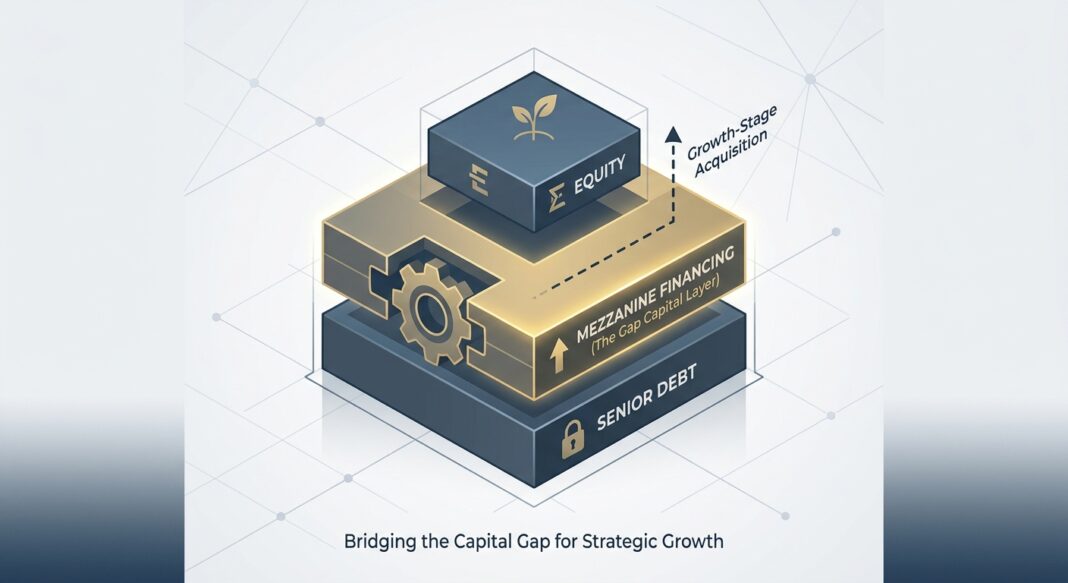
The Gap That Kills Otherwise Fundable Deals
Every growth-stage operator chasing a bolt-on acquisition eventually hits the same wall. The senior lender closes the credit agreement at 3.0x–4.0x EBITDA, the seller wants a clean exit at a full multiple, and the equity check required to bridge the difference would dilute ownership beyond what the deal economics can justify. The math works on a napkin. It does not work at the closing table.
That wall has a name: the capital gap. Between the senior debt ceiling and the equity contribution floor, there is a layer of financing — typically representing 15%–25% of total transaction value — that conventional banks will not underwrite and that institutional equity providers price at 25%–35% implied IRR. At those equity returns, the operator is effectively selling a controlling stake in future value creation to fund a minority acquisition. That trade rarely makes sense.
Mezzanine financing exists specifically to fill this layer. It is subordinated capital — subordinated to the senior lender in both payment priority and collateral position — that prices the risk of that junior position through a combination of a cash-pay coupon, payment-in-kind (PIK) interest, and an equity kicker in the form of warrants or a small co-investment. Understanding how to size, structure, and negotiate the mezz layer is among the highest-leverage skills a growth-stage operator or deal principal can develop in 2026’s bifurcated credit market.
The Capital Stack, Layer by Layer: Components and Mechanics
A well-constructed acquisition capital stack moves from cheapest to most expensive, from most senior to most subordinated. Each layer has a defined cost range, a leverage ceiling, and a structural logic. Here is how the layers interact in a growth-stage acquisition context as of Q3 2026:
Layer 1 — Senior Secured Debt (Bank or Direct Lending)
The cheapest cash-pay layer in the stack. Bank revolvers and term loans typically price at SOFR plus 250–450 basis points for investment-grade or near-investment-grade credits. For middle-market borrowers working with direct lenders, spreads run wider: approximately SOFR plus 480–500 basis points for middle-market direct loans, per Octus FY 2025 Direct Lending Analytics. Sizing depends on business quality and sector, typically reaching 2.5x–4.0x EBITDA before the senior lender hits its leverage wall. Senior lenders hold a first lien on operating assets, control the most restrictive covenant package, and set the leverage ceiling that defines the gap below.
Layer 2 — Mezzanine / Subordinated Debt (The Gap Capital Layer)
Mezzanine sits directly below the senior secured lender and directly above the equity. It is documented as a subordinated promissory note, governed by a subordination agreement that runs in favor of the senior lender. Current 2026 market terms for lower-middle-market mezzanine financing — deals with borrower EBITDA of $3M–$25M — price at roughly 11%–14% cash coupon plus 1%–4% PIK, plus warrant coverage of 1%–5% of fully diluted equity, per GF Data’s 1H 2026 report. The note typically carries a five-to-seven-year bullet maturity with a non-call period of one to two years. The blended cost of capital, inclusive of the equity kicker, runs 15%–18% all-in.
The PIK component is the structural mechanism that makes mezzanine viable for cash-constrained businesses in integration mode. Rather than paying the full coupon in cash every quarter, the PIK portion accrues to the principal balance. A $10M mezz facility at 12% cash plus 3% PIK means the business services $1.2M per year in cash interest while $300K accrues annually to principal — preserving $300K per year in free cash flow for operations, integration costs, or working capital reinvestment.
The equity kicker — most commonly structured as warrants — gives the mezzanine lender the right to purchase a small percentage of the fully diluted equity at a pre-agreed strike price. If the business exits at a strong multiple, warrant proceeds lift the lender’s blended IRR from the coupon range (10%–16%) into the target range (15%–20%), aligning lender and operator incentives around enterprise value creation.
Layer 3 — Seller Note (Optional Bridge Layer)
A seller note at 6%–9% over five years can close an additional $3M–$7M of the gap at a cost below institutional mezz pricing. Sellers who accept a note are effectively co-financing their own purchase price. This layer is negotiated directly and eliminates one institutional counterparty, simplifying the intercreditor structure.
Layer 4 — Equity (Sponsor, Rollover, or Common)
The most expensive layer in dilution terms, sized as the residual after all debt capacity and seller participation have been fully deployed. The central structuring objective is minimizing this layer without overleveraging the business relative to its free cash flow generation.
Worked Example: $50M Enterprise Value Distribution Services Acquisition
Consider a growth-stage operator acquiring a regional distribution business at a $50M enterprise value. The target generates $6.5M in EBITDA. The senior lender is willing to advance 3.5x EBITDA — a $22.75M term loan at SOFR plus 475 bps. A $5M seller note at 8% closes additional proceeds. The remaining $12.25M gap between available debt and the purchase price (net of a $10M equity check) is filled by a mezzanine facility at 12% cash pay / 2.5% PIK / 3% warrant coverage on a six-year bullet. Annual cash interest to the mezz lender: approximately $1.47M. PIK accrual: approximately $306K per year. The equity check drops from a theoretical $27.25M to $10M — and the operator retains 97% of the fully diluted cap table at close, subject only to warrant dilution at exit.
How Mezzanine Compares: Alternatives, Trade-Offs, and When Each Works
Mezzanine vs. Unitranche
A unitranche loan collapses senior and junior debt into a single tranche under one credit agreement, eliminating the intercreditor complexity of a bifurcated stack. Middle-market unitranche spreads run approximately SOFR plus 4.75%–5.50% for deals in the $40M–$100M EBITDA range, per Lincoln International’s Q1 2026 private market data, with all-in rates of 9.5%–11% at typical 5x leverage. The unitranche wins on execution speed and simplicity — one lender, one document, one closing. It loses on cost relative to a well-structured senior-plus-mezz stack when the blended rate comparison is done carefully. On a 50/50 senior/sub split, the traditional senior-plus-mezzanine structure prices 9%–10.5% all-in, only marginally cheaper than unitranche but with materially more execution complexity. For deals below $25M enterprise value, unitranche minimum check sizes of $15M–$25M often do not pencil, making the traditional bifurcated stack the default structure.
Mezzanine vs. Preferred Equity
Preferred equity sits below mezzanine but above common equity, carrying fixed dividend rights and a liquidation preference. It carries no scheduled amortization and no maintenance covenants — a structural advantage for businesses in active integration where near-term EBITDA may be temporarily compressed by one-time costs. A 14% mezzanine facility with quarterly maintenance covenants can be structurally more constraining than a 16% preferred equity instrument with no covenants and no scheduled amortization for a business in exactly that position. The analysis must be holistic: cash-pay burden, PIK accrual, covenant headroom, and warrant dilution evaluated simultaneously against the business’s projected free cash flow trajectory.
Mezzanine vs. Growth Equity
On a $30M enterprise value acquisition, filling a $10M gap with growth equity from a minority investor typically sells 25%–30% of the pro forma company. If the operator projects a 3x exit over five years, the mezzanine route retains roughly $6M–$8M of equity value that would otherwise be transferred to the growth equity provider. The mezzanine route preserves ownership; the equity route eliminates debt service risk. The decision hinges on cash flow predictability and integration confidence.
Current Market Terms and Standards: Q3 2026
The private credit market entered 2026 on a record pace — direct lending issuance reached $74.1 billion across 217 deals in Q1 2026, the strongest quarter in two years, per PitchBook LCD — before slowing materially in Q2 as LBO activity fell alongside macroeconomic uncertainty. That slowdown has recalibrated lender behavior, creating a market defined by bifurcation rather than uniform tightening.
Key data points governing mezzanine and subordinated capital structures in 2026:
- Cash coupon: 11%–14% for lower-middle-market deals ($3M–$25M EBITDA), per GF Data’s 1H 2026 report. GF Data’s median LMM mezzanine coupon was 11.75% cash plus 2% PIK as of mid-2026.
- PIK component: 1%–4% on outstanding principal, compounding annually. The 2026 market standard runs approximately 2% PIK on most sponsored deals.
- Warrant coverage: 1%–5% of fully diluted equity, with the specific percentage inversely correlated to credit quality and cash coupon level. Higher-risk credits pay wider cash coupons and grant smaller warrant packages; lower-risk credits invert the trade-off.
- Covenant design: Full financial maintenance covenant packages — quarterly testing of leverage, fixed charge coverage, and minimum EBITDA — remain standard in the lower middle market. KBRA DLD Research and ABF Journal data confirm that 98% of lower-middle-market loans with borrower EBITDA below $50M retain full financial maintenance covenant packages. This diverges sharply from the broadly syndicated market, where approximately 85% of institutional loans are covenant-lite, relying exclusively on incurrence covenants triggered only by specific borrower actions such as issuing new debt or making an acquisition.
- Market bifurcation in H2 2026: High-quality borrowers continue to attract aggressive lender bids, tight spreads, and covenant-lite terms. Marginal credits face wider spreads, tighter structures, and a materially smaller pool of willing capital providers — a dynamic confirmed by Sikich’s Q2 2026 credit market analysis. Spreads on “down-the-fairway” deals have widened 25–50 basis points since early Q1 as lenders reset terms in a more cautious environment.
- Lower middle market momentum: As M&A and buyout activity for larger borrowers slowed, the lower middle market maintained deal momentum in 2026, providing stable flow for private credit lenders seeking AI-proof investments and wider spreads relative to the large-cap market, per PitchBook analysis.
The Gap Capital Playbook: Quantify, Prepare, Run the Process, Negotiate
Mezzanine financing is not raised passively. It is engineered through a disciplined four-step process.
Step 1: Quantify the Gap Precisely
Build a sources-and-uses schedule that maps every dollar from capital sources to acquisition costs: purchase price, transaction fees, integration reserves, working capital, and debt service coverage buffers for Year 1. The gap is the residual after senior debt capacity (at the lender’s stated leverage ceiling) and any seller participation have been fully deployed. Do not approximate the gap; mezzanine lenders underwrite to a precise number, and vague sizing suggests insufficient deal preparation.
Step 2: Build the Credit Package
Mezzanine lenders underwrite cash flow durability, not asset coverage. The credit package must include: three years of audited or reviewed financials; a detailed trailing-twelve-month income statement with management adjustments; a five-year base-case / downside projection with explicit EBITDA bridge from historical to pro forma; a use-of-proceeds schedule; and a debt service coverage analysis at the proposed leverage level under both scenarios. Customer concentration, contract duration, and revenue quality — recurring vs. transactional — are the first screens applied by any institutional mezz provider.
Step 3: Run a Focused, Competitive Process
Approach three to five lenders simultaneously. Active 2026 mezzanine providers for lower-middle-market acquisitions include Golub Capital, Monroe Capital BDC, Twin Brook Capital, Audax Private Debt, Churchill Asset Management, NewSpring Mezzanine, Peninsula Capital Partners, and Northstar Mezzanine. SBIC-licensed funds including Plexus Capital and Falcon Investment Advisors handle smaller checks down to $2M. Competition between two or three bidding lenders produces meaningful pricing improvement — typically 50–100 basis points on the cash coupon and a reduction in warrant coverage of 1%–2%.
Step 4: Negotiate the Structure, Not Just the Rate
The cash coupon is only one term. Negotiate: (a) the PIK toggle — the right to elect PIK vs. cash pay on a portion of the coupon gives the business meaningful cash flow flexibility during integration; (b) the non-call period — a 12-month vs. 24-month non-call window materially affects refinancing optionality if the business outperforms and senior debt becomes available at lower cost; (c) warrant strike price — a strike set at closing enterprise value vs. a discount to closing value can represent $500K–$2M in economic difference at a typical 3x exit; (d) covenant headroom — negotiate cushion of 20%–30% above the projected financial ratios, not 5%–10%, to avoid trip wires during integration-phase EBITDA dips; and (e) permitted acquisition baskets — the right to make future tuck-in acquisitions without lender consent up to a defined threshold is structurally critical for a growth-through-acquisition strategy.
Key Takeaways
- Mezzanine fills the structural gap that banks won’t touch and equity providers price at 25%–35% IRR. Deployed correctly, it reduces the required equity check by 30%–50% while preserving majority ownership at close.
- Current 2026 pricing is 11%–14% cash coupon plus 1%–4% PIK plus 1%–5% warrant coverage all-in. GF Data’s 1H 2026 median LMM mezz coupon was 11.75% cash plus 2% PIK — roughly 175 basis points wider than the 2021 trough, reflecting the higher-rate environment.
- PIK is a cash flow management tool, not a red flag. Electing PIK on 2%–3% of the coupon preserves $200K–$400K annually per $10M of mezzanine principal — capital that can fund integration costs, working capital, or tuck-in opportunities without increasing equity dilution.
- Covenant design determines real flexibility. The lower middle market retains full maintenance covenants on 98% of loans — a structurally different environment from the broadly syndicated market where 85% of loans are cov-lite. Borrowers should negotiate covenant headroom, not covenant elimination.
- Market bifurcation in H2 2026 rewards preparation. High-quality borrowers with clean financials, predictable free cash flow, and a clear integration plan are still attracting competitive mezz bids. Marginal credits face wider spreads and smaller lender pools. Process quality — how well you quantify the gap and package the credit — is the single largest driver of financing outcome.


