
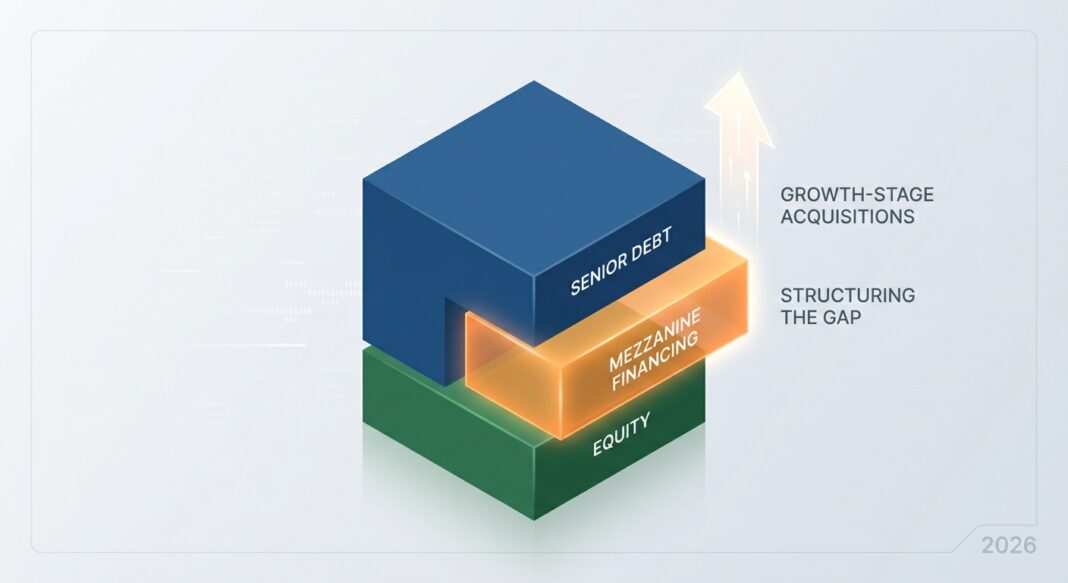
The Growth-Stage Financing Dilemma: When Senior Debt Tops Out and Equity Costs Too Much
Picture a $10 million EBITDA industrial services platform executing its third bolt-on acquisition. The senior lender — a bank or direct lender — will comfortably advance to 3.5x–4.0x EBITDA, funding roughly $35–$40 million of the $80 million purchase price. The equity sponsor or founder can contribute 30–35 percent of the stack, or roughly $24–$28 million. That leaves a gap of $12–$18 million sitting in no-man’s land: too deep in the structure for the senior lender, and too expensive to fill with common equity at a 25–30 percent IRR hurdle.
This is the classic gap-capital problem at the growth stage, and it appears in essentially every leveraged acquisition, partner buyout, or large growth-capex decision where the operator wants to avoid either capping total leverage or surrendering additional ownership. The instrument purpose-built to fill this gap is mezzanine debt — subordinated capital priced above senior debt but well below the cost of equity, typically carrying a cash coupon, a paid-in-kind (PIK) interest toggle, and a small equity warrant kicker that gives the lender a share of exit upside in exchange for accepting a junior lien position.
Understanding when to use mezzanine, how to structure it correctly, and how to negotiate its terms is one of the highest-leverage skills in middle-market deal execution. This article maps every dimension of the structure for 2026 market conditions.
Structure Breakdown: Components, Mechanics, and a Live Term-Sheet Example
Where Mezzanine Sits in the Capital Stack
Mezzanine debt occupies the layer between the senior secured lender and the common equity holder. It is typically unsecured or secured only by a pledge of equity interests in the operating company — never by a first lien on hard assets. Because it ranks behind the senior lender in liquidation, recovery rates in a default scenario run roughly 20–30 percent, compared with 60–80 percent for senior secured debt. That subordination is precisely what commands a higher yield and is why mezzanine lenders demand additional return through PIK interest and equity warrants.
The three core components of a mezzanine instrument are:
- Cash coupon: A contractual interest rate paid quarterly in cash. This is the base yield floor for the lender and the most predictable carrying cost for the borrower.
- PIK interest: Paid-in-kind interest that accrues to the outstanding principal balance instead of being paid in cash. If a mezzanine note carries a 3 percent PIK rate on a $15 million principal, after one year the outstanding balance grows to $15.45 million with no cash leaving the business — preserving liquidity for operations and senior debt service.
- Equity kicker (warrants): Options to purchase a small percentage of the common equity at a nominal strike price, typically $0.01 per share. The warrant converts into real equity proceeds at exit, lifting the lender’s blended IRR from the coupon range into its target return band.
Illustrative Term Sheet: $15M Mezzanine Tranche in a $80M Platform Acquisition
Consider a $10M EBITDA industrial services company acquired for $80M (8.0x EV/EBITDA). The capital stack is structured as follows:
| Layer | Amount | % of Stack | Instrument | Pricing (2026) |
|---|---|---|---|---|
| Senior Secured (Unitranche) | $40M | 50% | First-lien term loan | SOFR + 550 bps (~10%) |
| Mezzanine Debt | $15M | 19% | Subordinated note + warrants | 12% cash + 2% PIK + 3% warrants |
| Sponsor / Founder Equity | $25M | 31% | Common equity | 25–30% target IRR |
Mezzanine Note Terms:
- Principal: $15,000,000
- Cash Coupon: 12.0% per annum, paid quarterly
- PIK Rate: 2.0% per annum, capitalizing to principal (PIK toggle at borrower’s election in years 1–3)
- Maturity: 6 years, bullet repayment
- Call Protection: Non-call 2 years; 103/102/101 step-down thereafter
- Warrant Coverage: Warrants representing 3.0% of fully diluted equity at $0.01 per share strike
- Closing Fee: 2.0% OID (~$300,000)
- Covenants: Maintenance leverage covenant (Total Debt / EBITDA ≤ 6.5x), tested quarterly; minimum liquidity cushion; negative covenant basket on additional indebtedness
- Board Rights: Observer seat; springing voting seat on payment or covenant default
- Subordination: Contractual subordination to senior lender via intercreditor agreement
At the stated terms, the mezzanine lender’s blended IRR — assuming a 5-year exit at the same 8.0x multiple — would land in the 15–18% range, consistent with fund-level target returns. The borrower’s all-in blended cost of capital across the full stack drops materially below the ~25–30% cost of filling that $15M gap with common equity.
How Mezzanine Compares: Unitranche, Preferred Equity, and Growth Equity
Mezzanine does not operate in a vacuum. Three alternatives compete for the same gap in the capital stack, each with distinct trade-offs:
1. Unitranche (Stretch Senior)
A unitranche collapses senior and junior debt into a single instrument with a blended rate. It is faster to execute and carries a single covenant package, but it prices its junior-risk component directly into the blended spread. Current unitranche spreads sit at SOFR + 500–750 basis points for LMM transactions, producing all-in yields of roughly 9–12% — meaningfully cheaper than mezzanine, but available only to borrowers whose leverage needs stay within the unitranche lender’s comfort zone (typically 4.5–5.5x EBITDA). When an operator needs to push above that ceiling, the senior lender will not follow, and mezzanine becomes necessary.
2. Preferred Equity
Preferred equity sits below all debt but above common in the waterfall, carrying a fixed dividend (cash or PIK) and a liquidation preference. It carries no covenant default risk (there is no debt agreement to breach), but its cost is typically 10–14% in dividends plus meaningful dilution on conversion. Operators reaching for preferred instead of mezzanine are often trading covenant risk for dilution risk — a rational trade when cash flow visibility is low but ownership preservation matters.
3. Minority Growth Equity
Growth equity solves the gap problem through outright dilution, targeting 25–35% IRR with a board seat and consent rights. For an operator who values a strategic partner or is building toward a broader institutional process, equity capital brings operational bandwidth alongside the capital. But the dilution cost — often 20–40% of common equity — is dramatically more expensive than mezzanine on a per-dollar basis when the business generates reliable cash flow to service debt.
The decision rule is straightforward: when the business generates predictable, recurring EBITDA sufficient to service a 12–15% blended coupon, mezzanine preserves more ownership at lower total cost than equity. When cash flow is lumpy, early-stage, or dependent on a single growth bet, equity’s absence of fixed charges is worth the dilution.
Current Market Terms: What Mezzanine Looks Like in Mid-2026
The mezzanine market for lower-middle-market (LMM) transactions has recalibrated since the rate cycle peak. Key data points for H1–H2 2026:
- Cash coupon: According to GF Data’s 1H 2026 report (cited by CT Acquisitions), mezzanine for LMM business acquisitions prices at 10–12% cash coupon at the term sheet stage, with a market midpoint near 11%.
- PIK component: The 2026 market standard PIK component sits near 2% per annum, with aggressive deals clearing at 1% PIK and conservative structures reaching 3% elective PIK. PIK toggles — where the borrower elects cash or PIK quarterly — remain common in sponsor-backed transactions.
- All-in blended cost: The total blended cost of mezzanine capital, including cash coupon, PIK, and warrant dilution, runs 12–15% all-in for LMM transactions in 2026, consistent with mezzanine fund target IRRs of 15–20%.
- Warrant coverage: Warrant kickers representing 1–5% of the fully diluted cap table are standard in LMM mezzanine deals. Sponsor-backed transactions with cleaner governance structures tend to land at the lower end (1–3%), while founder-direct deals or higher-risk credits absorb 3–5%.
- Leverage context: Senior lenders in 2026 will generally advance to 4.5–6.0x EBITDA before requiring mezzanine to fill additional capacity, with mezzanine itself typically funding 10–20% of the total acquisition capital stack — the incremental 1.0–1.5x of leverage above the senior limit.
- Covenant structure: Mezzanine loans carry maintenance covenants tested quarterly — typically a total leverage ratio — with a 30-day cure window and limited equity cure rights (generally 1–2 cures per year). This stands in contrast to broadly syndicated loans, where covenant-lite incurrence-based packages dominate. In private mezzanine markets, maintenance covenants remain the norm, providing the fund with a meaningful early-warning trigger.
- Typical tranche size: LMM mezzanine tranches run $5M–$75M, with SBIC-licensed funds able to write checks as small as $2M for the lower end of the market.
The Gap-Capital Playbook: Quantifying, Preparing, and Running the Mezzanine Process
Step 1 — Quantify the Gap (Week 1–2)
Begin by stress-testing the capital stack from both ends. Confirm the maximum senior advance rate with your lead lender (typically expressed as a leverage multiple against trailing-twelve-month EBITDA). Then set the equity contribution floor — the minimum common equity you are willing to commit or the maximum dilution you can accept from a co-investor. The difference between total deal value, senior capacity, and equity contribution is your mezzanine need. Stress-test the debt-service coverage: at 12% cash coupon on the mezzanine tranche plus senior service, does the business generate at least 1.20x DSCR on a base-case year-two projection? If not, a higher PIK component or a different capital structure is warranted before going to market.
Step 2 — Prepare the Diligence Package (Week 2–4)
Mezzanine lenders are underwriting subordinated credit risk, which means they scrutinize free cash flow durability more intensely than senior lenders do. Your package must include: (a) three years of audited or reviewed financials with a quality-of-earnings summary, (b) a detailed 3-year operating model with EBITDA bridge and capex schedule, (c) customer concentration analysis, (d) a clear use-of-proceeds narrative tying the mezzanine tranche to a specific value-creation lever (acquisition, capacity expansion, technology investment), and (e) a cap table showing the warrant dilution impact at projected exit multiples. Mezzanine funds want to see the exit story — they are equity-return-oriented, not just credit-return-oriented.
Step 3 — Run a Focused Process (Week 4–8)
Unlike syndicated loan processes, mezzanine is a private, relationship-driven market. Run a focused process contacting 6–10 dedicated mezzanine funds and SBIC platforms simultaneously, not a broad shotgun blast. Provide a 2–3 page deal summary first; follow with full CIM only to credible respondents. LMM-focused platforms — including Audax Mezzanine, Northstar Capital, Falcon Investment Advisors, Monroe Capital, and NewSpring Mezzanine — will typically respond with an indication of interest within 2–3 weeks. Evaluate term sheets on four dimensions: (1) cash coupon versus PIK split, (2) warrant coverage and anti-dilution mechanic, (3) covenant tightness (leverage covenant headroom, cure rights), and (4) board rights on default.
Step 4 — Third-Party Diligence and Documentation (Week 8–12)
Upon selecting a lead mezzanine lender, expect a Quality of Earnings review, legal diligence, and sometimes an insurance or IT assessment. Any material QoE adjustment to EBITDA will trigger a repricing negotiation — build in a 5–10% EBITDA haircut buffer in your advance-rate assumptions. Documentation involves a subordinated note, warrant agreement, and intercreditor/subordination agreement with the senior lender. The intercreditor agreement is the most negotiated document in the package: it governs standstill periods, cure rights, and the senior lender’s ability to enforce remedies before the mezzanine lender can act.
Negotiation Guidance: Five Leverage Points for Borrowers
For Operators and Borrowers
- Negotiate the PIK toggle aggressively. A fully elective PIK toggle in years 1–3 preserves maximum cash flexibility in the early post-close integration window, when surprises are most likely. Push for borrower election (not lender election) on the PIK mechanism.
- Cap warrant coverage and negotiate anti-dilution terms. The difference between a narrow-based ratchet (bad for borrowers) and a broad-based weighted-average adjustment (standard and acceptable) is meaningful in a scenario where you raise additional equity before exit. Insist on broad-based weighted average as a hard floor in any warrant agreement.
- Build covenant headroom — not just on entry, but through the model. A maintenance leverage covenant set at 6.5x Total Debt / EBITDA may appear comfortable at close, but after a difficult quarter or an integration delay, headroom disappears fast. Negotiate for 20–25% of cushion above your base-case leverage peak. Push hard on the definition of EBITDA in the covenant: addbacks for non-recurring items, one-time charges, and future run-rate savings from completed acquisitions are all negotiable and can materially widen headroom.
- Limit cure frequency, but secure flexibility. Mezzanine funds have tightened equity cure limits in 2024–2026 in response to cure-abuse patterns. Standard terms now allow 1–2 cures per year with no more than 4 over the life of the instrument. Accept these limits, but negotiate broad cure mechanics — shareholder loans, not just equity injections — to preserve flexibility on how the cure is funded.
- Negotiate the springing board seat trigger carefully. Most mezzanine lenders take a non-voting observer seat at closing. The risk is a springing voting seat triggered by a covenant default or payment default. Negotiate a reasonable cure period — at least 30 days after written notice — before the springing seat activates, giving the company time to remedy a technical breach before control dynamics shift at the board level.
For Investors and Lenders Evaluating the Structure
When reviewing a mezzanine investment opportunity, the equity warrant is not a bonus — it is the structural explanation for why the fund accepts subordinated, uncollateralized risk at below-equity pricing. Underwrite the warrant as if it were a real equity position: model exit multiples, dilution scenarios, and anti-dilution mechanics before committing to headline coupon. Covenant headroom analysis matters more at mezzanine than at senior, because the first default signal you receive may be a quarterly leverage test rather than a missed payment. Monitor it actively.
Key Takeaways
- Mezzanine fills a structural gap, not just a pricing gap. It exists because senior lenders will not advance past 4.5–6.0x EBITDA in most 2026 LMM transactions, and common equity carries a 25–30% IRR cost that destroys returns on reliable cash-flowing businesses. Mezzanine at 12–15% all-in is the arithmetically correct answer in that space.
- PIK interest is a cash-flow tool, not a red flag. A PIK toggle preserves liquidity in integration-heavy post-close periods. The key discipline is ensuring the PIK accrual does not compound the leverage ratio above covenant thresholds by year 2 or 3 — model this scenario explicitly before accepting PIK terms.
- Warrant dilution is real but bounded. A 2–3% warrant kicker at a 5–6x exit multiple represents a meaningful dollar amount. Negotiate the anti-dilution mechanic (broad-based weighted average), model the dilution at multiple exit scenarios, and ensure the economics still work for equity holders before accepting warrant terms.
- Maintenance covenants in mezzanine are a feature, not a bug — if headroom is right. Unlike incurrence-based covenants in broadly syndicated loans, maintenance covenants in mezzanine notes are tested quarterly and provide real early-warning signals. Borrowers who negotiate adequate headroom (20–25% cushion above peak projected leverage) can live comfortably with maintenance covenants while still benefiting from their operational flexibility.
- Run a focused, structured process. The mezzanine market is private and relationship-driven. A 6–10 fund process with a crisp CIM and clear use-of-proceeds narrative will produce better terms than a broad blast. The difference between the best and median mezzanine term sheets on a $15M tranche can represent $300,000–$600,000 in closing fees, 50–100 bps in coupon, and 1–2% in warrant coverage — all negotiable with the right preparation and process.


