
The Capital Gap Every Growth-Stage Acquirer Hits
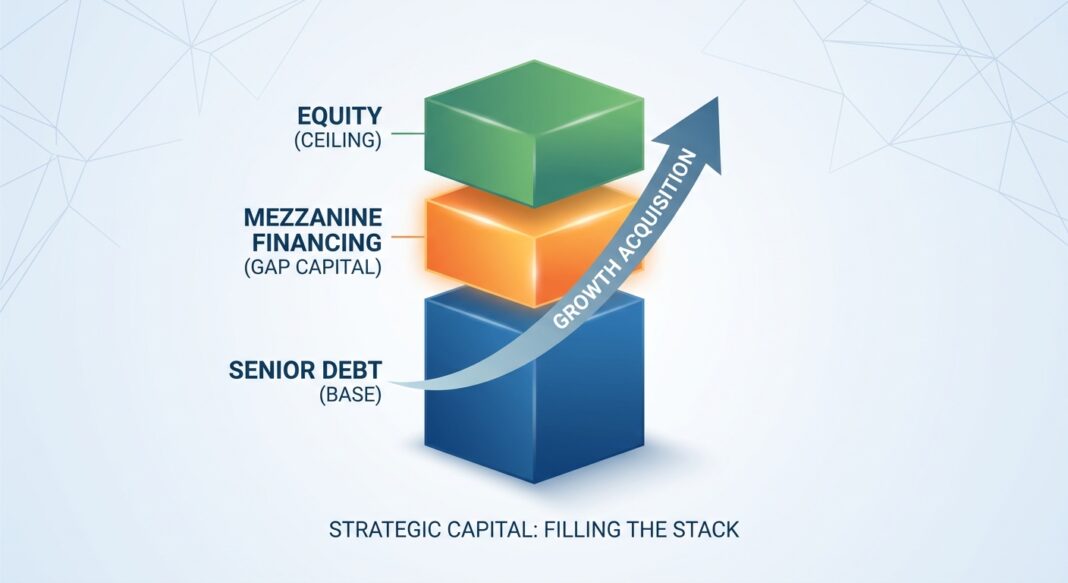
A growth-stage operator has found a bolt-on acquisition: a $35M enterprise value business with $5M in EBITDA. The business case is clean. The purchase price is fair. The problem is the math. The operator’s community bank will lend to 3.0x–3.5x EBITDA — call it $15M to $17.5M. Sponsor equity is capped at what the operator is willing to dilute. That leaves a $10M–$12M funding gap sitting between the senior debt ceiling and the equity floor.
This is the moment mezzanine financing was designed for. Mezzanine financing is subordinated capital that fills the gap between senior debt and the owner’s equity, adding leverage without giving up ownership. It is not cheap capital — but it is precise capital. For a growth-stage acquirer who has already proven a business model and wants to fund scale through acquisition without handing over a board majority, mezzanine is often the most rational tool in the stack.
This article maps the full structure: how mezzanine financing is built, what it costs in 2026, where it sits versus alternatives on the cost-of-capital spectrum, and how operators should run the process from quantifying the gap to closing the deal.
Structure Breakdown: Components, Mechanics, and a Worked Example
Mezzanine debt occupies the second layer of a leveraged capital stack, directly behind senior secured debt and ahead of common equity. Its structural defining features are three: subordination, PIK optionality, and an equity kicker.
Subordination
Mezzanine financing for business acquisition is subordinated debt, usually with equity warrants attached, that funds a portion of a buyout between the senior secured loan and the equity check. In a default scenario, mezzanine lenders are repaid only after the senior lender has recovered in full. That structural risk is why the instrument prices materially higher than senior debt.
PIK Interest (Payment-in-Kind)
PIK interest is paid by increasing the outstanding principal balance of the debt rather than making cash payments. For example, a $100 million note with 5% PIK interest grows to $105 million after one year. The interest compounds each period, so the total payoff at maturity is higher than the original principal. This preserves the company’s cash flow for operations and senior debt service. For growth-stage companies whose free cash flow is already deployed toward organic expansion or integration of the acquired business, this deferral mechanism is operationally critical.
Equity Kicker (Warrant Coverage)
Equity kickers are warrants or options attached to mezzanine debt that give the lender the right to purchase equity in the company, typically at a nominal strike price. The warrant usually entitles the lender to 1–5% of equity on a fully diluted basis. If the company exits at a high multiple, the warrants convert into meaningful equity proceeds, lifting the lender’s blended IRR from the coupon range (10%–16%) into the target range (15%–20%).
Worked Example: A $35M Acquisition at 7x EBITDA
Consider a growth-stage professional services platform acquiring a $35M EV target generating $5M EBITDA. The capital stack is engineered as follows:
| Layer | Amount | Leverage Turn | Pricing | Structure |
|---|---|---|---|---|
| Senior Term Loan (Bank) | $17.5M | 3.5x EBITDA | SOFR + 350 bps (~7.2%) | Amortizing, 5-year, maintenance covenants |
| Mezzanine Debt | $10M | 2.0x EBITDA (gap) | 11% cash + 2% PIK; warrants for 3% fully diluted equity | 7-year bullet, interest only, 3-year non-call |
| Sponsor Equity | $7.5M | — | Target 25%+ IRR | Common equity |
The mezzanine tranche fills exactly the gap the senior bank cannot reach. GF Data’s 1H 2026 report puts the median LMM mezzanine coupon at 11.75% cash plus 2% PIK, roughly 175 basis points wider than the 2021 trough of 10.0% cash. In this example, the borrower keeps the equity check at $7.5M instead of $17.5M — the difference is the leveraged return on that $10M gap.
The Cost-of-Capital Spectrum: From Banks to Equity
No financing decision exists in isolation. Mezzanine only makes sense when modeled against every other option available at the same leverage need. Here is the 2026 spectrum for a growth-stage LMM acquirer:
1. Senior Bank Debt — Cheapest, Most Constrained
Community and regional banks typically lend 2.5x–3.5x EBITDA for acquisition transactions, secured by all business assets. Pricing runs Prime + 1% to Prime + 2.5%, with full amortization and quarterly maintenance covenant testing. This is the lowest-cost capital available — but it caps out well below what most acquisition financings require.
2. Unitranche / Direct Lending — Mid-Tier Speed and Leverage
The dominant LMM structure in 2026 is a first-lien unitranche of 3.5x to 4.5x EBITDA, six-year tenor, one percent annual amortization, one leverage covenant, and a fixed charge coverage covenant, priced at SOFR plus 525 basis points on average per Lincoln International Q2 2026 data. Unitranche collapses senior and junior debt into a single instrument, trading a modest pricing premium for execution simplicity. Unitranche financing can close in 45–90 days versus 90–150 days for traditional senior-plus-mezzanine syndication, which matters most for buyers running roll-up platforms with frequent add-ons.
3. Mezzanine / Subordinated Debt — High Cost, High Flexibility
All-in cost in 2026 runs 12% to 15%, split among 10% to 12% cash coupon, 1% to 3% PIK, and 1% to 2% warrant coverage per GF Data’s 1H 2026 report. Mezzanine is expensive relative to senior debt, but compared to a dilutive equity round it can be significantly cheaper on a total-value basis. At a total IRR of 16–22% including the equity component, mezz is expensive — but it avoids the permanent dilution of a priced equity round.
4. Growth Equity — Most Expensive on a Dilution Basis
Growth equity minority checks typically demand 15%–30% dilution with board seats, protective provisions, and a preferred return structure. LMM growth capital raises in 2024, 2025, and 2026 have increasingly stacked minority equity with a senior credit facility and sometimes a mezzanine layer to keep dilution below 30% while still funding the acquisition or growth plan. The layered approach — senior + mezz + minority equity — is now the standard architecture for growth-stage acquisitions above $20M.
When Mezzanine Beats Unitranche
The unitranche is the right call when speed and single-lender simplicity matter more than cost precision and maximum leverage. Mezzanine wins when the deal requires leverage above 4.5x EBITDA, when the borrower has a strong bank relationship they want to preserve in the senior tranche, or when near-term cash flows are constrained and the PIK toggle provides essential liquidity relief. On a 50/50 senior/sub split, the traditional structure prices 9–10.5% all-in — only marginally cheaper than unitranche, with materially more execution complexity — making the senior/mezz split most defensible in larger transactions where the cost savings are material in absolute dollar terms.
Current Market Terms and Standards (Q3–Q4 2026)
Mezzanine terms in the lower middle market have stabilized since the rate peaks of 2023–2024, but remain materially wider than the pre-2022 era. Operators and advisors should benchmark against the following current market data points:
- All-in Cost: Mezzanine financing for business acquisition costs 12% to 15% all-in in 2026, comprising a 10% to 12% cash coupon, 1% to 3% PIK interest, 1% to 2% warrant coverage, and a 2% to 3% origination fee.
- Tranche Sizing: Typical LMM tranche size runs $5M to $75M, with SBIC-licensed funds like Plexus Capital and Falcon Investment Advisors handling smaller checks down to $2M.
- Target IRR for Lenders: Check sizes range from $2M at the SBIC end to $75M at the institutional end, with target IRRs of 15% to 20% blending cash coupon, PIK, and warrants.
- Maturity and Call Protection: Common mezzanine note structures include a five-to-seven-year bullet maturity, a one-to-two-year non-call period, and step-down call premiums thereafter.
- Covenant Package: Unlike senior bank loans, which carry quarterly maintenance tests, mezzanine instruments typically run incurrence-based covenants. Covenant-lite loans provide borrower companies more freedom to negatively impact lenders because their covenants are incurrence-based, meaning they are only tested and can only be breached following an affirmative action of the borrower, rather than by a deterioration in the borrower’s financial condition. This matters enormously for growth-stage borrowers navigating post-acquisition integration periods where EBITDA may temporarily compress.
- PIK Market Standard: The 2026 market standard PIK is 2%, with aggressive lenders willing to accept 1% PIK and conservative structures running to 3% elective PIK. Borrowers should push hard to make PIK optional (toggle) rather than mandatory.
Direct lending spreads to growth-stage borrowers compressed 175 basis points from Q1 2024 peaks, with median all-in coupons on unitranche facilities in the $5M–$50M band now clearing at 10.2% per S&P LCD US Loan Comparable, June 2026. The compression in unitranche pricing has narrowed the all-in cost differential between unitranche and senior/mezz splits, making structural simplicity a stronger argument for the unitranche in deals under $50M.
The Gap Capital Playbook: Quantify, Prepare, Run the Process, Close
Running a mezzanine raise for acquisition financing is a four-phase process. Operators who treat it as an ad hoc exercise leave price on the table; those who run it as a competitive, structured process routinely achieve tighter pricing and better structural terms.
Phase 1 — Quantify the Gap
Before approaching any lender, the operator must know the exact capital gap with precision. Start with the purchase price plus closing costs. Subtract what the senior bank will commit at its stated leverage multiple and what the operator is prepared to inject in equity. The delta is the mezzanine need. Model three scenarios — base, downside, and upside — and stress the mezzanine coverage ratio in the downside case. If the business cannot service the full cash coupon under the downside scenario, the PIK percentage must increase to compensate.
Phase 2 — Build the Materials Package
The buyer-side package includes entity formation documents for the acquisition vehicle, sources and uses reconciled to the purchase price and closing costs, five-year projections with base, downside, and upside cases, sponsor and management team biographies including relevant transaction and operating history, equity commitment letters signed by each co-invest partner with amount and pro-rata, and evidence of good standing for each entity in the closing structure. For mezzanine specifically, add a collateral summary and a clear articulation of the intercreditor relationship with the senior lender.
Phase 3 — Run a Competitive Lender Process
A competitive lender process run through an experienced advisor will typically produce 4 to 8 written term sheets and 25 to 75 basis points of spread compression versus a self-run inbound loop with 1 or 2 lenders. Target 12–18 mezzanine sources across three categories: SBIC funds for smaller tranches ($2M–$10M), institutional mezzanine managers for mid-market checks ($10M–$50M), and BDCs or direct lenders willing to hold the full mezz tranche alongside a co-underwritten senior piece. Signing 30-day exclusivity before term sheets are compared and negotiated hands the lender leverage. The correct sequence is: term sheet negotiation, mutual selection, then exclusivity.
Phase 4 — Stage the Capital Draw
Negotiate unfunded delayed-draw capacity into the mezzanine facility wherever possible. A $10M committed facility with $7M drawn at close and $3M available as a delayed-draw for integration capital or a near-term add-on is significantly more valuable than a fully funded bullet. The market is accommodating this request more frequently in 2026 as direct lenders compete for quality credits.
Negotiation Guidance: What to Push For and Where to Concede
For Operators and Borrowers
The five highest-value negotiation points in a mezzanine term sheet, ranked by impact:
- Make PIK Optional (Toggle), Not Mandatory. A mandatory PIK that compounds into a balloon at maturity creates a predictable refinancing cliff. Push for a PIK toggle that lets management elect PIK or cash quarterly, preserving optionality for profitable periods.
- Minimize Warrant Coverage and Negotiate the Cap. Warrants are permanent dilution. Push the coverage percentage below 2% and insist on a buy-back right triggered by a full repayment event, giving the company the ability to retire the warrant at a pre-agreed formula price before a liquidity event.
- Negotiate Incurrence-Only Covenants. Maintenance covenants in a mezzanine instrument are largely unnecessary given the senior bank already holds the maintenance package. An incurrence covenant is tested only when the borrower takes a specific action — incurring new debt, paying a dividend, making an acquisition. Maintenance is a trip wire; incurrence is a gate. Incurrence-only covenants give the operator maximum operational flexibility during integration.
- Negotiate the Non-Call Period Down. Lenders push for a three-year non-call period. Operators with clear line-of-sight to refinancing or exit within 24–36 months should push the non-call to 18 months, accepting a modest spread premium in exchange.
- Secure Pre-Agreed Incremental Capacity. In a roll-up strategy, negotiate an accordion or incremental basket into the credit agreement at close. Pre-agreed mechanics for additional mezzanine draws at the same pricing eliminate the need to re-run the full process for every add-on.
For Investors and Capital Allocators
When reviewing a mezzanine tranche as a lender or co-investor, prioritize three structural screens: (1) verify the intercreditor agreement with the senior lender explicitly defines mezzanine standstill rights and purchase option mechanics — ambiguity here is the primary source of workout complexity; (2) stress-test the PIK compounding at the stated percentage against a flat-EBITDA scenario to determine whether the bullet maturity is serviceable without a forced exit; and (3) confirm that warrant coverage is tied to the post-money cap table at the time of closing, not subject to anti-dilution ratchets that could expand the warrant percentage in a down-round scenario.
Key Takeaways
- Mezzanine is a gap-filling instrument, not a primary debt layer. It is engineered for the specific leverage range between a senior lender’s ceiling (typically 3.0x–4.0x EBITDA from banks) and the total leverage needed for an acquisition-financed growth strategy (5.0x–6.0x), filling that gap at 12%–15% all-in in 2026.
- The true cost comparison is dilution-adjusted. At 1%–3% warrant coverage versus 15%–30% dilution in a growth equity round, mezzanine frequently wins the cost-of-capital comparison for operators who are confident in the business’s trajectory to a high-multiple exit.
- PIK toggle is the most operator-friendly structural feature. The ability to elect cash or PIK interest quarterly allows management to preserve cash during integration and optimize debt service during periods of peak operational investment — insist on toggle rather than mandatory PIK.
- Running a competitive process is non-negotiable. A structured outreach to 12–18 mezzanine sources produces 4–8 term sheets and consistently delivers 25–75 basis points of spread compression versus a bilateral negotiation, a material economic difference on a $10M+ tranche over a seven-year hold.
- The covenant package matters as much as the coupon. Incurrence-based covenants in the mezzanine layer — as opposed to quarterly maintenance tests — give the borrower the operational room to execute integration, tolerate a transient EBITDA dip, and pursue further acquisitions without triggering a technical default that hands leverage to the lender at the wrong moment.


