
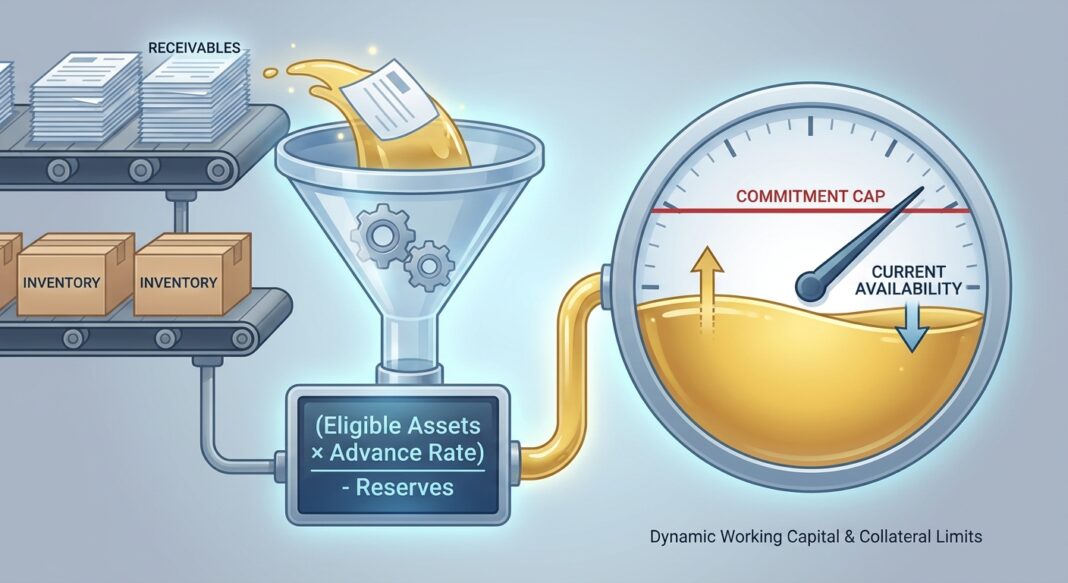
Borrowing-base availability: the collateral limit that moves with the business
A borrowing base turns a company’s eligible assets into a revolving credit limit. Instead of sizing debt only against earnings, the lender applies advance rates to specified collateral, usually accounts receivable and inventory, then subtracts reserves. As invoices are collected, new invoices are generated, or inventory is sold and replenished, the amount available to draw changes.
This structure matters when a business has valuable working assets but uneven cash flow. A distributor may need to pay suppliers weeks before retailers pay invoices. A manufacturer may have cash tied up in raw materials and finished goods. A borrowing-base facility can bridge that timing gap, but it does not lend against every dollar shown on the balance sheet. Eligibility rules and lender haircuts determine what counts.
For investors, the formula connects collateral quality to repayment capacity. For operators, it explains why a stated facility size is not the same as cash available today. The central question is not simply how much collateral exists, but how much remains eligible after the lender applies its rules and stress controls.
The concept: commitment, borrowing base, and availability
An asset-based loan, or ABL, is a secured facility whose borrowing capacity is tied to identified assets. A borrowing base is the lender’s calculation of the maximum amount supported by eligible collateral. The facility commitment sets a separate contractual ceiling. At any point, the borrower’s permitted balance is generally limited by the lower of the commitment and borrowing base, subject to the agreement’s terms.
A simplified formula is: eligible receivables multiplied by their advance rate, plus eligible inventory multiplied by its advance rate, less reserves. Eligible means the asset meets negotiated conditions. A past-due or disputed invoice, a receivable from an affiliate, or an invoice concentrated in one customer may be excluded or discounted. Inventory can be reduced for obsolescence, work in process, or weak liquidation value. A reserve is an additional deduction for risks such as unpaid taxes, freight, or collateral shortfalls.
The lender typically requires periodic borrowing-base certificates, receivables aging reports, inventory schedules, and collateral examinations. The OCC’s Asset-Based Lending Comptroller’s Handbook identifies eligibility, advance rates, reserves, reporting frequency, dilution, and collateral quality as core underwriting and monitoring considerations. Cash collected on invoices can repay the revolver; when eligible assets are replenished, availability can rise again.
That makes the borrowing base a working limit, not a permanent promise of liquidity. If eligible collateral falls below the outstanding loan balance, the borrower may face a deficiency and must address it under the credit agreement.
How it works: an illustrative borrowing-base calculation
Consider a hypothetical wholesaler with a $5 million revolving commitment. Its ledger shows $5.2 million in receivables, but $1.2 million is excluded because the invoices are disputed, too old, or otherwise ineligible. The remaining $4 million qualifies at an illustrative 85% advance rate, producing $3.4 million of receivables availability.
The company also has $3 million of inventory on its books. After excluding $500,000 of obsolete or otherwise ineligible goods, $2.5 million remains. At an illustrative 50% inventory advance rate, that contributes $1.25 million. The two components total $4.65 million. After a $250,000 reserve, the borrowing base is $4.4 million.
The $5 million commitment does not override that result. With $2.9 million already drawn, the company has $1.5 million of current availability: $4.4 million of borrowing-base capacity less the outstanding balance. It cannot draw the unused $2.1 million of commitment because the borrowing base is the tighter limit. These advance rates and amounts are hypothetical, not a statement of prevailing market terms.
Now assume customer payments reduce eligible receivables by $600,000, and the company does not replace those invoices with new qualifying sales. At an 85% advance rate, the borrowing base falls by $510,000 before considering other adjustments. If the company has already drawn near its limit, an ordinary collection cycle can create a liquidity squeeze. A lender may also reduce availability if customer concentration, disputes, returns, or inventory values deteriorate.
Current market relevance
Recent indicators show why collateral-backed liquidity deserves careful analysis, while not proving that ABL availability is rising or falling. The Federal Reserve’s October 2026 SLOOS, released November 2 and covering third-quarter changes, found that 88.3% of responding banks reported unchanged C&I standards for large and middle-market firms; 6.7% reported tightening. For the maximum size of C&I credit lines to those firms, 85.0% said terms were unchanged over the quarter. These are broad bank-loan responses, not a measure of private ABL approval standards.
Private credit supply and borrower demand are also uneven. PitchBook’s November 6, 2026 U.S. Private Credit Monitor said direct-lending volume had edged higher over the prior three months but remained behind the prior year’s pace year to date; buyout financing was at its lowest level since 2020. PitchBook also reported direct-lending spreads widening while syndicated-loan spreads tightened. That divergence makes it important to compare total financing cost and flexibility, not just headline interest rates.
Preqin’s November 8, 2026 Q3 update reported $185 billion of private-credit fundraising through Q3, equal to 95% of full-year 2025 fundraising, while 79% of surveyed LPs planned to commit to only one private-credit fund over the next 12 months. Separately, Goldman Sachs Alternatives’ 2026 LP survey found 56% of respondents under-allocated to private credit, based on a survey conducted from June through August 2026. Taken together, these figures show available investor capital alongside selectivity. They do not establish that a particular borrower can obtain a favorable advance rate.
Decision framework for investors and operators
For investors evaluating a lender or facility, start with collateral conversion, not accounting value. Review how the agreement defines eligible receivables and inventory, and whether advance rates reflect collection history and liquidation value. Test customer concentrations, aging, dilution from returns and credits, and inventory obsolescence. Then examine reporting cadence, field-exam rights, cash dominion or lockbox arrangements, reserves, and the remedy for a borrowing-base deficiency. A large stated commitment offers little protection if reporting is weak or collateral quality can deteriorate faster than monitoring detects it.
For operators comparing financing structures, an ABL can fit a company whose funding need rises and falls with receivables or inventory. It can be less suitable when the primary need is permanent capital for acquisitions, losses, or long-lived investment, because working-capital collateral may not support those uses reliably. Compare interest and unused-line fees with audit, reporting, and collateral-control costs. Model a downside case in which collections slow, inventory is marked down, and customers become more concentrated. A forecast should show not only the expected borrowing base, but also the minimum availability the business needs to meet payroll and supplier terms.
Key takeaways
- Availability is not the commitment. The borrowing base can cap draws below the facility maximum.
- Eligibility drives proceeds. Invoices and inventory on a balance sheet may not qualify at full value.
- Collateral is dynamic. Collections, sales, returns, disputes, and obsolescence can change capacity quickly.
- Monitoring is part of the credit. Certificates, audits, and cash controls help lenders detect shortfalls.
- Match the structure to the use. Borrowing-base debt fits working-capital cycles better than permanent funding needs.


