
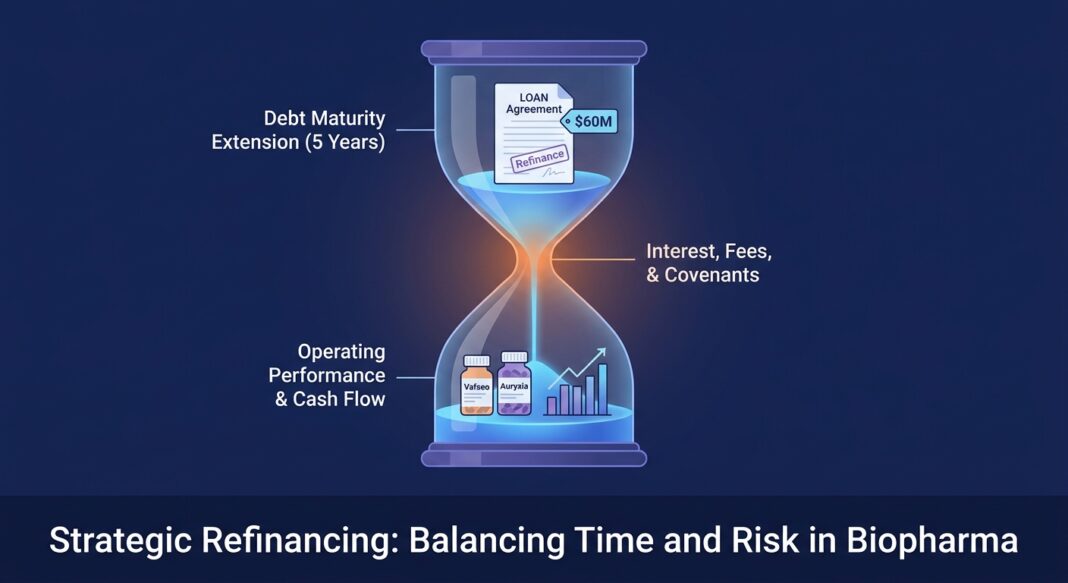
The Story
On November 12, 2026, Akebia Therapeutics replaced a $55 million secured term loan with a new $60 million facility from healthcare lender Symbiotic Capital. On paper, that looks like a modest refinancing. The business context makes it a more revealing capital decision: Akebia was funding a commercial kidney-disease portfolio and developing new treatments while its revenue mix faced pressure.
Akebia sells Vafseo, a treatment for anemia due to chronic kidney disease, and Auryxia, another kidney-disease medicine. For the third quarter of 2026, revenue was $36.9 million, down from $58.8 million in the year-earlier quarter. Vafseo generated $14.8 million, while Auryxia generated $20.0 million, down from $42.5 million a year earlier amid generic competition and pricing pressure. Akebia reported a $14.4 million net loss. As of September 30, cash and cash equivalents were $159.3 million.
The calendar mattered. Akebia’s prior loan was due to be refinanced, and its latest quarterly filing said that cash and expected revenue could fund the operating plan for at least 12 months, but that refinancing on favorable terms was not assured. Nine days after the quarter closed, the company completed the new loan. This was not a founder choosing between venture capital and a lender. It was a public biopharma company choosing how to replace secured debt without raising a large block of common equity at that moment. The distinction matters: leverage can defer dilution, but it cannot erase operating risk.
Akebia’s November 5, 2026 third-quarter release and its Form 10-Q for the quarter ended September 30 set out the operating picture.
The Decision
Akebia’s broad alternatives were to refinance with another lender, sell new shares, or attempt to manage the existing loan and cash needs through operating cash and other financing sources. The company chose a senior secured term loan with a five-year maturity. Symbiotic funded $60 million at close. Up to another $80 million is available only at the lender’s discretion, so it is not committed capital that Akebia can assume it will receive.
The mechanics are important. After estimated fees and expenses, Akebia reported net proceeds of approximately $58.6 million. It used the proceeds to repay the prior $55 million Kreos facility, managed by BlackRock, plus customary termination fees and other expenses. The transaction therefore primarily replaced an existing obligation and extended its maturity to November 12, 2031. It did not put $60 million of unrestricted growth capital into the company’s hands.
The new loan has no scheduled principal amortization. Interest accrues at the greater of 11.5% or the Wall Street Journal prime rate plus 4.5%, subject to a 15% cap. That structure preserves near-term cash otherwise used for amortization, but it leaves principal due at maturity and makes cash interest a substantial recurring obligation. Early repayment can also trigger a 1% to 3% premium before November 12, 2030, an additional make-whole payment for certain early repayments on or before August 12, 2029, and a 3.25% exit fee on principal and capitalized PIK interest repaid.
Nor is the facility wholly equity-free. Symbiotic affiliates received warrants to buy 3,441,352 common shares at $0.6974 per share. If the discretionary tranches are funded, additional warrant coverage applies. The company avoided an immediate large common-stock issuance to finance the refinancing, while granting the lender potential equity participation. Akebia’s November 12 Form 8-K details the security package, fees, warrants and covenants.
The Outcome
At publication, the facility had been closed only days earlier. There is no multi-quarter operating result from which to call the financing a success. The measurable outcome so far is narrower: Akebia repaid the previous $55 million loan, obtained a new five-year maturity, and kept the refinancing from taking the form of an immediate large common-equity raise. The company said it reaffirmed its expectation that cash and anticipated product, royalty, supply and license revenue would support its current operating plan for at least two years.
That runway statement is management’s forecast, not a lender guarantee or a realized result. The operating test remains whether cash from products and other sources can sustain expenses and service the loan. In Q3, total revenue fell year over year, Auryxia sales faced generic pressure, and Vafseo’s quarterly revenue was affected by inventory reduction at its largest customer. The credit agreement also imposes minimum-cash and revenue covenants, including a separate minimum tied to Vafseo. If performance misses those thresholds, the lender has contractual remedies, including acceleration after an event of default.
The equity counterfactual cannot be assigned a defensible share count without specifying an issue price and transaction size. An equity raise would avoid this loan’s cash interest, collateral pledge, maturity balloon and fees, but it would dilute existing holders immediately. The chosen debt path avoids that immediate share sale, not all dilution: warrants can become shares if exercised. It also transfers meaningful risk to future cash flow. This is a timing trade, not a free preservation of ownership.
In the near term, the balance sheet has more time. In 2031, unless the loan is repaid or refinanced sooner, Akebia faces the full outstanding principal. Shareholders retain their existing shares, but those shares sit behind a secured creditor with broad claims on company assets.
The Lessons
Akebia’s case shows why “non-dilutive” should describe the immediate financing form, not imply zero equity cost or zero risk. Warrants provide an equity-linked return to the lender; fees and interest consume cash; the lien and covenants constrain flexibility. Each belongs in the total financing cost alongside the stated principal.
A useful way to assess a similar decision is to begin with the use of proceeds. Here, the main use was to refinance existing debt, not to fund a discrete investment with a predictable payback. Next, separate committed funds from optional capacity: the $60 million was funded, while the additional $80 million depends on lender approval. Then stress-test cash interest and the maturity payment against a downside case for revenue, expenses and refinancing access. Akebia’s revenue decline and product-specific covenant make those tests especially relevant.
Compare that downside with the equity alternative on equal terms. Estimate dilution at an actual achievable issue price, then compare it with the loan’s cash interest, fees, warrants, collateral and covenant restrictions. Finally, match maturity to the time needed for the operating plan to produce cash. A five-year interest-only period eases scheduled principal payments today; it does not prove the business will generate enough cash or have refinancing access when the balloon comes due.
This structure can fit a company with commercial revenue, a credible cash plan and enough liquidity to absorb debt service while preserving room to execute. It is less forgiving when forecasts rely on one product ramp, revenue is declining, or a lender’s discretionary tranche is treated as assured. Akebia’s refinancing is a live example of the trade: time and avoidance of immediate broad dilution in exchange for expensive secured debt, covenant tests and potential warrant dilution. The result will be determined by operating performance, not the label attached to the capital.
Key Insights
- A $60 million refinancing can primarily replace old debt rather than deliver $60 million of new growth cash.
- Optional lender tranches are not the same as committed financing.
- “Non-dilutive” debt can still include warrants, high cash interest and restrictive covenants.
- Interest-only terms defer principal; they do not eliminate the maturity balloon.
- Judge the financing against downside operating performance, not only the avoided equity raise.


