
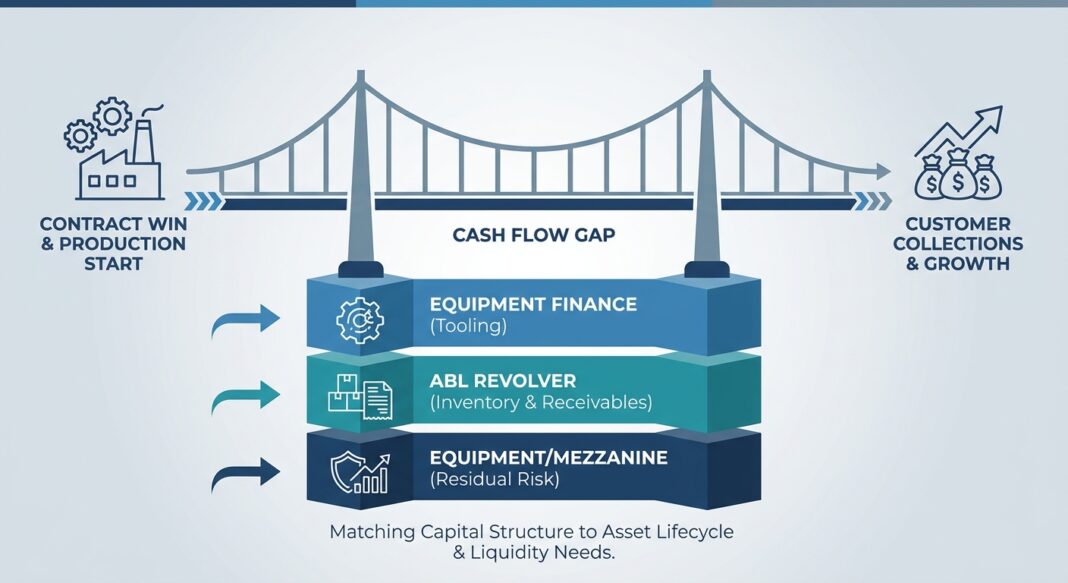
A growth-stage manufacturer wins a large customer program, but production starts months before cash arrives. The company may need to buy raw materials, fund labor, install dedicated tooling, and wait through delivery, acceptance, and payment terms. The contract can be commercially attractive and still create a liquidity shortfall. The financing question is not simply how much capital the business needs. It is which part of the cash gap belongs against collateral, which part can be supported by operating cash flow, and which risk requires equity.
That distinction helps prevent a common mismatch: financing long-lived equipment with a short-term revolver, or using expensive permanent capital to cover receivables that will convert to cash. A growth-stage company should build its capital plan around the sequence of spending and collections. Then it can compare a bank revolver, asset-based lending (ABL), equipment finance, private credit, mezzanine capital, preferred securities, and common equity by availability, repayment profile, control, and total cost. The objective is a stack that funds the ramp without assuming the customer pays early or the production line reaches full yield on schedule.
Match each cash need to the layer that can underwrite it
Start with the business stage. Seed companies usually rely on founder capital, grants, and venture equity because they lack predictable cash flow and lendable collateral. Early-revenue businesses may add customer prepayments, venture debt, or receivables finance when contracts and collections are demonstrable. Growth companies can combine bank credit, ABL, equipment loans, and cash-flow debt as earnings and collateral deepen. Mature companies can access broader private or public credit markets and preferred capital. Succession transactions add seller notes, acquisition debt, and sponsor or management equity, with the ownership transfer shaping the stack.
For the customer ramp, separate the uses. Tooling and production equipment have identifiable useful lives and may support equipment loans or leases with amortization aligned to asset life. Eligible receivables and saleable inventory can support a borrowing-base revolver. The borrowing base is generally constrained by collateral eligibility, reserves, and agreed advance rates, not just the headline commitment. The OCC’s Asset-Based Lending Comptroller’s Handbook describes how eligibility, inventory liquidity, reporting, and monitoring affect this structure.
Cash-flow term debt can fund the portion supported by recurring earnings rather than a specific asset. Private credit can provide more execution flexibility or greater debt capacity than a bank facility, but typically comes with a higher all-in cost and tighter lender control. Mezzanine debt can fill a residual financing gap when senior capacity is capped; PIK interest or an equity-linked return may reduce near-term cash payments but increases total repayment or dilution. Preferred equity and common equity absorb risk that debt cannot prudently carry. Their cost is ownership economics and potential governance rights.
Build the financing around the ramp, not the headline amount
For illustration, consider a manufacturer preparing a new customer program with four distinct requirements: tooling deposits before installation, inventory purchases before shipment, a temporary payroll and freight build, and receivables outstanding after delivery. The financing schedule should show when each cash outflow occurs, what collateral exists at that date, when the customer accepts product, and when cash is expected. It should also include slower acceptance, scrap, customer deductions, and a delayed production qualification case.
A practical structure may pair an equipment facility for dedicated machinery with a revolving ABL facility against eligible receivables and inventory. If the company has stable earnings, a modest cash-flow term loan may fund costs that do not convert into eligible collateral. Any remaining gap should be tested against sponsor equity, preferred equity, or subordinated debt. A borrowing-base line can be committed for a maximum amount yet provide less availability than expected if new inventory is ineligible, receivables are unbilled, or customer concentration limits apply. The OCC handbook notes that inventory is typically less liquid than receivables and requires separate underwriting and monitoring.
This is a use-of-proceeds allocation, not a prescribed stack. If equipment is highly specialized and has weak resale value, the equipment lender may require more borrower equity or shorter amortization. If a single customer dominates receivables, the ABL lender may impose concentration reserves. If the ramp consumes cash before earnings support debt service, mezzanine or equity may be more durable than layering on another amortizing loan.
Gap capital playbook: quantify, prepare, run
Quantify. Build a weekly cash forecast from purchase orders through collections. Calculate peak cumulative cash usage, not just total program spending. Separate committed costs, variable costs, contingency, and the cash contribution from existing operations. Reconcile the forecast to inventory turns, production yield, shipping dates, acceptance terms, and customer payment behavior. Model the minimum liquidity required if the first collection slips.
Prepare. Assemble customer contracts and purchase orders, a production schedule, equipment quotes, inventory detail, receivables aging, customer concentration, historical borrowing-base data, monthly financials, and downside projections. Explain which assets secure each facility. Identify liens, landlord waivers, supplier purchase-money claims, and restrictions on assigning receivables before lenders identify them as closing issues.
Run the process. Compare bank and nonbank proposals on net usable proceeds, collateral scope, borrowing-base exclusions, reserves, reporting burden, unused-line fees, amortization, covenants, and prepayment costs. The Federal Reserve’s October 2026 Senior Loan Officer Opinion Survey reported that banks left standards for large and middle-market C&I loans basically unchanged in the third quarter, while standards tightened for small firms; banks also tightened collateral requirements for small firms. That is survey evidence, not a quote for an individual borrower. A recent example of ABL’s working-capital role is eCapital’s November 16, 2026 announcement of a $10 million facility for a food manufacturer facing increased requirements under new large-scale contracts. The release did not disclose pricing or detailed advance rates, so those terms should not be inferred.
Negotiate availability and flexibility, not only price
For operators, negotiate eligibility definitions and customer concentration treatment using actual program data. Seek a clear process for adding approved customers, inventory categories, and new locations. Confirm how often borrowing-base certificates are due, how reserves are set, and whether excess availability triggers a springing covenant. Match equipment amortization to installation and ramp timing where possible, and test whether scheduled principal begins before the program generates cash.
For capital providers, diligence the customer’s credit quality, contract cancellation rights, acceptance mechanics, setoff exposure, inventory resale value, and the borrower’s reporting controls. The primary structural question is whether each funded dollar has a credible repayment source. Across the stack, document lien priority, intercreditor arrangements, permitted debt, and cash dominion triggers before closing. A lower stated rate can be outweighed by weak availability, restrictive collateral controls, or repayment dates that precede collections.
Key takeaways
- Size the facility to peak cash use and collection timing, not total contract value.
- Finance equipment, receivables, inventory, and operating losses against the repayment source each can support.
- Treat borrowing-base eligibility and reserves as core economics, not technical fine print.
- Use mezzanine or equity only for the residual risk that senior debt cannot responsibly carry.
- Negotiate a downside case, reporting cadence, and ramp-period liquidity before signing.


