
The Story
On October 11, 2026, STERIS agreed to buy Xodus Medical, a Pennsylvania maker of specialty surgical products focused on patient and operating-room staff safety. The purchase price is $2.1 billion in cash, subject to customary adjustments, plus a possible $150 million earnout tied to performance targets in 2028. The agreement puts a precise financing question behind a strategic expansion: how much of the purchase should be paid for with new borrowing, existing cash, or newly issued shares?
STERIS presented Xodus as a natural extension of its healthcare consumables portfolio. The company said the deal is expected to add to revenue growth, margins and adjusted earnings. It also estimated that transaction-related cash tax benefits have a net present value of about $300 million, lowering its stated net purchase price to roughly $1.8 billion. Those are management expectations, not realized results.
The buyer had scale and cash generation to draw on. For the quarter ended September 30, 2026, STERIS reported $1.6 billion in revenue, up 9% from the comparable prior-year quarter. Still, the transaction is large relative to its existing debt. In its November 5 filing, STERIS reported approximately $1.9 billion of debt outstanding at September 30 and expected to incur about $2.0 billion in additional debt for the acquisition. The announced deal is pending regulatory and other customary conditions, with closing anticipated by December 31, 2026. STERIS’s October 12 announcement and its November 5 quarterly filing set out the rationale and financing plan.
The Decision
STERIS could have funded more of the cash price from its balance sheet, issued equity, or borrowed against the company’s future cash flows. Its public filings describe a combination of approximately $2.0 billion in new debt and cash on hand. They do not disclose an equity issuance as part of the planned funding mix. Debt avoids selling new shares to fund the purchase, but it leaves STERIS with contractual interest and repayment obligations whether or not the acquisition performs as planned.
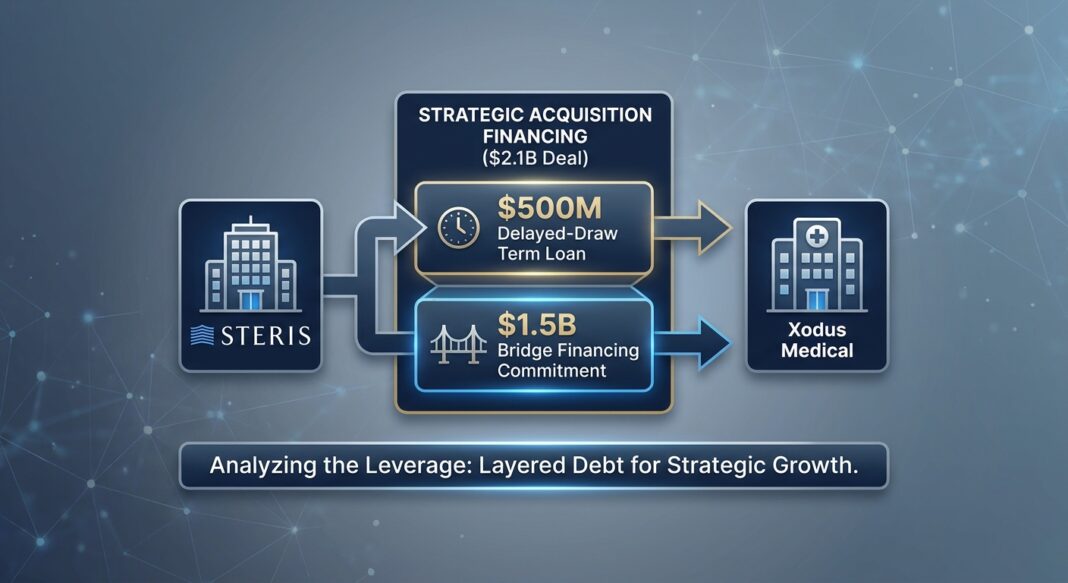
The financing was designed in layers rather than as one fully drawn loan at signing. On November 4, STERIS entered a delayed-draw term loan agreement for up to $500 million, available only if the acquisition closes. The facility matures five years after closing. It has no scheduled principal repayment in year one; quarterly amortization begins in years two and three, then increases in years four and five, with the remaining balance due at maturity. Interest is based on a floating benchmark plus a margin tied to STERIS’s debt rating.
Separately, the company had committed bridge financing of up to $2.0 billion from JPMorgan Chase and Goldman Sachs. After arranging the $500 million delayed-draw facility, the bridge commitment fell by the same amount, to $1.5 billion. STERIS said it expects to replace the remaining bridge commitment with permanent financing before closing. This arrangement gives the buyer committed funds while it finalizes longer-term funding, but the final cost and terms of that permanent debt were not set out in the filing.
The structure matches funding to a closing that has not happened yet. The term loan cannot be drawn if the transaction does not close, limiting the risk of borrowing acquisition money for a deal that fails. But the bridge commitment is not free of execution risk: STERIS warned that permanent financing could be less favorable than expected and that a bridge draw could carry higher costs and shorter maturities.
The Outcome
At the November 16, 2026 reporting date, Xodus remained an announced, pending acquisition. There is no completed-deal operating record to assess, and no realized earnings contribution to compare with STERIS’s projections. The appropriate outcome is therefore the financing commitment, not a claim that the transaction has already created value.
If the purchase closes and STERIS borrows the expected $2.0 billion, simple addition to its reported September 30 debt implies roughly $3.9 billion of gross debt before subsequent repayments, cash movements or other financing changes. That is an illustrative arithmetic estimate, not a reported pro forma balance or a leverage ratio. The company has not disclosed Xodus’s EBITDA in the cited materials, so a defensible debt-to-EBITDA calculation is not available here. The potential $300 million present value of tax benefits and the possible $150 million earnout also affect the economic cost, but neither should be treated as cash already received.
The counterfactual is a different risk allocation, not a known better result. Using more cash would reduce added borrowing but consume liquidity that could support operations or other investments. Issuing shares would reduce the debt burden but dilute existing shareholders. STERIS has not published a quantified comparison of those paths. The announced plan instead accepts added debt to acquire a business management expects to strengthen its healthcare offering and earnings profile. Investors will be able to judge that choice only after closing, financing is finalized, and Xodus’s performance is reported.
The Lessons
This case turns on the fit between the use of proceeds and the repayment source. STERIS is buying an operating business that it says complements its existing customer and product base. Debt can preserve the existing share count when a buyer has cash flows and balance-sheet capacity to service it. That is different from borrowing to cover operating losses or to fund a strategy whose revenue engine is still unproven.
But the arithmetic begins with the debt burden, not the ownership benefit. Before committing, an operator should model interest expense under higher-rate scenarios, integration costs, working-capital needs, and a slower-than-planned earnings contribution. The financing must remain serviceable if synergies arrive late or the acquired business misses targets. A maturity balloon deserves separate attention: scheduled amortization can look modest while a large principal balance still comes due at the end of the term.
STERIS’s delayed-draw feature offers one useful structural point. Borrowing is conditional on closing, and scheduled amortization is back-ended. That helps align funding with the transaction timeline, but it does not make the loan inexpensive or eliminate refinancing risk. The company also retains bridge exposure until permanent financing replaces it. In a founder-led business, debt may preserve ownership percentage, while new equity can bring capital without mandatory repayment. Neither source is automatically superior; the choice depends on cash-flow visibility, valuation, control terms, and resilience under a downside case.
A practical screen for a similar decision has four tests: identify the exact cash flows the acquisition adds; size debt against a conservative earnings case rather than a synergy target; confirm that liquidity remains adequate after closing; and compare the full cost of debt with the dilution and governance cost of equity. In an October 1, 2026 interview, Orbit Capital’s Radovan Nesrsta put the operating test plainly: a founder should be able to specify which P&L line the capital changes and by how much. For STERIS, that test remains open until Xodus closes and delivers measured results.
Key Insights
- STERIS agreed to pay $2.1 billion in cash for Xodus, with a potential $150 million performance-based earnout.
- The announced funding plan combines about $2.0 billion of new debt with cash on hand; no equity issuance is disclosed as part of the plan.
- The $500 million delayed-draw loan is contingent on closing, while a $1.5 billion bridge commitment remains after that facility reduced the original bridge.
- At the reporting date, the acquisition had not closed, so earnings accretion and tax benefits remain projections, not achieved outcomes.
- Debt can avoid share dilution, but only cash flows that withstand downside scenarios can carry the added fixed obligations.
Sources: STERIS acquisition announcement, October 12, 2026; STERIS Form 10-Q, filed November 5, 2026; How to Web interview with Orbit Capital’s Radovan Nesrsta, October 1, 2026.


