
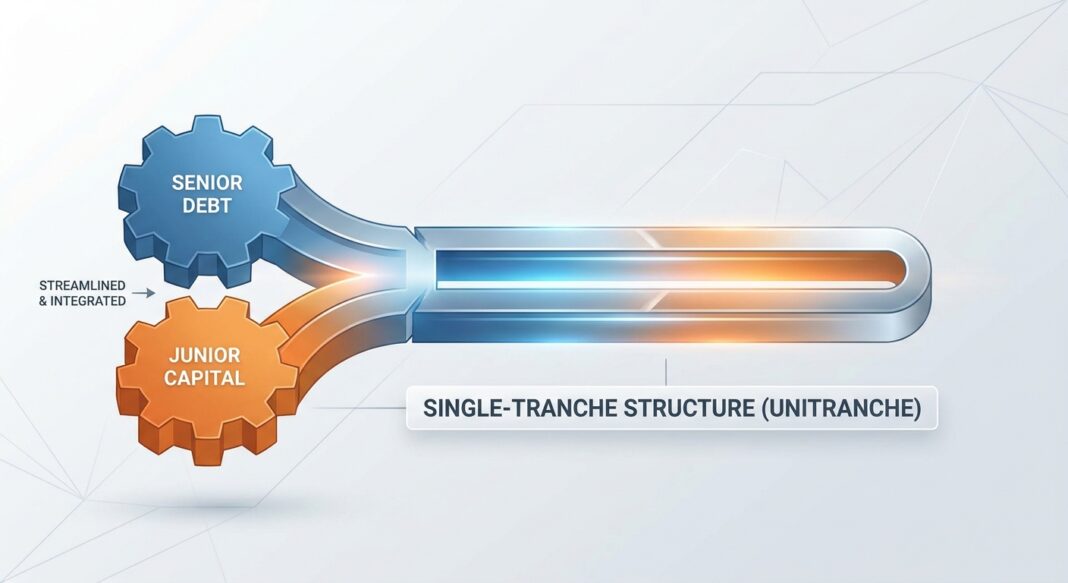
One Loan, Two Risk Positions, and a Market Worth $1.7 Trillion
If you have spent any time reviewing private credit term sheets in the past five years, you have likely encountered the word unitranche. It appears on deal tombstones, in fund fact sheets, and in lender pitch decks as though it were a simple product. It is not. Unitranche financing is one of the most structurally creative innovations in modern private credit — a single loan instrument that conceals an entirely private, layered risk-sharing arrangement between lenders that borrowers typically never see.
Understanding the unitranche mechanic matters for two audiences. For investors evaluating private credit funds, it explains why a “senior secured” label can encompass a wide spectrum of actual risk. For business owners and sponsors seeking capital, it explains why a single lender relationship can replace a multi-tranche negotiation — and what that streamlined structure actually costs.
This article breaks down how unitranche loans work, why they now dominate middle-market lending, and what the current market environment means for both audiences in 2026.
What Is a Unitranche Loan?
Before unitranche structures existed, a leveraged buyout or middle-market recapitalization required two separate lender groups. A first lien senior lender provided a secured loan with the primary claim on collateral and charged a lower rate — typically SOFR plus 250 to 350 basis points. A second lien or mezzanine lender provided subordinated capital, accepted a junior position in any recovery, and charged a higher rate to compensate for that risk. Two agreements, two sets of covenants, two closing timelines, and ongoing negotiation over an intercreditor agreement governing who gets paid first in a default.
Unitranche debt collapses that into one loan, one interest rate, one credit agreement, and one lender relationship. The rate is blended — sitting between what pure senior debt and pure subordinated debt would have cost separately. The borrower signs a single document and deals with a single administrative agent.
Behind the scenes, however, the lenders typically split the economic risk through a private contract called an Agreement Among Lenders (AAL). The AAL divides the single facility into a “first-out” piece and a “last-out” piece — a structure practitioners call First-Out/Last-Out (FOLO). First-out lenders are repaid first in any distribution event and accept a lower return. Last-out lenders absorb losses first and earn a higher yield in exchange.
As Mayer Brown (July 2026) describes it, the structure is “intended to provide the ‘first out’ lender reduced risk and return, providing the ‘last out’ lender increased risk and return” — all while presenting the borrower with a single, streamlined credit facility.
How It Works: A Concrete Example
Consider a private equity sponsor acquiring a software-enabled business services company at an enterprise value of $200 million. The sponsor is contributing $80 million in equity (40% of enterprise value) and needs $120 million in debt financing — representing a 4.0x leverage ratio on $30 million of EBITDA.
Old two-tranche structure:
- $90 million first lien term loan at SOFR + 375 bps (3.0x leverage) — Bank A
- $30 million second lien at SOFR + 775 bps (4.0x leverage) — Mezzanine Fund B
- Two separate credit agreements, two sets of financial covenants, one intercreditor agreement, and typically 60–90 days to close
Unitranche alternative:
- $120 million unitranche at a blended rate of SOFR + 525 bps — Single private credit manager
- One credit agreement, one covenant package, one closing timeline (often 30–45 days)
- Behind the scenes, the lender or lending club privately allocates an ~$80M first-out piece at SOFR + 425 bps and a ~$40M last-out piece at SOFR + 725 bps via an AAL the borrower never sees
The borrower pays a blended rate that is modestly higher than pure senior debt but lower than a combined senior-mezzanine stack would have cost in aggregate fees and coordination time. The real premium paid is for certainty, speed, and simplicity — not purely for cost savings.
Current Market Relevance
Unitranche has moved from a middle-market niche to the defining structure of private credit. Here is what current data shows:
Market Size: According to Preqin’s 2026 Global Alternatives Report (via CT Acquisitions, June 2026), the global private credit market reached approximately $1.7 trillion in AUM at the start of 2026, up from $970 billion in 2019. Unitranche is now the default structure for LBOs under $500 million in enterprise value.
Current Unitranche Spreads: According to the Valuation Research Corporation (VRC) Q3 2026 Private Credit Update, traditional middle-market unitranche coupon spreads held unchanged at SOFR plus 500 to 575 basis points in Q3 2026, with spot yields ranging between approximately 9.33% and 10.08% — meaningfully above pre-2022 historical ranges of 7% to 8%.
Spread Widening in 2026: Northleaf Capital (Q2 2026) reported that new issue pricing for U.S. sponsor-backed middle-market transactions widened approximately 25 basis points through Q2 2026, reflecting broader market volatility and an evolving competitive environment.
CDLI Performance: The Cliffwater Direct Lending Index (CDLI), as of June 30, 2026, returned 7.7% on a trailing twelve-month basis, exceeding all major fixed income indices. The index has now delivered nearly 22 years of returns averaging 9.5%, with only one negative year (2008).
Bank Lending Context: The Federal Reserve’s July 2026 SLOOS reported that C&I lending standards were basically unchanged in Q2 2026 and are currently easier than the midpoints of banks’ historical ranges — which has compressed the competitive gap between bank loans and private credit for the most creditworthy borrowers, making the unitranche’s non-price attributes (speed, flexibility, covenant control) increasingly important differentiators.
| Metric | Value | Source |
|---|---|---|
| Global Private Credit AUM (2026) | ~$1.7 trillion | Preqin via CT Acquisitions, June 2026 |
| Traditional Middle Market Unitranche Spread (Q3 2026) | SOFR + 500–575 bps | VRC Q3 2026 Private Credit Update |
| Unitranche Spot Yield Range (Q3 2026) | 9.33%–10.08% | VRC Q3 2026 Private Credit Update |
| CDLI Trailing 12-Month Return (June 30, 2026) | 7.7% | Cliffwater, August 19, 2026 |
| Bank C&I Lending Standards vs. Historical Midpoint (Q2 2026) | Easier than midpoint | Federal Reserve SLOOS, July 2026 |
Decision Framework
For Investors Evaluating Private Credit Funds
When a private credit fund describes its portfolio as “senior secured,” investors consider whether the fund holds first-out or last-out positions within unitranche facilities — because that distinction drives materially different risk and return profiles. Key questions include:
- What is the fund’s actual position within the AAL? First-out exposure behaves more like traditional senior debt; last-out exposure carries characteristics closer to mezzanine.
- What is the weighted average leverage at origination? A unitranche at 5.5x total leverage carries meaningfully different equity cushion dynamics than one at 4.0x.
- How does the manager handle AAL voting disputes? As Daeryun Law (2026) notes, first-out and last-out lenders can hold materially different preferences on amendments, waivers, and enforcement decisions — and the governance language in the AAL determines who prevails.
- Is the spread premium sufficient for the actual risk taken? With Q3 2026 spreads at SOFR + 500–575 bps, investors evaluate whether that premium adequately compensates for illiquidity and complexity relative to broadly syndicated alternatives.
For Business Owners and Sponsors Considering Unitranche Financing
Operators and private equity sponsors evaluate unitranche financing against traditional multi-lender structures on several dimensions beyond headline rate:
- Certainty of close: A single lender or small club eliminates the coordination risk of multi-party negotiations — a significant advantage in competitive auction processes.
- Covenant flexibility: Private credit lenders often offer maintenance covenant packages tailored to the business’s specific financial profile, rather than market-standard terms driven by syndicated market conventions.
- Amendment dynamics: A single lender relationship means that if performance deteriorates, the borrower negotiates with one counterparty rather than managing a syndicate — which can accelerate resolution but also concentrates lender leverage.
- All-in cost vs. complexity cost: While unitranche rates are higher than pure senior bank debt, operators weigh that premium against the legal, advisory, and time costs of running a two-tranche process.
Key Takeaways
- Unitranche is not just one loan: Behind the borrower-facing single instrument, lenders typically divide risk into first-out and last-out positions through a private Agreement Among Lenders (AAL) — a distinction that materially affects investor risk profiles.
- The blended rate reflects blended risk: Unitranche pricing at SOFR + 500–575 bps in Q3 2026 sits above pure senior debt because it absorbs what was previously a second-lien or mezzanine position. That premium is the cost of structure consolidation.
- Speed and certainty are the primary value drivers for borrowers: Unitranche became the dominant structure not because it is the cheapest option, but because it offers speed, confidentiality, and a single lender relationship — attributes that are especially valuable in time-sensitive M&A processes.
- Bank lending standards are easing — which sharpens the comparison: With the Federal Reserve’s July 2026 SLOOS showing C&I standards easier than their historical midpoints, well-credentialed borrowers now have more genuine bank alternatives. Unitranche’s value proposition increasingly rests on structural flexibility, not just access.
- The CDLI’s 22-year track record provides a performance context: With the Cliffwater Direct Lending Index delivering a 9.5% average annual return over nearly 22 years with only one negative year, the asset class’s long-term return profile — much of which flows through unitranche structures — offers investors a data-grounded basis for evaluating the risk-return trade-off.


