
The Financing Problem That Unitranche Was Built to Solve
A growth-stage company running a bolt-on acquisition strategy faces a structural friction point that most operators underestimate: multi-lender capital stacks are slow, expensive to document, and adversarial under stress. The traditional path — a senior bank facility layered with a subordinated mezzanine tranche — brings two sets of lawyers, two credit agreements, two covenant packages, and an intercreditor negotiation that foreshadows every future dispute.
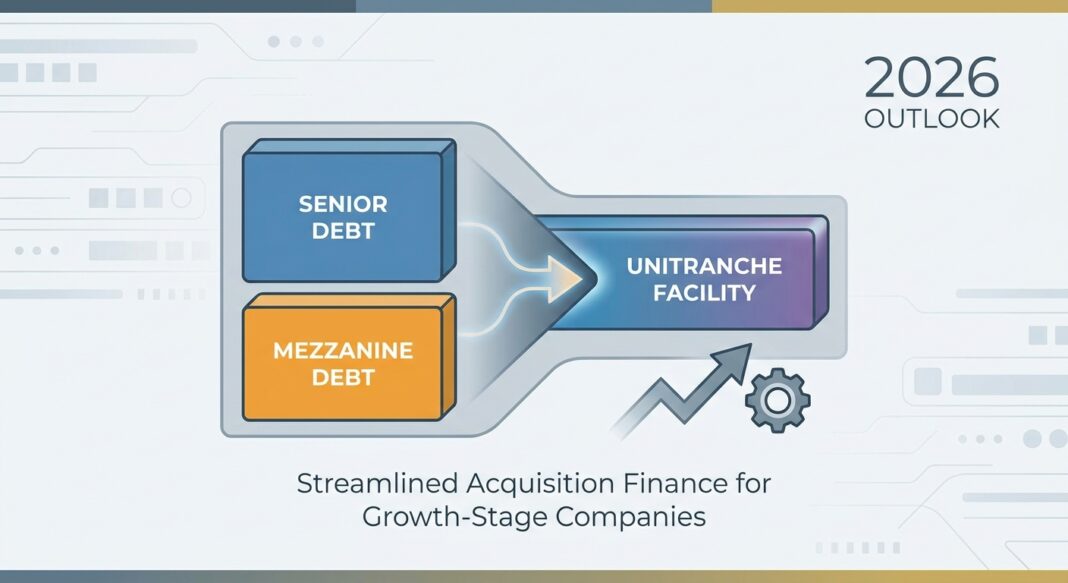
The unitranche structure was built as the antidote. A unitranche loan combines senior and subordinated debt into a single financing facility with one set of loan terms. For the borrower, the result is structural simplicity: one lender relationship, one credit document, and a single blended interest rate. For the lender, the result is control — by providing the entire debt facility, the unitranche lender controls the borrower’s entire capital structure, and in a default scenario, there is no senior lender competing for control of the enforcement process, no intercreditor disputes, and no risk that a junior lender will disrupt a restructuring.
Unitranche dominates the lower middle-market direct lending channel in 2026. For operators running acquisition-led growth strategies, it has become the default first call — not because it is the cheapest capital on the spectrum, but because speed, certainty, and structural flexibility compound over the life of a deal in ways that a 150-basis-point spread savings rarely does.
Structure Breakdown: Components, Mechanics, and a Live Example
How the Instrument Is Built
In many instances, the unitranche loan is divided into distinct first and second lien components similar to a senior bank loan and junior mezzanine financing. However, one unitranche investor may provide all the capital and use their own credit facility to create the structure. In either case, the resulting instrument has a single interest rate and term, which is often five to seven years.
When multiple lenders participate — a common configuration in larger club deals — the economics are governed by an Agreement Among Lenders (AAL). In an AAL, the unitranche is privately divided into a “first-out” tranche and a “last-out” tranche. The first-out lender receives priority of payment and lower risk, similar to a traditional senior lender. The last-out lender absorbs more risk and earns a higher spread, similar to a mezzanine position. The borrower sees none of this — the borrower makes one payment, but behind the curtain, the economics are allocated according to the AAL waterfall.
The lender provides total leverage that can reach 5–6x EBITDA in a single facility, compared to 3–4x that a senior-only lender would typically provide.
Worked Example: $50M Unitranche for a $100M EV Software Acquirer
Consider a sponsor-backed B2B software platform with $10M EBITDA and a $100M enterprise value, financing a tuck-in acquisition that brings pro forma EBITDA to $12M. The capital structure looks like this:
| Component | Amount | Terms |
|---|---|---|
| Unitranche Term Loan | $50M (5.0x pro forma EBITDA) | SOFR + 600 bps, 6-year term, 1% annual amortization, bullet at maturity |
| Revolving Credit Facility | $5M | Working capital; 25–50 bps undrawn fee |
| Delayed Draw Term Loan (DDTL) | $20M committed | Available 36-month window for add-on acquisitions; ticking fee on undrawn balance |
| Equity Contribution | $50M | Sponsor equity; 50% LTV at closing |
| OID | 2.0% | Borrower receives $49M; repays $50M at maturity |
| Prepayment | 102/101/par | 2% premium in year 1, 1% in year 2, at par thereafter |
Unitranche pricing in 2026 runs SOFR + 500–700 bps, plus a 2–3% original issue discount and a 2–3% prepayment fee declining over the first 24 months. Direct lending loans are typically originated at a discount to par — the OID — which increases the effective yield to the lender and the cost to the borrower. Average OIDs range from 97.5 to 98.5 cents per dollar of par value. For a five-year bullet loan, an OID of 98 cents contributes approximately 40 basis points of additional annualized yield. Upfront arrangement fees, typically 1–2% of commitment, add a further 20–40 basis points on an annualized basis.
The DDTL is the structural centerpiece for an acquisition platform. This type of acquisition financing provides flexible funding at the initial close as well as future capital at a later date. The future capital is structured in a delayed draw term loan committed for 2–3 years that can be drawn in smaller amounts usually to fund acquisitions or business investment. As long as the company has strong deals that fit its acquisition strategy and the core business is performing, the delayed draw term loan can be borrowed, making the process streamlined thereby expediting the closing timeline.
Unitranche vs. Traditional Senior + Mezzanine: The Real Trade-Offs
The apples-to-apples comparison between unitranche and a bifurcated senior/mezz stack reveals that the premium the borrower pays is largely a premium for simplicity, speed, and flexibility — not total leverage.
| Dimension | Unitranche | Senior + Mezzanine |
|---|---|---|
| Number of Lenders | 1 (or 2–3 club) | 2–5+ (separate syndicates) |
| Credit Agreements | 1 | 2 + intercreditor agreement |
| Blended Pricing (2026) | SOFR + 500–700 bps | Senior SOFR + 350–450 bps; Mezz 12–14% cash + PIK |
| Time to Close | 60–90 days | 100–130 days |
| Legal Cost | $200–300K | $450–650K |
| Add-On Flexibility | Accordion feature; simple consent | Requires both senior + mezz consent |
| Total Leverage | 4–6x EBITDA | 5–7x EBITDA (more flexibility on sub layer) |
The mezzanine stack becomes the better tool when maximum leverage is the overriding priority — typically in large LBO contexts. In a traditional senior + mezzanine structure, subordinated debt prices at 12% cash interest + 2% PIK (14% all-in), with a 7-year term and a 3-year non-call period. Because mezzanine lenders seek a return of 14–20%, this return must be achieved through means other than simple cash interest payments. By using equity ownership and PIK interest, the mezzanine lender effectively defers its compensation until the due date of the security or a change of control of the company.
Companies large enough to have scale and operating history, but generally not large enough to rely on liquid markets as a competing financing source, occupy the core middle market. Borrowers with liquid market alternatives can pressure private lenders to give up spread, covenants, or other structural protections. For this cohort — sub-$500M enterprise value, $5M–$50M EBITDA — the unitranche is almost always the faster and cleaner path.
Current Market Terms: What 2026 Deals Actually Look Like
The 2026 middle-market unitranche market has experienced meaningful spread compression from the 2023 wides, but pricing remains well above pre-2022 norms due to the Fed funds rate floor.
Five Data Points Defining the 2026 Market
- Spread Range: A private credit fund lends most commonly through unitranche facilities priced at SOFR plus 475–650 basis points. In 2026, the asset class manages well over $1.7 trillion globally, and the typical middle-market unitranche is sized at 4.0–5.5x EBITDA with one or two maintenance covenants.
- All-In Cost: The all-in cost of capital for a typical 5x leverage deal is 9.5–11% blended.
- OID and Fee Load: Median all-in spread on lower-middle-market unitranche facilities is estimated at SOFR plus 537 basis points, plus 1–2 points of original issue discount, a 1–2% closing fee, and 25–50 basis points on undrawn revolver commitments.
- Covenant Trends: Larger unitranche deals (above $200M EV) are increasingly closing covenant-lite (no maintenance financial covenant; only incurrence covenants). Covenant-lite was historically reserved for broadly syndicated loans; it now appears in 30–40% of $200M+ unitranche deals.
- Credit Quality Trends: New loans are increasingly coming with better credit structures: less leverage, more covenants, fewer PIK requests, and tighter documentation.
Covenant Architecture in 2026
Unitranche facilities typically include maintenance covenants, which is a meaningful advantage for lenders compared to the broadly syndicated loan market where covenant-lite has become standard. Common covenants include a maximum total leverage ratio and a minimum fixed charge coverage ratio.
The distinction between maintenance and incurrence design is a core negotiating point. Unlike a maintenance covenant, which is tested regularly (for example, quarterly) regardless of activity, an incurrence covenant is tested only at the time of the proposed action. Leverage ratios commonly determine margin step-ups or step-downs and drive excess cash flow sweep percentages and other mandatory prepayment requirements. In this respect, leverage tests shape both risk allocation and pricing over the life of the loan.
The large deal threshold matters here: flexible covenant packages distinguish unitranche financing from traditional bank lending. Unitranche lenders generally structure facilities with incurrence-based covenants that only test compliance when borrowers undertake specific actions such as acquisitions or dividend payments.
Structuring Guidance: How to Run the Process and Negotiate the Deal
For Operators and Sponsors: The Preparation Checklist
Before approaching unitranche lenders, a borrower must be able to answer three questions with precision: (1) What is the fully-loaded, defensible LTM EBITDA — and how is EBITDA defined in the credit agreement? (2) What is the acquisition pipeline and how will the DDTL be deployed? (3) What are the maintenance covenant headroom levels at each draw, modeled on a downside case?
Because the leverage ratio drives maintenance testing, incurrence baskets, pricing mechanics, excess cash flow sweeps and, in many cases, amendment negotiations, its definition receives significant scrutiny and heavy negotiation between the parties. The EBITDA definition — specifically add-backs for one-time costs, acquired EBITDA, and run-rate synergies — is where value is made or lost in the credit agreement.
Key Negotiation Points for Borrowers
- PIK Toggle Optionality: Push for a PIK toggle on a portion of the coupon (typically up to 2–4%), which preserves cash in periods of acquisition integration. Note that where a PIK option is available, private credit providers expect to be paid a premium when the PIK option is exercised.
- Accordion Size and Conditions: Negotiate the maximum accordion multiple and ensure the pro-forma leverage test for accordion draws is tied to acquired EBITDA, not just closing EBITDA.
- Covenant Headroom: Push for 25–30% headroom above projected leverage on the day-one covenant test. EBITDA declines of 20% should not trigger a covenant breach in a well-structured deal.
- Prepayment Flexibility: An incurrence covenant requires no ongoing compliance — it blocks a defined action unless a condition is satisfied at that moment, often on a pro forma basis. Negotiate incurrence-only covenants for the accordion and add-on draws, so acquisitions are not blocked by a temporary EBITDA dip.
- DDTL Commitment Window: DDTLs usually have an availability period between three to four years, can be drawn in multiple tranches subject to a minimum draw amount, and once drawn, cannot be re-borrowed following prepayment. Push for the longest availability window the lender will commit, and negotiate the ticking fee to begin accruing only after 90 days.
For Investors: What to Look For in Unitranche Structure
Increased emphasis on income consistency, capital preservation, and active liquidity management aligns well with a disciplined lower-middle-market approach, where conservative leverage, stronger documentation, and earlier intervention through covenants can support more resilient outcomes. The lower middle market’s simpler capital structures, stronger covenants, and more conservative leverage should support better recovery outcomes relative to larger, more aggressively structured segments.
Key Takeaways
- One Document, One Lender, One Covenant Package: The core value proposition of unitranche is structural simplicity — one credit agreement, one set of covenants, and a lender with full-stack control who can move decisively in both growth and distress scenarios.
- All-In Cost Is 9.5–11% in 2026: SOFR + 500–700 bps, plus OID of 1–2 points and a closing fee of 1–2%, makes the fully-loaded cost of a middle-market unitranche materially higher than senior-only bank debt — but the spread is the price of leverage, speed, and DDTL flexibility.
- The DDTL Is the Acquisition Platform’s Most Valuable Feature: A committed delayed draw facility eliminates the need to re-underwrite each tuck-in acquisition, compresses closing timelines, and allows a platform to move faster than competitors dependent on bank syndications.
- Covenant Architecture Is the Real Negotiation: The difference between a maximum leverage maintenance covenant tested quarterly and an incurrence-only covenant tested at the moment of a gated action is enormous. Know which architecture you are signing before you close.
- The EBITDA Definition Is Where Deals Are Won: Add-back methodology, acquired EBITDA treatment, and run-rate synergy inclusion determine effective leverage at close and headroom under every covenant test that follows. This is the highest-leverage point in any credit agreement negotiation.


