
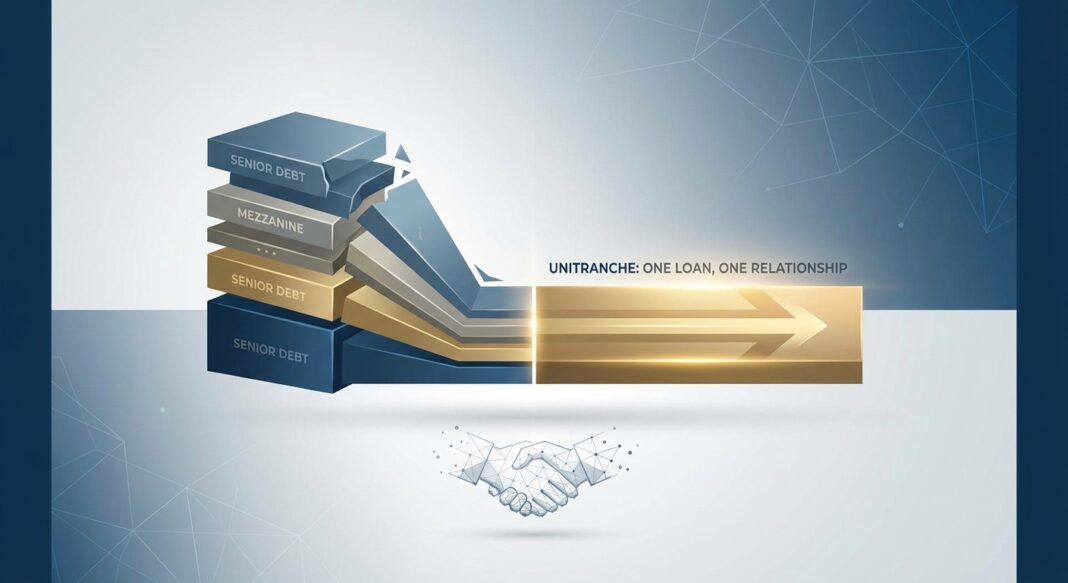
One Loan, One Rate, One Relationship — And Why It Dominates Middle-Market Finance
There is a moment in every middle-market acquisition when the financing structure either accelerates the deal or kills it. For decades, that moment was defined by a familiar bottleneck: a senior bank lender and a mezzanine provider sitting across from each other, negotiating who gets paid first when things go wrong. The intercreditor agreement alone could take 90 to 120 days and hundreds of thousands of dollars in legal fees. Unitranche debt was invented to eliminate that moment entirely.
Today, unitranche is not a niche product. It is the dominant financing structure for middle-market acquisitions in the United States. CT Acquisitions (May 2026) estimates that for acquisitions between $25 million and $200 million in enterprise value — the core of the lower middle market — there is a 70 to 80 percent chance the deal is financed, at least in part, by a unitranche facility. Understanding how unitranche works is no longer optional for investors evaluating private credit funds or operators considering a capital raise. It is foundational.
What Unitranche Debt Actually Is
Unitranche debt is a single-tranche term loan that combines what would otherwise be a senior secured loan and a subordinated or mezzanine loan into one instrument, governed by one credit agreement, with one lender or a small club of lenders. The borrower pays a single blended interest rate that sits between what pure senior debt would cost and what subordinated debt would cost.
The key insight is where the complexity lives. In a traditional capital stack, two separate lenders each hold their own security interest, their own covenants, and their own remedies — and the intercreditor agreement spells out who can act when. In a unitranche, Customers Bank explains, that complexity is handled entirely on the lender’s side. The borrower gets a cleaner structure, a single point of accountability, and a faster path to close.
Many large unitranche facilities also involve an internal first-out / last-out split among lenders. As Goldman Sachs Private Middle Market Credit II LLC describes in its Form 10-Q (June 2026), the first-out portion receives priority with respect to payment of principal and interest, while the last-out portion bears deeper risk in exchange for a higher return. The borrower sees none of this — they have one loan. Investors in a private credit fund, however, are exposed to whichever slice their manager holds.
How It Works: A Concrete Example With Real Numbers
Consider a manufacturing business generating $10 million in EBITDA being acquired for $60 million (a 6x purchase price multiple). The acquisition requires $40 million in debt financing at 4.0x EBITDA. Here is how the two structures compare side by side:
Traditional Senior + Mezzanine Structure:
- Senior loan: $25 million at 3.0x EBITDA — pricing at SOFR + 325 bps (~6.9% all-in)
- Mezzanine: $15 million at 1.5x additional leverage — pricing at SOFR + 900 bps (~13.4% all-in)
- Two lenders. Two credit agreements. One intercreditor agreement. 90–120 days to close.
- Blended cost of debt: approximately 9.5–10.5%
Unitranche Structure:
- Single unitranche facility: $40 million at 4.0x EBITDA — pricing at SOFR + 550 bps (~9.2% all-in at current rates)
- One lender. One credit agreement. One covenant package. 45–60 days to close.
- All-in cost of debt: approximately 9.0–9.5%
The blended cost differential is modest — often 50 to 100 basis points when compared to a well-structured senior/mezz split. But operators consistently choose unitranche for three reasons that have nothing to do with the coupon: speed (no intercreditor negotiation), certainty (no syndication risk that can blow up a deal at closing), and simplicity (one relationship to manage for the duration of the hold period). Fundamently’s capital stack analysis puts it plainly: for a middle-market acquisition on a timeline, that speed is often worth more than the rate difference.
Current Market Relevance: Where Unitranche Pricing Stands in 2026
The pricing backdrop for unitranche has shifted meaningfully over the past twelve months. Here is what the current data shows:
| Metric | Data Point | Source |
|---|---|---|
| Unitranche all-in yield range (Q2–Q3 2026) | ~9.00% – 9.75% | Valuation Research Corp., Q2 2026 |
| New-issue private credit spreads (3 months to Aug 31, 2026) | 502 bps average, up from 475 bps in Q1 | PitchBook LCD via Kadenwood Group, Sep 2026 |
| Premium: private credit vs. syndicated loans (Aug 2026) | 162 bps, ~39 bps wider than Q1 2026 | PitchBook LCD via Kadenwood Group, Sep 2026 |
| Bank C&I lending standards (Q2 2026) | Basically unchanged; easier than historic midpoints | Federal Reserve SLOOS, July 2026 |
| Global private credit AUM (2026) | ~$1.7 trillion, up from $970B in 2019 | Preqin 2026 Global Alternatives Report via CT Acquisitions |
| Average buyout leverage, new transactions (Q4 2025) | 5.2x EBITDA | Lincoln International via ABF Journal, 2026 |
The spread widening in 2026 reflects a structural shift in bargaining power. PitchBook reported in March 2026 that some private credit loans were pricing 50–100 bps higher than late-2025 levels as the market entered a period of price discovery. By August, PitchBook LCD data showed that 52 percent of sponsor-backed direct lending deals priced between S+500 and S+549 — a band that held only 25 percent of deals in Q1. The middle of the market moved an entire pricing band in under six months.
Paradoxically, the July 2026 Federal Reserve SLOOS showed bank C&I lending standards at their easiest relative to historical ranges — meaning banks have loosened, yet private credit has simultaneously gotten more expensive. This divergence creates a genuine decision point for operators: bank debt may now be comparatively cheaper on rate, but it still cannot match the leverage depth, covenant flexibility, or execution speed of a unitranche facility for complex transactions.
Decision Framework: Investors and Operators
For Investors Evaluating Private Credit Funds:
- Ask about first-out vs. last-out exposure. A fund holding predominantly last-out unitranche positions carries meaningfully more subordinated risk than its senior-secured label implies. Evaluate the portfolio’s actual position in the payment waterfall, not just the lien designation.
- Understand the spread widening context. Unitranche yields of 9.00–9.75% (Q3 2026) represent a roughly 250 bps decline from 2023 peak levels near 11.5–12.5%, per Valuation Research Corp. Investors allocating today are entering at a lower absolute yield environment than the vintage cohorts that defined the asset class’s return profile.
- Monitor LP conviction metrics. According to Preqin’s November 2025 LP survey via IQ-EQ, 81% of LPs plan to hold or increase private credit commitments in 2026 — a signal of asset class durability, but also of continued capital inflows that can compress spreads further.
For Operators Deciding Whether to Use a Unitranche:
- Use unitranche when time is the constraint. Competitive auction processes, add-on acquisitions, and recapitalizations with tight timelines favor unitranche’s 45–60 day execution window over a traditional two-tranche structure’s 90–120 days.
- Model the true all-in cost. Spreads are only one input. Coyote Wealth (2026) notes that operators should add original issue discount (typically 1.0–2.0 points), a closing fee (1.0–2.0%), and an undrawn revolver commitment fee (25–50 bps) to arrive at a true cost of capital. A quoted SOFR + 550 bps can translate to a materially higher effective yield once fees are annualized.
- Consider bank debt for simpler, asset-light deals. With C&I lending standards at their easiest historical midpoints per the July 2026 SLOOS, operators with clean financials, modest leverage needs (below 3.5x EBITDA), and no time pressure may find bank pricing more competitive than at any point in recent years.
Key Takeaways
- Unitranche is the workhorse structure of middle-market private credit. It collapses senior and mezzanine debt into one loan, one rate, and one lender relationship — solving a speed and complexity problem that defined the old two-tranche world.
- The blended rate hides an internal risk hierarchy. First-out and last-out positions within unitranche facilities carry very different risk profiles. Investors should understand which slice their fund holds before relying on the senior-secured designation alone.
- Spreads widened meaningfully in 2026. New-issue private credit spreads averaged 502 bps through August 2026, up from 475 bps in Q1, with over half of sponsor-backed deals now priced at S+500 or higher — a significant repricing of middle-market credit risk.
- The bank-versus-unitranche decision is more nuanced today. The July 2026 SLOOS shows bank C&I standards at their easiest relative to history, narrowing the access gap — but unitranche still wins on leverage depth, flexibility, and execution certainty for complex transactions.
- The market’s growth trajectory remains intact. With global private credit AUM at approximately $1.7 trillion and Preqin projecting $4.5 trillion by 2030, unitranche is not a cyclical product. It is the structural foundation of a permanently expanded direct lending market.


