
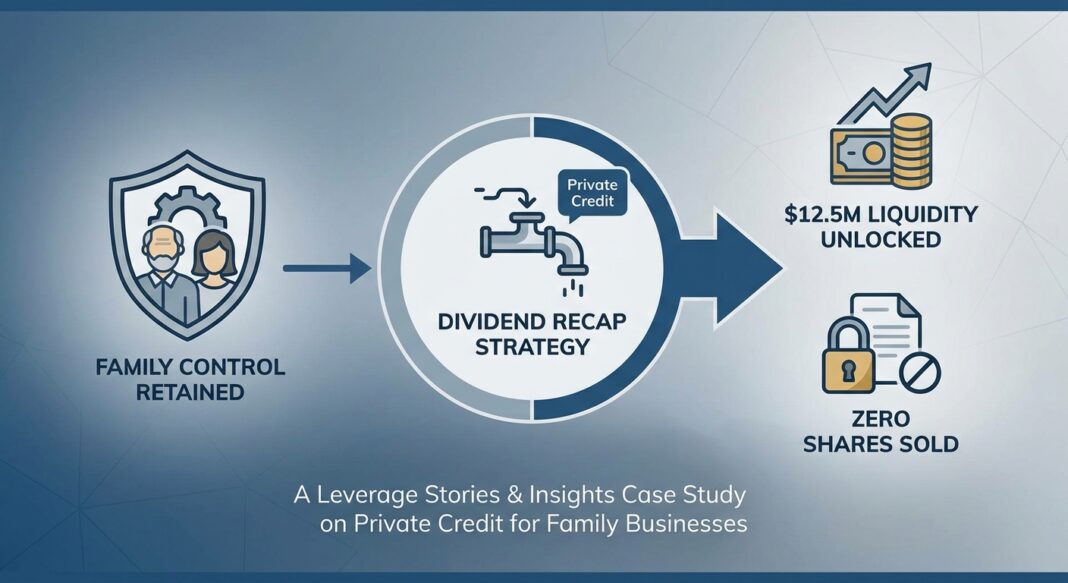
The Story: Thirty Years, One Decision
Marcus had spent thirty years building his precision contract manufacturing business in the Ohio River Valley. His father had started the company with two CNC machines and a handful of employees. Marcus had grown it into a regional anchor — 180 employees, $25 million in annual EBITDA, and contracts with three Tier-1 automotive suppliers. It was, by any measure, a remarkable story of American industrial ownership.
But in 2024, at 61 years old, Marcus faced a problem that success had quietly created: nearly his entire net worth — roughly $18 million on paper — was locked inside the company. His daughter, the likely successor, was 34 and not yet ready to run operations alone. His two sons had careers outside the business. And three of his minority shareholders — early employees who had received equity grants a decade prior — were in their late 50s, increasingly vocal about liquidity.
Marcus had received two approaches from private equity firms in the prior eighteen months. Both would pay a fair multiple — six to seven times EBITDA — but both came with the same terms: Marcus would retain a 20–30% minority stake, exit the CEO role within 24 months, and watch a new management team execute a debt-laden growth plan with a five-year sale horizon baked in from day one.
He didn’t want to sell. He wanted to stay. He wanted his daughter to have a company to run. He just wanted some of his own money back.
“I built this for forty years. I wasn’t going to hand the keys to a fund that would flip it in five.” — Composite voice, representative of founder-operator sentiment across multiple middle-market recapitalization conversations
Note: The company and founder described above represent a hypothetical composite scenario based on publicly documented deal structures in the private credit market. All financial figures, structures, and market data cited are drawn from real market sources as referenced throughout.
The Decision: Three Paths, One Right Answer
Marcus’s advisor laid out three options with clinical clarity:
Option A — Full Sale to Private Equity: A clean exit at 6.5x EBITDA ($162.5M enterprise value), netting Marcus approximately $130M after debt repayment and minority payouts. He walks away wealthy and entirely out. His daughter inherits nothing to run. The business gets levered up, institutionalized, and sold again in five years.
Option B — Minority Equity Recap: Sell 30–40% to a minority growth equity investor at a similar multiple. Take $40–50M in personal liquidity. Gain a capital partner. But accept board seats, governance rights, a forced exit timeline, and a cap table that would complicate succession planning for years.
Option C — Dividend Recapitalization via Private Credit: Borrow against the company’s cash flows. Pay a special dividend to all shareholders, proportionate to ownership. Keep 100% of the equity. Keep the board. Keep the succession plan intact.
His direct lending advisor structured the following: a $37.5M unitranche facility at 5.25x total leverage (5.25x EBITDA of $25M = ~$131M enterprise value implied), with an initial 24-month interest-only period, flexible covenants tied to integration milestones, and no amortization penalties for early repayment. The structure was underwritten by a single private credit fund — no syndication, no inter-creditor complexity, no public disclosure requirements.
Marcus owned 82% of the business. His minority employee-shareholders owned the remaining 18%. The $37.5M distribution was paid proportionally: Marcus received $30.75M in cash, and his three minority shareholders split $6.75M. No equity changed hands. No new investor joined the cap table. No board seat was surrendered. Annual debt service at the negotiated spread consumed roughly $3.6M — well within the company’s $25M EBITDA base.
This is not a novel structure. Sponsored dividend recapitalizations in the U.S. broadly syndicated loan market alone reached $72.2 billion in 2025, the second-highest annual total on record, per PitchBook-LCD data. What makes Marcus’s story instructive is not the instrument — it’s the context in which a founder-operator deployed it to solve a specific control-and-liquidity tension that equity could not resolve without destroying what he had built.
The Outcome: What Equity Would Have Cost
Three years after the recap, the comparison is instructive. Marcus’s company continued to grow under his leadership and his daughter’s increasing operational responsibility. EBITDA expanded to $31M by year two of the recap, aided in part by a bolt-on acquisition financed with the revolving portion of the same credit facility. Debt service remained manageable. The lender — who held the loan to maturity, as direct lenders characteristically do — remained a stable, low-interference capital partner.
Now model the counterfactual: what would Option B’s minority equity deal have looked like by the same period? A 35% minority investor acquired at a $162.5M enterprise value would hold equity now worth considerably more as EBITDA expanded. But more corrosive than the economic dilution would have been the governance implications. Equity financing typically dilutes existing ownership by 10–25% per round and often brings new board members who influence major decisions, according to data compiled by Flow Capital. A minority equity partner with board rights and a five-year return horizon would have had direct input into whether the company pursued the bolt-on acquisition, at what leverage, and at what pace.
Marcus’s daughter would have been managing not just operations, but an investor relationship with misaligned time horizons from the moment she stepped into the CEO role.
Instead, Marcus retained full ownership, extracted $30.75M in personal liquidity, diversified his family balance sheet, and handed an unencumbered governance structure to his successor. The math favors debt decisively — as long as the business can service it.
That caveat carries weight. A 2025 NBER working paper studying PE-sponsored dividend recapitalizations found that the instrument meaningfully increases average deal returns, but also found measurable increases in financial distress risk for companies that are overleveraged relative to their cash flow stability. The margin of safety is everything.
The Lessons: A Framework for Similar Decisions
Marcus’s story is increasingly common, and the market infrastructure now supports it at scale. Direct lending has become the dominant source of acquisition and recapitalization financing for companies with EBITDA between $10M and $75M, according to Preqin and PitchBook data reviewed by Growth Shuttle. Global private credit assets under management surpassed $1.7 trillion in early 2025, more than tripling from $500 billion a decade prior — and 70% of recent founder- and family-owned transactions financed by Overland Advantage, a Wells Fargo and Centerbridge Partners direct lending joint venture, were for founder- and family-owned businesses, per their January 2026 announcement.
But market availability does not mean universal applicability. The framework for evaluating a dividend recapitalization rests on four questions:
1. Can the business reliably service the debt? The lever should be set at a level where even a moderate revenue contraction — 15–20% — does not impair debt service. Average leverage multiples on dividend recaps reached 5.21x in 2026, per PitchBook-LCD. That is a useful market reference, not a target. Conservative operators should underwrite to 4x–4.5x with a clear de-leveraging plan.
2. Is the motivation liquidity, control, or both? A recap solves liquidity without sacrificing governance. If the primary need is a large capital infusion for transformation, a strategic equity partner may add more value than leverage alone. The instrument should match the problem.
3. What is the succession timeline? A recap executed five years before a leadership transition gives the incoming generation an unencumbered balance sheet to manage. A recap executed with no succession plan is a financial event without a strategic anchor.
4. Who is the lender, and what are the covenants? Unlike syndicated bank facilities where loan holders may trade positions, direct lenders typically hold their loans to maturity, creating a more stable lender base with genuine alignment around business performance, as noted by Max Wave Capital’s analysis of private credit structures. A lender who understands the business and intends to hold through cycles is a materially different partner than one optimizing for secondary market pricing.
Key Insights
- Liquidity and ownership are not mutually exclusive. A well-structured dividend recapitalization allows founders and family owners to extract decades of built value without surrendering governance, board seats, or the succession timeline they’ve designed.
- The dilution math of equity is permanent; the cost of debt is finite. Each equity round typically dilutes founders by 15–25%, and that ownership is never recovered. Debt is retired. By Series C, founders on the equity path often hold 15–25% of the company they built — a fact Marcus’s story makes visceral.
- Private credit has matured enough to serve the founder-owned middle market at scale. With direct lending AUM exceeding $950 billion in 2025, access to sophisticated, non-bank capital is no longer limited to sponsor-backed platforms. Founder- and family-owned companies with stable cash flows are now primary targets for direct lenders seeking differentiated deal flow.
- The right leverage is not the maximum available leverage. Market averages (5.2x in 2026) reflect sponsor-driven transactions with institutional oversight. Founder-operators without that infrastructure should underwrite to lower multiples with meaningful headroom — the NBER research on dividend recaps is a sober reminder that distress risk rises measurably with aggressive structures.
- Capital structure is a succession planning tool, not just a financing decision. Founders who use a recap to diversify personal wealth and simplify the cap table before a leadership transition are handing their successors a cleaner, more navigable business. That is a strategic gift that equity-heavy alternatives rarely provide.


