
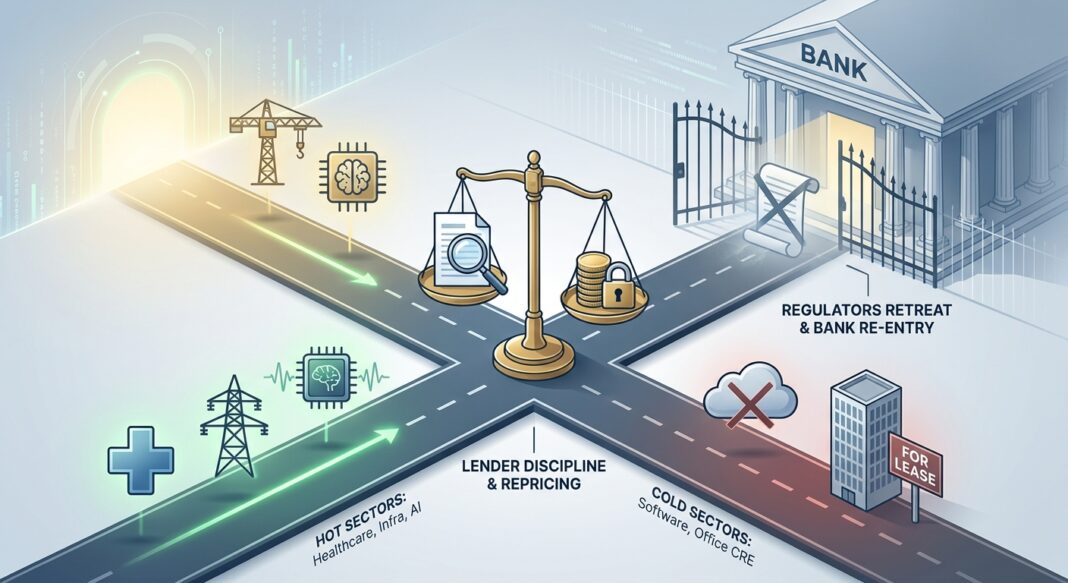
Market Headline: A Lender-Friendly Reset Takes Hold
The private credit market entered Q4 2026 in a state of structured recalibration — tighter where it counts, more selective where it should be, and strategically reshaped by a regulatory decision that few operators have fully priced into their capital planning. After a turbulent first half marked by AI-sector disruption, geopolitical volatility, and a sharp surge in BDC redemptions, market conditions have stabilized but have not reversed. The macro signal is clear: the lending environment of 2021–2022 is not coming back, and borrowers who were underwritten against it are now confronting that reckoning in real time.
The headline structural development is the December 2025 rescission of the 2013 Interagency Leveraged Lending Guidance by the OCC and FDIC — a decade-long regulatory constraint that had effectively channeled higher-leveraged deal flow away from banks and into private credit. That realignment is now unwinding at the margin, with banks showing early signs of re-entry into leveraged credits. At the same time, private credit itself is exhibiting the hallmarks of a mid-to-late cycle lender market: improved documentation, stricter covenants, more conservative leverage, and widened spreads on risk-differentiated credits. The market is bifurcating — and intelligently so.
For institutional investors and operators relying on debt capital to fund acquisitions, recapitalizations, and growth, the present moment demands sharper KPI discipline and a clearer understanding of where lender appetite is concentrating — and retreating.
Quantitative Market Snapshot
The table below reflects the most current available market data as of Q3/early Q4 2026.
| Metric | Current Value (Q3 2026) | Prior Period | Change | Source |
|---|---|---|---|---|
| Middle Market Direct Lending Spreads (new issuance) | S+500–549 bps (sponsor/buyout) | S+475–500 bps (Q4 2025) | +25–50 bps | PitchBook LCD, Aug 2026 |
| Unitranche New Issuance Coupon Spread | 4.75%–5.75% over SOFR | 4.50%–5.50% (YE 2025) | ~+25 bps | VRC Q3 2026 Update |
| All-In Yield (Middle Market, floating-rate) | +43 bps vs. YE 2025 (on spot 3M Term SOFR) | YE 2025 baseline | +43 bps YTD; +35 bps QoQ | VRC Q3 2026 Update |
| US High Yield Composite Spread (public market) | ~324 bps (Oct 8, 2026) | ~304 bps (YE 2025) | +20 bps YTD | StreetStats Finance, Oct 8, 2026 |
| Private Credit vs. Public High Yield Spread Premium | ~150–200 bps | ~350 bps (2019) | Compressed ~150–200 bps since 2019 | Owners.pe, Apr 2026 |
| BDC Non-Accrual Rate (median, 20 largest BDCs) | 2.8% (Q2 2026); Fitch 12-mo default rate: 6.1% | 2.0% (Q1 2026); 1.9% (YE 2025) | +0.8 pp QoQ; cycle high since 2017 | Morningstar / PitchBook LCD, 2026; Fitch, Aug 2026 |
| New Deal Leverage Multiples (high-quality transactions) | 5.0x–6.0x Debt/EBITDA | More conservative post-March 2026 | Underwriting tightened since Q1 2026 volatility | VRC Q2 2026 Update |
| Bank C&I Lending Standards (large/mid-market firms) | Unchanged in July 2026; easier than historical midpoints | Net +10.0% tightening (Q2 2026 SLOOS) | Eased from Q2 to Q3 | Federal Reserve SLOOS, July 2026 |
OID pricing on standard transactions remains 98.75–99.25. BSL B-rated loan index tightened from S+445 to S+412 in Q3 2026. Sources: VRC, PitchBook LCD, Fed SLOOS, StreetStats Finance, Morningstar, Fitch.
Sector Analysis: Where Capital Is Flowing — and Where It Is Pulling Back
🟢 Hot Sectors: Healthcare, Infrastructure & AI-Adjacent Hard Assets, Business Services
Healthcare remains the dominant anchor of private credit deal flow. According to Octus, healthcare led all sectors in 2025 direct lending activity, accounting for 19% of total deal volume — and was the only sector not to see meaningful year-over-year spread tightening, with average pricing holding at approximately SOFR+500 bps in Q4 2025. Lenders value healthcare’s non-cyclical revenue streams and the FCCR predictability that demographic-driven demand delivers. Specialist platforms and sponsor-backed physician services and tech-enabled care models are seeing the most active bidding.
Infrastructure and AI-adjacent hard assets have emerged as a structurally distinct opportunity. The Financial Stability Board’s May 2026 vulnerability report estimated that AI infrastructure capex between 2025 and 2028 is projected at $2.9 trillion, with approximately $800 billion expected to be financed by private credit. Data centres, power generation, and digital infrastructure are among the highest-conviction deployment themes for 2026 and beyond. Paul Weiss’s 2026 outlook identifies energy infrastructure, digital infrastructure, defense, and next-generation manufacturing as priority sectors for institutional capital.
Business Services has quietly displaced Industrials in portfolio weighting. Credit Benchmark’s 2026 review of 20 major U.S. private credit funds found Technology, Business Services, and Healthcare as the three dominant sector concentrations — with Business Services gaining share from Industrials year-on-year.
🔴 Cold Sectors: Software/SaaS, Office CRE, Leveraged Tech Services
Software and technology-services credits continue to price at a meaningful penalty. New issuance spreads in the sector run 50–100 bps wider than broader market levels, and BSL secondary B-rated software loan spreads remain 100 bps above the all-loan B-rated index, according to VRC’s Q3 2026 data. New software issuance has remained limited, and rating agencies and VRC both flag elevated defaults, restructurings, and amendment activity among 2021–2022 software vintages. Borrowers in this cohort have seen average interest coverage decline from approximately 2.2x at underwriting to the mid-1.5x range — a structural FCCR impairment driven by ~40% higher interest expense since origination.
Lower Middle Market (LMM) continues to represent a bifurcated but compelling segment. While large-cap direct lending spreads experienced compression in 2025, the LMM spread premium over large-cap widened to 232 bps in Q3 2025 — the structural consequence of capital concentration at the upper market. For the $5M–$25M EBITDA segment, real maintenance covenants, lender-sponsor proximity, and more favorable entry pricing remain structural advantages.
Regulatory Inflection: The Leveraged Lending Guidance Rescission and Its Cascade Effects
The single most consequential structural development shaping the lending environment in 2026 is the rescission of the 2013 Interagency Leveraged Lending Guidance. On December 5, 2025, the OCC and FDIC formally withdrew the decade-long prescriptive guidance that had effectively capped bank underwriting of leveraged loans — particularly those exceeding 6x Debt/EBITDA — and redirected that deal flow to private credit. The Federal Reserve has not yet followed, though rescission is widely anticipated.
The implications are structural, not cosmetic. The rescission may bring more leveraged lending back into the traditional banking system, intensifying competition with private credit firms. However, multiple market participants note that capital requirements, syndication risk, and liquidity constraints will continue to limit how aggressively banks re-enter the space — particularly for club and bilateral deals below $500M. The July 2026 SLOOS confirms that C&I lending standards are currently easier than their historical midpoints for large and middle-market firms — a signal that banks are incrementally willing to compete, but not yet aggressively so.
KPI Underwriting Shifts: FCCR and Leverage Multiples Under Active Revision
The credit underwriting framework is tightening in measurable and directionally consistent ways across the market. Key KPI shifts that operators and investors must internalize:
- Fixed Charge Coverage Ratio (FCCR): Lenders are increasingly applying forward-looking FCCR stress tests that incorporate higher floating-rate assumptions. VRC’s proprietary data on 2021 vintage cohorts shows adjusted cash interest coverage declining by approximately 0.4x since origination — a direct consequence of base rate elevation. Coverage ratios in the mid-1.5x range (down from ~2.2x at underwriting) are now a portfolio-wide concern, not an edge case.
- Debt/EBITDA: For high-quality new transactions, leverage is being underwritten in the 5.0x–6.0x range. However, Heron Finance’s Q2 2026 benchmark report finds that borrower Debt/EBITDA has been stable with no material upward drift across the platform universe — a sign that portfolio-level discipline is holding even as new deal competition remains elevated.
- Covenant Structure: Lord Abbett’s midyear analysis notes that improved loan structures — fewer PIK requests, less aggressive leverage, more covenants, and stronger documentation — are emerging ahead of broader spread widening. This is a classic early lender-reset signal.
- Subordinated Debt Yields: VRC increased subordinated yield ranges by 25 bps in Q3 2026 to maintain appropriate premiums over floating-rate senior assets — reflecting both higher base rates and a structural reassessment of subordinated risk in a higher-default environment.
Implications for Institutional Investors and Operators
For Institutional Investors & Lenders
- Vintage selection is now the alpha variable. Credit risk remains most pronounced in 2021–2022 vintages, which were underwritten at historically low rates with aggressive growth assumptions and peak leverage. Portfolios with high concentrations in these cohorts — particularly software and tech services — face elevated restructuring activity and impairment risk heading into 2027 maturity walls.
- The illiquidity premium is compressing. Private credit’s spread over public high yield has compressed from ~350 bps in 2019 to ~150–200 bps today. As BNY noted in September 2026, all-in yields on public high yield corporates of ~7.3% are creating a legitimate re-allocation question for new marginal capital.
- Manager selection is the dominant risk control. Lord Abbett’s analysis concludes that manager discipline, sector selection, and underwriting standards are beginning to matter more than market beta — and that the most durable advantage comes from better documentation and the time to conduct stress analysis before deployment.
- BDC liquidity requires monitoring. Average redemption requests among the largest non-traded BDCs declined slightly from 13.9% in Q2 to 13.0% in Q3 — but remain well above the standard 5% quarterly limit. Non-accrual debt across the BDC universe jumped to 3.3% in Q1 2026, up 116 bps from the prior quarter.
For Borrowers & Operating Executives
- Refinancing windows are narrowing for lower-quality credits. Refinancing risk is increasing as maturities approach for 2021–2022 vintage loans, particularly for borrowers with stagnant EBITDA and elevated leverage. Proactive engagement with lenders — before covenant headroom erodes — is a strategic necessity, not a reactive option.
- Unitranche remains the dominant access point. Direct lending via unitranche structures — now pricing at SOFR+4.75%–5.75% — continues to offer execution speed and documentation flexibility that syndicated markets cannot match, particularly for sub-$1B transactions. OIDs have stabilized at 98.75–99.25, indicating no further deterioration in upfront economics.
- Sector positioning is a lender decision driver. Borrowers in healthcare, infrastructure, and business services with recurring, non-cyclical cash flows will continue to access credit on more favorable terms. Technology and software borrowers must demonstrate AI-resilience and unit economics discipline to access the tighter end of the pricing range.
Forward-Looking View: Next 3–6 Months
The credit cycle is signaling mid-to-late cycle dynamics without an imminent cliff: spreads have widened constructively, non-accruals are rising but concentrated among specific vintages and managers, and the regulatory environment is selectively loosening. Markets are currently pricing one to two additional 25 bp Fed rate increases by year-end 2026, with further hikes expected in H1 2027 — keeping base rates elevated and all-in debt costs structurally higher than the 2019–2022 era.
PitchBook’s August 2026 Private Credit Monitor shows direct lending activity recovering off Q2 2026 lows, though year-to-date pace still trails 2025. As banks tentatively re-enter leveraged markets following the guidance rescission, private lenders with the origination infrastructure, sponsor relationships, and sector expertise to lead large, complex transactions will retain their structural advantage. Scaled platforms — those that can offer speed, certainty, and covenant flexibility — will continue to command the best deal flow and pricing power.
For the asset class broadly, the 2026 second half looks constructive but selective: wider spreads on risk-differentiated credits, improving deal structures, and a rising tide of distressed opportunity for those positioned to capitalize on it.
Key Market Insights
- Spreads have repriced: Middle market direct lending new-issuance spreads are now 25–50 bps above year-end 2025 levels, with all-in yields rising approximately 43 bps YTD — a meaningful shift in lender economics. (VRC Q3 2026)
- Non-accruals are at cycle highs: The median BDC non-accrual ratio reached 2.8% in Q2 2026 — the highest since 2017 — and Fitch’s trailing 12-month private credit default rate hit a record 6.1% in July 2026. The acceleration is concentrated in software and 2021–2022 vintage loans. (Fitch / Morningstar, 2026)
- Regulatory deregulation is a structural wildcard: The OCC/FDIC rescission of the 2013 Leveraged Lending Guidance effective December 2025 removes a decade-long constraint on bank leveraged underwriting, potentially intensifying competition with private lenders at the upper end of the credit market. (Mayer Brown, Dec 2025)
- The illiquidity premium is compressing — but hasn’t vanished: Private credit’s spread premium over public high yield has fallen from ~350 bps in 2019 to ~150–200 bps today, narrowing the relative value argument for new allocations, though meaningful compensation for illiquidity, concentration, and information asymmetry remains. (Owners.pe, Apr 2026)
- Sector and vintage selection are paramount: Healthcare, infrastructure, and AI-adjacent hard assets are commanding the strongest lender appetite; software/SaaS credits face a 50–100 bps pricing penalty and constrained access. FCCR discipline, covenant protections, and conservative leverage in new underwriting are now the hallmarks of best-in-class origination. (Credit Benchmark 2026; VRC Q3 2026)


