
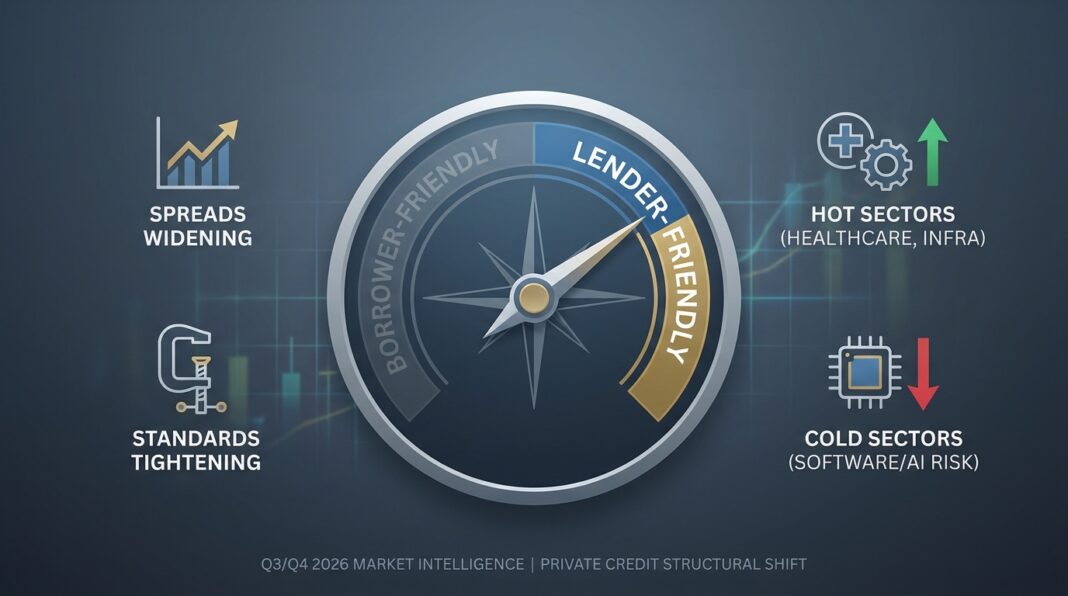
Market Headline: The Lender-Friendly Reset Is No Longer a Forecast — It Is the Market
As of October 7, 2026, the private credit market is navigating its most consequential inflection point since the 2022 rate shock. The first half of 2026 tested several assumptions underlying prior-year outlooks, with the pullback in technology underwriting, combined with net outflows from Business Development Companies (BDCs) and other private credit vehicles, contributing to wider spreads on newly originated loans in both direct lending and the broadly syndicated market. Following an extended period of spread compression, lenders are once again earning greater compensation for risk. That structural reversal is now confirmed across multiple data sets and is intensifying into Q4.
Three macro-level forces are converging simultaneously. First, the ongoing market volatility and risk-off sentiment has led to early signs of repricing in credit markets, with spreads on broadly syndicated and high-yield loans widening by approximately 15–30 basis points on new issues from Q4 2025 to Q1 2026, while spreads in the private credit market have adjusted upward, with new loans pricing approximately 25 basis points higher. That initial repricing has since accelerated further. Private credit spreads have returned to the SOFR+500 context again, up from the mid-400 bps level prior to geopolitical escalation events earlier in the year. Second, middle market credit spreads widened in Q1 2026 amid AI uncertainty, geopolitical risk, and slower deal flow, as heightened volatility pushed credit markets back into price discovery mode — with primary market activity slowing and secondary spreads widening, particularly for technology and software-exposed credits. Third, Fitch Ratings’ trailing 12-month private credit default rate climbed to a record 6.0% through Q2 2026, up from 5.7% in Q1, with 32 default events from 20 new defaulters logged in the quarter alone.
These are not isolated data points. They represent a synchronized repricing of credit risk that is reshaping underwriting standards, sector capital flows, and the fundamental value proposition for both lenders and borrowers. The era of borrower-friendly documentation, covenant-lite structures, and peak leverage is being unwound — and the speed of the unwind is accelerating.
Quantitative Market Snapshot — Q3/Q4 2026
DATA BOX: Key Credit Market Metrics as of October 7, 2026
| Metric | Current Value | Prior Period | Change | Source |
|---|---|---|---|---|
| Middle Market Direct Lending Spread (new-issue) | SOFR + ~500–550 bps | SOFR + ~450–475 bps (YE 2025) | +50–100 bps wider | Lord Abbett / PitchBook, Jun 2026 |
| ICE BofA US HY Index OAS (broad market) | 312 bps (Oct 5, 2026) | 265 bps (Jan 31, 2026) | +47 bps YTD | FRED / ICE BofA (Oct 6, 2026) |
| Leveraged Loan OAS (Morningstar LSTA Index) | 453 bps (Jun 2026) | 404 bps (YE 2025) | +49 bps wider | Fidelity Q2 2026 Loan Market Review |
| Senior Loans Yield to Worst | 9.60% (Oct 2, 2026) | ~8.5% (YE 2025 est.) | +~110 bps wider | Nuveen Fixed Income Weekly, Oct 2, 2026 |
| Fitch Private Credit Default Rate (trailing 12M) | 6.3% (Aug 2026, record high) | 5.7% (Q1 2026) | +60 bps; record | Fitch / Yardeni Private Credit Monitor, Sep 2026 |
| Middle Market Leverage (avg. total debt/EBITDA) | 5.0x–5.5x (upper MM); 3.5x–4.5x (lower MM) | 5.0x–6.0x (Q1 2026 peak deals) | Compressing post-March | VRC Q2 2026 / PGIM benchmark |
| Direct Lending Loan Origination Volume (Q2 2026) | $32.9B (Q2 2026) | $74.1B (Q1 2026) | –55.5% QoQ | Capstone Partners / PitchBook LCD Q2 2026 |
| Direct Lending Fundraising (North America, Q2 2026) | $16.25B (Q2 2026) | $1.3B (Q1 2026) | +12.5x QoQ | Preqin / Reuters, cited by Angel Investors Network |
All data current as of publication date, October 7, 2026. Spread data sourced from public indices and institutional research; private credit figures represent market estimates based on observed transactions. Past performance does not guarantee future results.
The spread data reveals a critical bifurcation: high-yield yields rose toward 8.3% in late September, reflecting broad deterioration in tone, with new issuance active but performance on recent deals poor, leaving the market technically weaker and more defensive heading into October. Meanwhile, the deployment-to-fundraising gap is sharpening the dry powder paradox. Deal count fell to 154 completed direct lending transactions in Q2, down from 217 in Q1 — the weakest quarter for lending activity since Q2 2023 — even as fundraising surged from $1.3 billion to $16.25 billion over the same period. With so much capital competing for a shrinking pool of quality deals, GPs face real pressure to cut pricing or loosen covenants, yet Q2 data suggests that on balance, direct lenders chose discipline over volume.
The bank lending backdrop offers additional context. The July 2026 SLOOS reported that banks left commercial and industrial (C&I) lending standards basically unchanged over the second quarter of 2026 for firms of all sizes. However, the aggregate framing obscures a more nuanced picture: banks reported that the levels of standards are currently at the tighter end of the historical range for all loan categories except C&I loans, for which standards are generally easier than their midpoints. Crucially, in commercial real estate, banks eased lending standards the most since early 2022, a sign that some appetite for risk is returning in select segments. Demand remains concentrated among larger borrowers: approximately 16% of banks cited stronger demand for C&I loans from large businesses, while that figure was just 4% for small firms.
KPI Underwriting Thresholds: FCCR and Leverage Multiples Under Active Revision
The shifting spread environment is recalibrating lender KPI expectations in real time. Through June 2026, competitive dynamics had supported higher leverage levels — often in the 5.0x–6.0x range for high-quality transactions — although underwriting standards have become more conservative since March amid expectations for higher base rates and constrained M&A volumes. The vintage stress problem compounds this: credit risk remains most pronounced in 2021–2022 vintages, which were underwritten at historically low reference rates and often incorporated aggressive growth assumptions and peak leverage; VRC’s proprietary data indicates leverage in this cohort has increased by approximately 0.9x while adjusted cash interest coverage has declined by roughly 0.4x as of Q1 2026.
In practical terms, new deal spreads have widened by roughly 50 to 100 basis points since late 2025, but the more important change is structural: new loans are increasingly coming with better credit structures — less leverage, more covenants, fewer PIK requests, and tighter documentation. This directly impacts FCCR thresholds. Lenders are resetting minimum fixed charge coverage requirements upward, with the combination of excess leverage, weakened documentation, and uncertainty around enterprise value multiple sustainability meaning that if companies disappoint, many lenders will find themselves with lower recovery rates than the asset class has historically delivered — signaling that the private credit market could be entering its first serious test of underwriting decisions made under unusually favorable conditions.
Sector Analysis: Hot Sectors, Cold Sectors, and Structural Capital Shifts
🔥 Hot Sectors: Healthcare, Infrastructure & Energy, Asset-Based Finance
Healthcare led all private credit sectors in 2025, accounting for 19% of all direct lending deals and remaining the only major industry not to see significant disruption heading into 2026. A Credit Benchmark review of 20 major U.S. private credit funds confirms that sector exposures remain concentrated in Technology, Business Services, and Healthcare — with exposures broadly stable across the fund sample.
Infrastructure is the structural growth story. Corporate borrowers have increasingly looked to private credit to finance real estate, infrastructure, and technology, with infrastructure financing specifically used to fund large-scale projects such as renewable energy developments that require significant capital investment. Looking ahead, priority sectors include energy infrastructure, digital infrastructure, defense and national security, and next-generation manufacturing — all requiring patient institutional capital.
Asset-based finance is emerging as the structural challenger to traditional direct lending. Specialty finance launches as a proportion of all funds in development rose from 23% in 2024 to 34% in 2025, with the 10 largest specialty finance funds collectively targeting around $35 billion — and in the long term, asset-based finance is expected to challenge or even overtake the direct lending market as banks continue to de-risk their balance sheets.
❌ Cold Sectors: Software/SaaS and AI-Exposed Technology Credits
The software sector is experiencing the sharpest dislocation in the private credit market. Performance is notably weaker in the software sector, where secondary spreads are approximately 245 basis points wider than year-end levels and roughly 229 basis points above the broader B-rated loan index, based on PitchBook LCD data as of June 19, 2026, reflecting continued uncertainty related to AI-driven disruption.
Within sector-specific lending, market participants broadly expect new software-related direct lending transactions to price at premiums of approximately 75 to 100 basis points above year-end levels, while many lenders continue to adopt a more cautious stance, with some remaining risk-off, others already overexposed, and many limiting incremental exposure amid ongoing uncertainty in borrower performance. The risk concentration is acute: a majority of the software sector’s private credit exposure is tied to lower credit ratings, with 50% of loans carrying a B– or lower credit rating according to Morgan Stanley estimates, while private credit software and services exposure is approximately 20% of total portfolios per BNP Paribas analysts.
Software exposure may be larger than headline allocations suggest: industry classifications can obscure underlying business models, with companies categorized as “business services” and certain segments within healthcare and financial services often being fundamentally software-driven enterprises — meaning true technology exposure in private credit portfolios may be understated.
Smaller borrowers are carrying a disproportionate load: issuers with $25 million or less in EBITDA defaulted at a 12.3% rate in July 2026, roughly triple the 3.9% rate for the next size band up. The PIK trend reinforces this stress signal: the share of BDC loans carrying payment-in-kind terms rose from approximately 6% in early 2022 to roughly 10% by early 2026 — a 67% increase that appears broadly across industries rather than in a handful of troubled sectors, which researchers read as a sign of cash flow pressure spread across the middle market.
Implications for Institutional Investors and Operators
For Borrowers and Operating Executives
The borrowing environment has fundamentally repriced. Combining current base rates and spreads, direct lending continues to generate high single-digit unlevered asset returns — and the combination of interest rates remaining elevated and potentially widening spreads presents an attractive gross yield outlook for lenders, but a more expensive environment for borrowers. U.S. Treasury yields have moved meaningfully higher, with the 10-year at 5.27% and the 30-year at 5.62% as of October 2, 2026 — setting a high all-in cost floor for any leveraged transaction.
Operators with 2021–2022 vintage debt face the sharpest near-term pressure. By Q3 2024, interest expense for early 2022 vintages had increased by approximately 40%, contributing to a decline in average interest coverage from approximately 2.2x at underwriting to the mid-1.5x range, and for borrowers experiencing stagnant or declining EBITDA, elevated leverage and approaching maturities have driven increased restructuring activity. Executives should model refinancing scenarios against a base case of SOFR + 500–550 bps for senior secured credit with 5.0x leverage maximum, and stress-test FCCR under rate-hold and moderate EBITDA compression scenarios.
Standard terms have firmed, with 2% to 3% original issue discount at funding and 102/101/par call protection across the first three years confirmed as broad-based across the latest middle market leveraged finance data. Companies with clean balance sheets, diversified revenue, and non-software business models remain best positioned to access competitive pricing.
For Institutional Investors and Lenders
Forward return potential in private credit is more attractive today than at the start of the year, supported by wider spreads, stable borrower fundamentals, and growing financing demand — and despite macro headwinds, broader credit fundamentals have remained notably resilient, with a composite of default measures remaining well below the 2024 peak.
Investors should focus on niche areas of private credit such as core middle-market direct lending, which may sidestep concerns percolating in broader markets, while an allocation to opportunistic credit makes sense for those positioned to capitalize on volatility as it grips both public and private markets.
Manager selection has never been more consequential. The private credit market may be entering its first serious test of underwriting decisions made under unusually favorable conditions, and outcomes are expected to diverge meaningfully across managers, with the degree of dispersion reflecting the degree to which documentation standards were compromised during the years of easy capital. Recent deterioration of investor sentiment in the private credit market has raised concerns that a contraction in credit availability may curtail the ability of some middle-market firms to obtain financing — making substitution patterns between private credit and leveraged loan markets a key monitoring variable.
Forward-Looking View: Liquidity and Lending Dynamics — Next 3–6 Months
Higher-for-longer rates continue to weigh on M&A activity — deal volumes were 42.4% lower by March 2026 than January levels — and a more challenging exit environment and extended hold periods are likely to persist in the near term, though substantial dry powder remains available and a stabilization in AI-related concerns or geopolitical tensions could allow markets to reopen quickly.
As banks begin to reenter the lending market and private equity M&A activity shows signs of recovery, upward pressure on credit spreads has moderated, and VRC maintained its credit spread ranges for middle market securities during Q2 following a prior-quarter increase. This suggests spreads may be approaching a near-term ceiling for non-software credits, though the path forward remains highly dependent on geopolitical developments and the trajectory of Fed rate policy.
Going into the second half of 2026, the private credit industry’s growth trajectory remains structurally strong, with the retreat of bank lending from middle-market loans showing no signs of reversing despite regulatory relief. The asset class has grown to approximately $2 trillion in funded private credit globally — ten times the size of the same market in 2009 — according to McKinsey & Company data.
Core and lower middle market direct lending — as well as non-sponsored finance — continue to offer attractive spread premiums, while areas like asset-based finance and real estate credit may simultaneously accomplish income goals and enhance diversification for institutional allocators. The convergence of tighter documentation, wider spreads, and elevated selectivity positions Q4 2026 as a historically attractive vintage entry point for disciplined new-money deployment — provided manager selection is rigorous and sector exposure to distressed software credits is actively monitored and sized accordingly.
Key Market Insights — 5 Actionable Takeaways
- Spreads are wider and the trend has legs through Q4 2026. Middle market direct lending spreads have moved to SOFR + ~500–550 bps, up 50–100 bps from year-end 2025 levels, while new deal documentation — more covenants, less leverage, fewer PIK requests — makes today’s loans structurally superior to 2023–2024 vintages. New capital deployment benefits from both better pricing and stronger structural protections. (Lord Abbett / PitchBook)
- The Fitch default rate at 6.3% is a signal, not a crisis — but small-cap borrowers face a real reckoning. Issuers with $25M or less in EBITDA are defaulting at 12.3% — triple larger peers — and the PIK ratio has risen 67% over three years. Lenders and operators must actively distinguish between index-level noise and concentrated vintage-specific credit deterioration, particularly in the 2021–2022 cohort. (Fitch / Angel Investors Network)
- Software and SaaS credits require a premium of 75–100 bps above standard yield matrix rates and tighter leverage caps. With secondary spreads for software credits approximately 245 bps above the broader B-rated loan index, and AI disruption continuing to pressure enterprise software revenue models, lenders with legacy software overexposure face meaningful mark and recovery risk. New origination in this sector demands explicit AI disruption underwriting. (VRC / PitchBook LCD)
- Bank C&I lending standards are easing for large corporates but the middle market gap remains structural. July 2026 SLOOS data confirms C&I standards are easier than the historical midpoint — but only for large firms, where 16% of banks report stronger demand vs. just 4% for small businesses. The structural retreat of banks from the middle market continues to create the primary addressable opportunity for private credit platforms with established origination networks. (Federal Reserve SLOOS, July 2026)
- Infrastructure, healthcare, and asset-based finance are the three highest-conviction sector allocations for new capital in H2 2026–2027. These sectors feature durable cash flows, less AI disruption exposure, stronger covenant negotiability, and alignment with secular capital demand from energy transition, healthcare delivery evolution, and bank balance sheet de-risking. Asset-based finance in particular is positioned for long-term structural growth as specialty finance launches reach 34% of all new fund development. (Paul Weiss; With Intelligence)


