
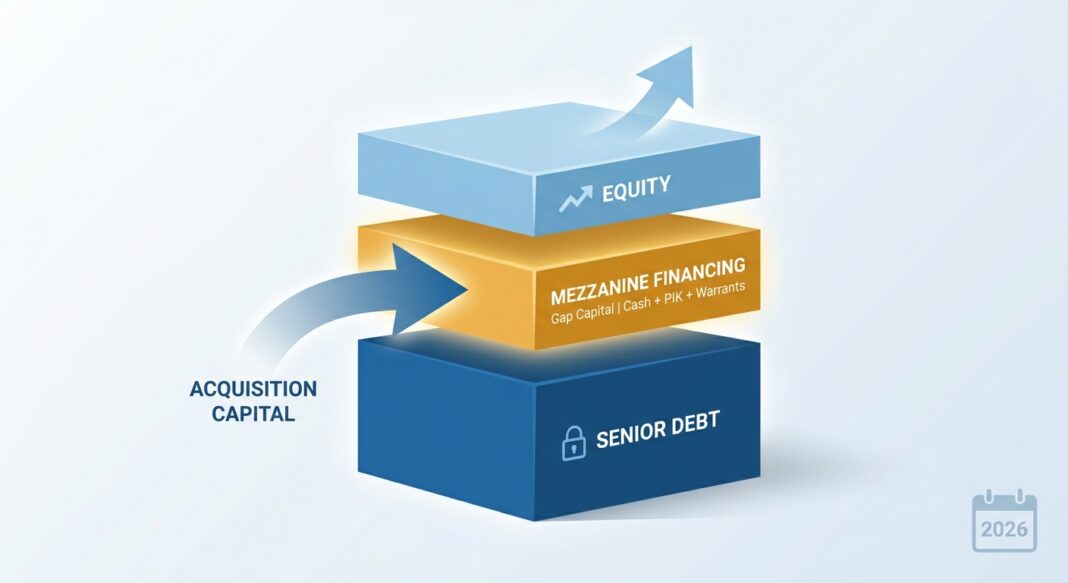
The Capital Gap That Equity Cannot Afford to Fill
Here is the scenario facing hundreds of growth-stage operators in 2026: you have found a compelling acquisition target. Your senior lender will stretch to 3.5x EBITDA—maybe 4.0x on a good day. The purchase price implies 6.5x EBITDA. The gap between what the bank will lend and what you need to close is real, material, and stubborn.
The instinct is to fill that gap with equity. But equity is the most expensive capital on the page. In 2026, a blended lower-middle-market stack of 50% senior debt at SOFR plus 6.0%, 15% mezzanine at 13% all-in, and 35% equity would produce a weighted average cost of capital near 12% to 14%—well below the 20% to 25% expected on all-equity growth capital. Plugging that gap with an equity round instead of mezzanine doesn’t just cost more in raw yield terms; it surrenders permanent ownership in a company whose upside you are acquiring specifically because you believe in it.
Fill the gap with too much dilutive equity and the founders lose the very upside the acquisition was designed to capture. Fill it with too much high-coupon debt and cash flow constraints strangle the combined business before synergies materialize. Mezzanine financing exists precisely to solve this tension. It is the layer of the capital stack that lets a growth-stage acquirer access leverage beyond the senior lender’s appetite without surrendering control or a large equity slice. This article is a complete practitioner’s guide to building that layer correctly.
Structure Breakdown: Subordination, PIK, and the Equity Kicker
Mezzanine capital sits between senior debt and equity in a company’s capital structure and is typically used to fund growth, acquisitions, or buyouts. In lower-middle-market transactions it is the workhorse layer that closes purchase price gaps, funds partner buyouts, and enables dividend recapitalizations when senior debt is fully drawn. Understanding its three core components is essential before approaching any mezzanine lender.
Component 1 — Subordination and Lien Position
Mezzanine debt is subordinated debt that represents a claim on a company’s assets senior only to that of the common shares and usually unsecured. Where it is secured, the lien is contractually junior to the senior lender’s first lien. This subordination is formalized through an intercreditor agreement that governs cure periods, enforcement rights, and standstill provisions. The mezzanine lender cannot act on a default unilaterally; standstills of 90 to 180 days are standard while the senior lender decides on enforcement.
Component 2 — Cash Interest, PIK, and the Blended Coupon
All-in cost in 2026 runs 12% to 15%, split among a 10% to 12% cash coupon, 1% to 3% PIK, and 1% to 2% warrant coverage per GF Data’s 1H 2026 report. The PIK (Payment-in-Kind) component is critical for growth-stage borrowers whose free cash flow does not yet fully support the total coupon. PIK interest is paid by increasing the outstanding principal balance of the debt rather than making cash payments. A $100 million note with 5% PIK interest grows to $105 million after one year. The interest compounds each period, so the total payoff at maturity is higher than the original principal—but this preserves the company’s cash flow for operations and senior debt service.
The note usually has a five-to-seven-year bullet maturity, a non-call period of one to two years, and step-down call premiums after that. Payment terms typically require quarterly cash interest, with the PIK interest capitalizing into the outstanding balance and paid at maturity or refinance.
Component 3 — Warrants and the Equity Kicker
Equity kickers are warrants or options attached to mezzanine debt that give the lender the right to purchase equity in the company, typically at a nominal strike price. The warrant usually entitles the lender to 1–5% of equity on a fully diluted basis. This is the component that makes mezzanine structurally different from pure debt. If the company exits at a high multiple, the warrants convert into meaningful equity proceeds, lifting the lender’s blended IRR from the coupon range of 10%–16% into the target range of 15%–20%. For the borrower, institutional mezzanine dilutes only through warrants—usually 1% to 5% of fully diluted equity—keeping the operator in control post-close.
Worked Example: A $15M Mezzanine Note in a $30M Acquisition
Consider a growth-stage managed services company with $4.0M EBITDA acquiring a complementary platform at a 6.5x multiple, implying a $26M purchase price.
| Capital Layer | Amount | % of EV | Instrument | Pricing / Terms |
|---|---|---|---|---|
| Senior Secured (Unitranche) | $14.0M | 54% | Term Loan | SOFR + 550 bps (~10.2% all-in), 5-yr, 1% annual amortization, max 4.5x leverage maintenance covenant |
| Mezzanine / Sub. Note | $6.5M | 25% | Sub. Note | 11.5% cash + 2.5% PIK + 3% warrant coverage, 5-yr bullet, NC1-103/102/101 call schedule, incurrence covenants + 1 maintenance test |
| Seller Note | $2.0M | 8% | Sub. Note | 6.0% fixed, 3-yr, PIK option in Year 1, fully subordinated to all institutional debt |
| Equity (Buyer) | $3.5M | 13% | Common Equity | Rollover + co-invest; no preferred features |
This structure delivers 5.1x total leverage at close. The mezzanine layer preserves $6.5M of equity value that would otherwise require a dilutive growth equity round—and at a 3% warrant coverage, the mezzanine lender’s equity exposure is bounded well below 5% fully diluted.
How Mezzanine Compares on the Cost-of-Capital Spectrum
Selecting the right capital instrument requires mapping the full spectrum from banks to equity and understanding what each layer costs in 2026 terms. The cost-of-capital comparison table is instructive: a senior bank term loan runs SOFR + 300–450 bps (roughly 8–10% all-in), a unitranche prices at SOFR + 550–750 bps (~10–12%), mezzanine or subordinated debt runs 12–15% (cash + PIK + warrants), preferred equity sits at 10–14% coupon plus conversion, and growth equity minority is priced to a 25%+ IRR expected return.
The comparison sharpens when viewed over a full investment horizon. A mezzanine sponsor might offer $10M at 12% cash + 3% PIK + 3% warrant coverage. On paper, growth equity delivers more cash. But on a five-year post-tax basis to the owner, mezzanine is usually cheaper by a factor of 2x because the owner keeps 97% of the equity appreciation, while the growth equity sponsor captures 30%.
The unitranche versus mezzanine decision is also worth unpacking. Unitranche collapses the senior and sub into one tranche from a single direct lender—one agreement, one lender, one covenant package. Direct lenders like unitranche because it lets them capture yield that used to flow to mezzanine funds while controlling the entire capital structure. The trade-off for the borrower is that unitranche typically carries a single, blended coupon across the full leverage quantum, whereas a layered senior-plus-mezz structure can achieve higher total leverage at a lower blended cost if the senior piece is priced competitively. The unitranche sweet spot sits at $25M–$200M enterprise value; below that range, SBA plus senior bank wins on cost, and above $300M the broadly syndicated loan market wins on cost.
The clearest use case for choosing mezzanine over unitranche is when the borrower can source senior debt at a lower spread independently and wants to layer in subordinated capital only to close the purchase price gap—avoiding the blended rate that unitranche applies to the entire facility.
Current Market Terms: What the 2026 Data Shows
The mezzanine market in 2026 is more active than at any point since 2014, driven by three structural forces: private credit AUM growth, senior bank retrenchment from the middle market, and elevated PE dry powder seeking deployment. Here are the current market data points operators need to know:
- Cash coupon and PIK pricing: Mezzanine financing costs 12% to 15% all-in in 2026, comprising a 10% to 12% cash coupon (typically SOFR + 700–900 bps or fixed 11.5%), 1% to 3% PIK interest, 1% to 2% warrant coverage, and a 2% to 3% origination fee.
- Rate trend: SOFR sat above 5.0% through most of 2024 before drifting to roughly 4.25% by mid-2026, which mechanically pulled the all-in mezzanine coupon down by 75 to 100 bps from the 2023 peak.
- Leverage attach and detach: Typical sizing is 1.0x to 1.5x EBITDA layered on top of 3.0x to 3.5x senior, taking total leverage to 4.0x to 5.0x on asset-light targets.
- Warrant coverage standard: Mezzanine debt financing in the second half of 2026 costs roughly 11% to 14% cash coupon plus 1% to 4% PIK plus 1% to 5% warrant coverage of the fully diluted cap table, with a 2% to 3% closing fee.
- Covenant standard: Common 2026 mezzanine structures for business acquisition include a 5-year note with bullet maturity, incurrence-based leverage covenants, one financial maintenance covenant (typically total leverage), 25% excess cash flow sweep, and a call schedule of NC1-103-102-101.
- Covenant testing mechanics: The typical covenant package includes a maximum total leverage ratio (usually 4.5x to 5.5x EBITDA), a minimum fixed charge coverage ratio (usually 1.10x to 1.25x), and a limit on annual capital expenditures. Some funds add a minimum liquidity floor for cyclical borrowers. Covenant testing is quarterly, with a 30-day cure window and cash-cure rights of one to two per year.
- Compressed spreads in senior layer: Current spreads in the middle market run approximately SOFR + 4.75% to SOFR + 5.50% for deals in the $40M–$100M EBITDA range, according to Lincoln International’s Q1 2026 private market data.
Looking ahead, unitranche and mezzanine are expected to penetrate deeper into the lower-middle market ($5M–$50M EBITDA) as regional private credit funds emerge and technology-enabled underwriting reduces friction and cost of execution, making these instruments accessible to a broader range of borrowers.
The Gap Capital Playbook: Four Steps to Closing a Mezzanine Round
Running a mezzanine process is structurally different from a senior debt raise. The universe of capital providers is smaller, the diligence is deeper, and the intercreditor negotiation can add 3–4 weeks to a timeline if not managed proactively. Here is the execution sequence:
Step 1 — Quantify the Gap Before You Call Anyone
Start with a precise sources-and-uses table and a bottom-up cash flow model. Determine exactly how much senior debt your business can service at the lender’s maximum leverage multiple. The gap between that number and your purchase price (or growth capital need) is the mezzanine quantum. Senior lenders will not lend past a certain debt-to-EBITDA multiple—typically 4.5x to 6.0x in 2026—and sponsor equity is the most expensive money on the page. A mezzanine tranche is most efficient when it closes a clearly quantified 1.0x–1.5x EBITDA gap. A clean fit test starts with fixed charge coverage: if pro forma FCCR falls below 1.20x after the mezz layer is added, the deal is stressed and a covenant trip is likely within 24 months.
Step 2 — Prepare the Deal Package
Mezzanine lenders are underwriting a subordinated cash flow credit—not a collateral story. Your package must lead with EBITDA quality, customer concentration, revenue retention, and margin stability. Include: (i) three years of audited or reviewed financials; (ii) a trailing twelve-month bridge; (iii) a five-year projection model with detailed assumptions; (iv) a quality of earnings summary if available; (v) a capital structure diagram showing the full pro forma stack; and (vi) proposed warrant terms and pre-money equity valuation. The intercreditor concept should be outlined in the teaser—mezzanine lenders will not engage without knowing the senior lender’s identity and whether a standstill agreement is achievable.
Step 3 — Run a Targeted, Competitive Process
Send the package to 6–10 direct lenders simultaneously. For a lower-middle-market deal with sub-$5M EBITDA, target SBIC-licensed funds that write smaller checks alongside institutional mezzanine managers. Typical LMM tranche size runs $5M to $75M, with SBIC-licensed funds like Plexus Capital and Falcon Investment Advisors handling smaller checks down to $2M. At the $5M–$50M tranche level, active 2026 mezzanine providers include Golub Capital, Monroe Capital BDC, Twin Brook Capital, Audax Private Debt, and Churchill Asset Management. Compress the IOI-to-term-sheet timeline by pre-answering the top-10 diligence questions in your data room before first calls.
Step 4 — Negotiate the Structure, Not Just the Rate
The headline coupon is one variable. The variables that govern your operating life for the next five years are the covenant package, the warrant coverage, and the call structure. Prioritize these three negotiation points above rate:
- Covenant headroom: Push for a maximum leverage covenant set at 5.5x EBITDA rather than 4.5x. The 100-basis-point difference in headroom can mean the difference between clean operations and a quarterly cure scramble.
- Warrant coverage and strike price: Negotiate the warrant percentage down from the initial ask—and negotiate the strike price to reflect a forward equity value (based on your projected EBITDA at Year 3) rather than the closing-date enterprise value. This materially limits the lender’s equity upside on a strong exit.
- Call schedule: A NC2 structure (no-call for two years, then 103/102/101/par) gives you more refinancing optionality than NC1 if the rate environment continues to compress. The owner and advisor should negotiate the winning term sheet, including subordination language, warrant terms, and change-of-control put rights.
Structuring Guidance: What Operators and Investors Must Watch
For Operators: Three Red Lines to Hold
First, do not accept a covenant package with more than two maintenance tests. Mezz covenants—leverage ratio, interest coverage, fixed charge coverage—test quarterly. Buyers operating near covenant limits face decision constraints: they can’t take on additional debt, can’t dividend, can’t pursue M&A, and can’t make CapEx investments. Limit maintenance tests to total leverage and FCCR, and insist all other restrictions be incurrence-based.
Second, model the PIK compounding. A mezzanine facility advertised at 14% interest is not a 14% cost of capital. It is 14% plus PIK interest that compounds over a three-to-five-year term, plus warrants that give the lender a percentage of the company, plus 2% upfront fees. Run the compounded balance at maturity before agreeing to any PIK rate above 2.5%.
Third, model cyclicality against the covenant package. Businesses with cyclical or volatile cash flow—construction services, commodities, project-based businesses, seasonal retailers—face cash flow squeezes during down years. Covenant breaches are likely; refinancing risk is real; and default is possible if cure rights are insufficient.
For Investors and Lenders: What Good Structure Looks Like
Mezzanine deployed into a deal with disciplined senior leverage (3.0x–3.5x) and a total stack at 4.5x–5.0x on stable EBITDA is fundamentally different from mezzanine written into a 6.0x+ total leverage deal with aggressive EBITDA add-backs. Loans to middle-market businesses continue to carry both incurrence and maintenance covenants—unlike large-cap leveraged lending which has trended covenant-lite—and that protective architecture should be preserved, not traded away. The equity kicker is not a replacement for fundamental credit quality; it is upside participation in a credit that should already stand on its own merits.
Key Takeaways
- Mezzanine fills the 1.0x–1.5x EBITDA gap that senior lenders leave on the table, bridging the distance between 3.5x senior capacity and 5.0x total leverage on acquisition transactions without permanent equity dilution.
- 2026 all-in pricing runs 12%–15%—comprising a 10%–12% cash coupon, 1%–3% PIK, and 1%–5% warrant coverage—down 75–100 bps from the 2023 peak as SOFR drifted to approximately 4.25% by mid-2026.
- PIK is a cash flow tool, not a free lunch—the compounding effect on principal over a five-to-seven-year bullet term is material; model the payoff balance at maturity before accepting any PIK rate above 2.5%.
- Covenant architecture is the operative battleground—push for incurrence-based tests on all restrictions except total leverage and FCCR; a maintenance covenant package set at reasonable headroom (5.5x leverage, 1.20x FCCR) keeps operational flexibility intact.
- Process discipline determines price—running 6–10 mezzanine providers simultaneously with a clean, pre-diligenced package compresses time-to-term-sheet and creates genuine competition on warrant coverage and call premium, the two most economically significant variables after the coupon.


