
The Growth-Stage Financing Problem: You Have Run Out of Senior Debt — and Equity Is Too Expensive
A profitable lower-middle-market business generating $8 million in EBITDA has identified an acquisition target at a $60 million enterprise value. The company is healthy, the deal is strategic, and the financial logic is clear. The problem is structural: the capital stack does not close.
Senior debt — from a bank or private credit direct lender — will typically size to 3.0x–4.5x EBITDA at the growth stage, depending on cash flow stability and the lender’s credit appetite. At 4.0x leverage, that yields $32 million in senior debt. With a 35% equity contribution, the operator brings $21 million to the table. Total: $53 million. The deal is $7 million short.
That $7 million is what practitioners call gap capital — the delta between what senior lenders will provide and what equity alone can efficiently cover. As summarized by CT Acquisitions’ 2026 M&A Finance guide, senior lenders will not lend past a certain debt-to-EBITDA multiple — typically 4.5x to 6.0x in 2026 — and sponsor equity is the most expensive money on the page. Mezzanine financing exists precisely to bridge that gap.
Understanding when mezzanine is the right tool, how to structure it correctly, and how to negotiate its terms is one of the highest-leverage skills in growth-stage capital strategy.
Mapping the Cost-of-Capital Spectrum: From Banks to Equity
Before structuring any solution, operators must anchor themselves to the full cost-of-capital spectrum. Every layer of the stack has a different risk profile, a different cost, and a different covenant burden. The spectrum, from cheapest to most expensive, works as follows.
Layer 1 — Senior Secured Debt (Banks and Private Credit)
The foundational, lowest-cost layer. Senior secured debt is priced off a base rate plus a spread — in the current environment, typically 7%–10% all-in for direct lending at the growth stage — and sized against normalized EBITDA, generally to 3.0x–4.0x leverage for established cash flows, less for earlier-stage businesses. It carries the most restrictive covenant package and first lien on all assets.
For larger, sponsor-backed transactions, unitranche structures from private credit funds have become the dominant execution vehicle. Unitranche agreements often include leverage ratios ranging from 4x–6x a company’s EBITDA, with blended interest rates typically falling in the range of SOFR + 500–700 basis points. S&P LCD’s US Loan Comparable index puts the median first-lien unitranche for sponsor-backed growth companies at SOFR + 550 to 625 basis points as of mid-2026.
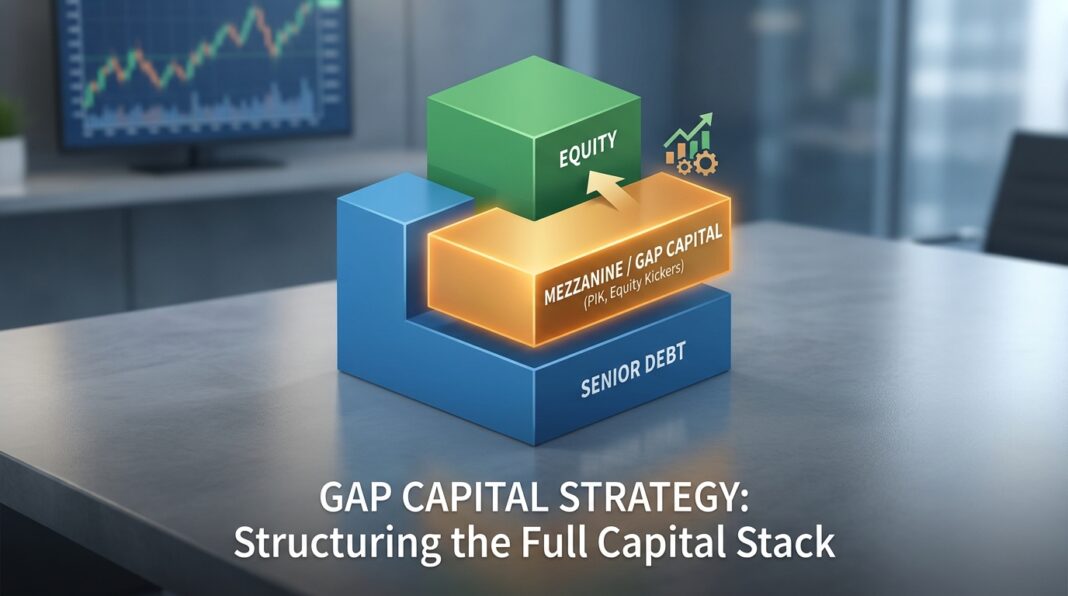
Layer 2 — Mezzanine / Subordinated Debt (The Gap Capital Layer)
Mezzanine financing refers to a class of hybrid securities that sit between senior debt and common equity in a company’s capital structure. It is the natural gap-filler when senior debt capacity is exhausted and additional equity would be too dilutive. Mechanically, a mezzanine note combines a fixed cash coupon of roughly 11%–14% with a payment-in-kind (PIK) interest accrual of 1%–4% and an equity kicker in the form of warrants or a small co-invest.
Mezzanine financing for business acquisition costs 12%–15% all-in in 2026, comprising a 10%–12% cash coupon (typically SOFR + 700–900 bps or fixed 11.5%), 1%–3% PIK interest, 1%–2% warrant coverage, and a 2%–3% origination fee. GF Data’s 1H 2026 report puts the median lower-middle-market mezzanine coupon at 11.75% cash plus 2% PIK, roughly 175 bps wider than the 2021 trough of 10.0% cash.
Layer 3 — Preferred Equity
Preferred equity is a hybrid that sits below all debt but above common equity, often with a fixed dividend (cash or PIK) and a liquidation preference. Used heavily in growth equity and minority recapitalizations, a single tranche of preferred at 8%–12% can replace a layer of mezzanine when the sponsor wants to avoid additional debt covenants.
Layer 4 — Common Equity (Growth Equity / PE)
The most flexible — and most expensive — layer. Growth capital for a lower-middle-market business typically comes as a minority equity check of $5M–$75M priced at 6.0x–10.5x trailing EBITDA per GF Data 2024 valuation reports, with operators expecting 15%–40% dilution for a primary minority round. For acquisition financing specifically, a blended LMM stack of 50% senior debt at SOFR plus 6.0%, 15% mezzanine at 13% all-in, and 35% equity would produce a weighted average cost of capital near 12%–14%, well below the 20%–25% expected on all-equity growth capital.
Mezzanine Structure Breakdown: PIK, Warrants, and Maturity
Mezzanine financing has three economic components that operators must understand before entering any negotiation.
Cash Coupon
The current cash-pay element, typically fixed or lightly floating. In 2026, the cash coupon runs 10%–12%, charged quarterly and priced at either floating SOFR + 700–900 bps or a fixed rate, and is largely market-driven with limited negotiability.
PIK Interest (Paid-in-Kind)
Mezzanine financing is often interest-only, with no amortization before maturity. These loans often extend up to 7–8 years and frequently combine cash interest with PIK interest, which gets added to principal instead of being paid currently. Most mezzanine in 2026 carries a cash coupon plus a PIK toggle. A typical structure is 10% cash plus 2%–4% PIK, where the PIK can be deferred and capitalized into principal during the early years — a feature that makes mezzanine attractive to growth-stage borrowers whose free cash flow does not yet support the full coupon. The PIK component is also the most negotiable element: the 2026 market standard is 2% PIK; aggressive terms run at 1%; conservative lenders may require 3% elective PIK.
Equity Kicker (Warrants)
A warrant is a security that gives the holder the right to purchase a company’s stock at a set price in the future. In mezzanine financing, warrants act as an equity kicker, letting lenders share in the company’s upside value if it grows. Because mezzanine lenders seek a return of 14%–20%, this return must be achieved through means other than simple cash interest payments. By using equity ownership and PIK interest, the mezzanine lender effectively defers its compensation until the due date of the security or a change of control of the company.
Warrant coverage in 2026 typically runs 1%–5% of fully diluted shares, structured as penny warrants exercisable at close, and is often the first item negotiated down by an operator with a credible alternative offer in hand.
Practical Example: Closing the $7M Gap
Return to the $60M acquisition example above. The capital stack closes as follows:
- Senior secured debt (direct lender / bank): $32M at SOFR + 575 bps (~10.5% all-in). 4.0x EBITDA. First lien on all assets. Quarterly maintenance covenant on leverage ratio.
- Mezzanine tranche: $7M at 11.5% cash + 2% PIK + 2% warrant coverage (fully diluted). 5-year bullet maturity. Subordination agreement in favor of senior lender. Board observer right.
- Operator equity: $21M (35% of enterprise value). Common shares, no contractual coupon.
Blended WACC on this structure lands near 13%–14% — meaningfully below the 20%–25% implied by adding additional equity in lieu of the mezzanine tranche. The operator retains control, limits dilution to 2% of the cap table via warrants, and preserves 98% of common equity upside.
Mezzanine vs. Alternatives: When Each Option Makes Sense
Mezzanine vs. Unitranche (No Separate Mezz Layer)
Mezzanine remains relevant in several contexts: very large transactions where unitranche lenders cannot provide the full quantum of debt needed; situations where the borrower wants to minimize total cost by maximizing cheap senior debt separately; deals where the sponsor or management team wants equity kickers to align lender incentives; and portfolio company add-on financings where existing credit agreements restrict additional senior debt.
For smaller growth-stage deals ($20M–$75M enterprise value), the choice is often practical: a single unitranche from a private credit fund collapses complexity but prices the entire facility at a blended rate that includes the mezzanine risk premium. A bifurcated senior/mezz stack can reduce the blended cost when a bank will provide senior debt at sub-9% but charges no mezzanine premium. Run both scenarios before committing.
Mezzanine vs. Growth Equity (Minority Round)
Mezzanine works when the owner wants to preserve equity and can service 11%–13% debt. Unitranche works when EBITDA and cash flow easily service SOFR + 550 bps and the owner wants zero dilution. Growth equity works when the operator values a strategic partner and is prepared to accept dilution of 15%–40% in exchange for capital plus operational bandwidth.
Mezzanine vs. Preferred Equity
The mezzanine/preferred equity decision turns on one axis: covenant tolerance. A single tranche of preferred at 8%–12% can replace a layer of mezzanine when the sponsor wants to avoid additional debt covenants. Preferred equity, however, typically sits inside the equity cap table — there is no contractual maturity date and no subordination agreement to negotiate. For operators who need a clean debt instrument with a defined payoff, mezzanine is the cleaner structure.
Covenant Design: What the Capital Stack Looks Like in Practice
The covenant package varies significantly by layer and deal size — and understanding where each instrument sits on the maintenance/incurrence spectrum is critical for modeling downside scenarios.
Ongoing performance is tested with financial maintenance covenants, which require periodic — typically quarterly — compliance with specified financial metrics. Unlike maintenance covenants, incurrence tests assess risk at the moment a potentially credit-negative action is proposed.
In 2026, the covenant divide is clear and well-documented:
- Approximately 85% of the broadly syndicated loan market is cov-lite and only ~15% retains maintenance tests.
- KBRA DLD Research data shows that 98% of lower-middle-market loans with borrower EBITDA below $50 million retain full financial maintenance covenant packages.
- In the broadly syndicated loan market, approximately 90% of new loans in 2024 remained covenant-lite, continuing borrower-friendly documentation trends. However, private credit lenders have maintained firmer positions on covenant inclusion, particularly for mid-market transactions.
- Borrowers with EBITDA of less than $50 million are typically subject to a maintenance requirement.
For operators navigating a senior/mezz stack, the senior lender will almost always require at least one quarterly maintenance covenant — typically a maximum leverage ratio or minimum fixed charge coverage ratio. The mezzanine lender typically operates with lighter covenant controls, relying instead on the subordination agreement and warrant coverage to protect its position.
The Gap Capital Playbook: Four Execution Steps
Step 1 — Quantify the Gap with Precision
The gap is the delta between senior debt capacity (typically 3.0x–4.5x EBITDA for credit-quality growth businesses) and total capital required. Size this number before entering any process. Build a sources-and-uses table. Calculate senior debt capacity at 3.5x, 4.0x, and 4.5x EBITDA. Then subtract senior debt plus equity contribution from total acquisition cost. The remainder is your mezzanine or preferred equity requirement.
Model three scenarios: (a) fill the gap entirely with mezzanine debt; (b) fill with preferred equity; (c) blend both. The target zone is FCCR above 1.20x, total leverage below 5.0x EBITDA, and equity dilution below 15% of common. The scenario that meets all three thresholds in your base case — and survives in your downside case — is the optimal structure.
Step 2 — Prepare a Lender-Ready Information Package
Mezzanine lenders underwrite differently from senior lenders. They focus on enterprise value stability (multiple times coverage on their position), management team depth, and the equity sponsor’s track record. Your package must address each of these dimensions. Include: (a) trailing 12-month and LTM-adjusted financials; (b) three-year financial model with base, upside, and downside cases; (c) acquisition rationale and integration plan; (d) cap table pre- and post-transaction; (e) proposed term sheet with use-of-proceeds mapping.
Step 3 — Run a Targeted, Competitive Process
Private credit AUM crossed $1.7 trillion in H1 2026, with roughly 40% of new deployment targeting the lower middle-market growth segment according to PitchBook’s H1 2026 Private Credit Report. Capital availability is not the constraint — structure and price are. Use the abundance of capital supply to negotiate, not just to access.
Send the package to 6–10 direct lenders and mezzanine funds simultaneously. Send the package to 6–10 direct lenders simultaneously. Request term sheets within 10 business days. Evaluate offers on five dimensions: (1) all-in cost (cash + PIK + warrants); (2) leverage multiple allowed; (3) covenant structure; (4) prepayment flexibility; and (5) speed of execution. Do not lead with a single lender exclusively — competitive tension is your primary negotiating lever.
Step 4 — Negotiate the Structure
Five points move the most value in a mezzanine negotiation:
- PIK percentage: Push from 3% toward 2% or below. This directly reduces interest compounding on the subordinated balance. The 2026 market standard is 2% PIK; aggressive lenders have accepted 1%.
- Warrant coverage: Warrant coverage typically runs 1%–5% of fully diluted shares and is often the first item cut by an operator with a credible alternative offer in hand. Target the low end of the range (1%–2%) and negotiate a cap on dilution if the company is acquired early in the hold period.
- Prepayment premiums: Standard 2026 prepayment schedules run at 102/101/par over the first three years. Negotiate for a soft call structure that drops to par by Year 2 if the business anticipates a refinancing event.
- PIK toggle rights: Ensure the borrower — not the lender — holds the toggle right. A borrower-controlled PIK toggle allows the company to conserve cash during integration periods without triggering a default.
- Equity cure rights: For the senior debt layer, standard 2026 terms allow up to four equity cures over the life of the loan, with no more than two in any consecutive four-quarter period. Confirm this right is explicitly preserved in the subordination agreement governing the mezzanine.
Key Takeaways
- Mezzanine is gap capital, not cheap capital: At 12%–15% all-in cost in 2026, mezzanine is significantly more expensive than senior debt — but significantly less dilutive than equity. Its value is structural precision, not low price.
- PIK is the most negotiable component: All-in cost in 2026 runs 12%–15%, split among 10%–12% cash coupon, 1%–3% PIK, and 1%–2% warrant coverage per GF Data’s 1H 2026 report. Focus negotiation energy on the PIK percentage and warrant coverage — these are the two variables with the most operator-favorable flexibility.
- Stack design before lender outreach: Every layer of the capital stack serves a different master: banks optimize for safety of principal, mezzanine investors optimize for risk-adjusted yield, and equity investors optimize for terminal value. Map the full stack on paper before approaching any single provider.
- Covenant bifurcation matters: The senior lender will require maintenance covenants. The mezzanine lender typically will not. Model the covenant headroom on the senior layer carefully — a breach at that level affects both tranches regardless of the subordination agreement’s terms.
- Private credit market depth creates negotiating leverage: The private credit market has reached a pivotal stage in its growth, with direct lending now matching the broadly syndicated loan market at $1.5–2 trillion in size and forecast to reach $3 trillion by 2028. Operators who run competitive processes — not single-lender conversations — consistently achieve 50–100 basis points of spread improvement and meaningfully better warrant economics.


