
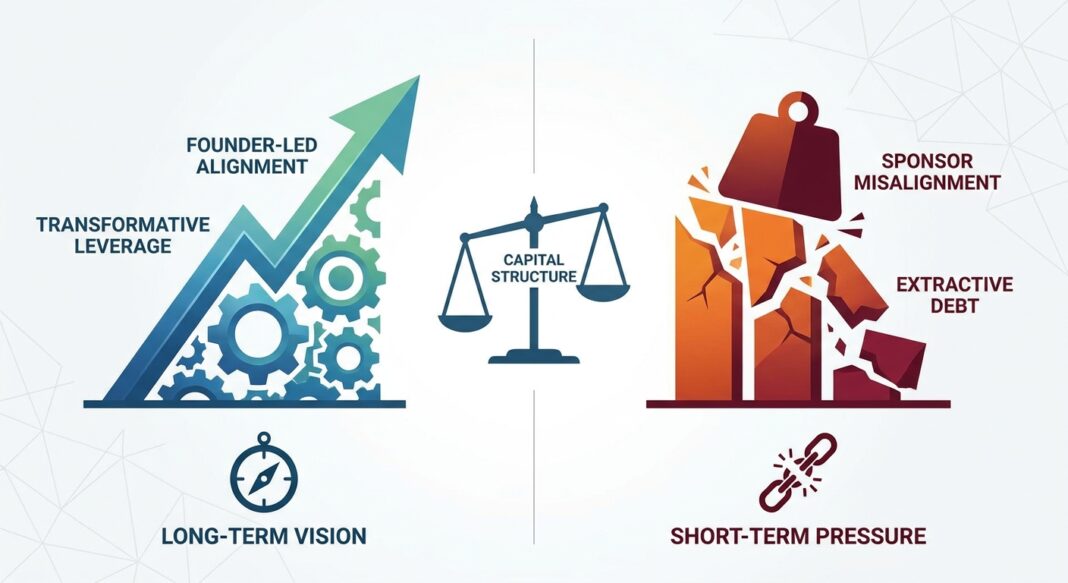
The Story: Same Era, Same Tool, Opposite Destinies
In September 2013, Michael Dell closed one of the most audacious corporate maneuvers in modern business history. He agreed to take his namesake company private in a $24.4 billion leveraged buyout — the largest since the 2008 financial crisis — defeating activist investor Carl Icahn in a months-long public war. The PC giant was bleeding market share, its stock had stagnated, and Wall Street’s short-termism was making a long-game transformation nearly impossible to execute. Dell needed room to breathe, and he was willing to use debt to buy it.
Eight years earlier, in 2005, a different kind of leveraged transaction was closing on the other side of the country. Bain Capital, KKR, and Vornado Realty Trust acquired Toys "R" Us through a leveraged buyout valued at $6.6 billion — loading one of America's most beloved retail brands with a debt burden that would define, and ultimately destroy, its final decade.
Both transactions used the same instrument: leverage. But the outcomes could not have been more different. One founder walked away controlling a business now worth roughly $290 billion as of August 2026, his personal stake multiplied more than fivefold. The other company filed for Chapter 11 in September 2017, citing approximately $7.9 billion in debt against $6.6 billion in assets, and liquidated all its U.S. stores the following year.
These are not two random data points. They are a master class in what separates leverage as a tool of transformation from leverage as a mechanism of extraction.
The Decision: Who Holds the Steering Wheel?
Dell Technologies (2013): The Founder's Gambit
Dell agreed to be taken private in a $24.4 billion buyout by a consortium led by its founder and chief executive, Michael Dell, alongside private equity firm Silver Lake Partners. The capital structure was intentional and founder-centric from day one.
Michael Dell rolled his existing ~16% public-company stake into the new entity, contributed an additional $750 million in cash, and partnered with Silver Lake ($1 billion equity) and Microsoft ($2 billion). At closing, Michael Dell owned 75% of the privately held firm. The remainder of the deal was financed with approximately $15 billion in bank debt — but crucially, that debt was subordinated to a controlling founder’s vision, not a financial sponsor’s exit clock.
The strategic intent was explicit: Michael Dell took the company private in part to shield it from public scrutiny as the PC business crumbled and it expanded into software and services. He didn't want quarterly earnings pressure dictating a multi-year pivot. The debt load was the price of that freedom — and he accepted it knowingly.
Toys "R" Us (2005): The Absentee Landlord Structure
The Toys "R" Us structure told a different story. The $6.6 billion acquisition saddled the company with more than $5 billion in debt from day one. Of the $6.6 billion total deal price, more than $5.3 billion was paid using debt — a leverage ratio that left almost no financial buffer for operational reinvestment.
Crucially, no founder, no long-term operator, and no strategic visionary was at the center of this deal. Three financial sponsors — each with their own fund timelines, fee structures, and exit expectations — held the equity. The leveraged buyout dumped over $6 billion in debt on Toys "R" Us, making it liable for $450 to $500 million annually just in interest payments. That figure alone — half a billion dollars a year in debt service — would prove to be a strategic death sentence in a retail environment demanding constant reinvestment.
Before the LBO, Toys "R" Us had a debt load of $1.86 billion. After the buyout, that figure ballooned by more than 4x with no corresponding operational overhaul to support it.
The Outcome: Transformation vs. Suffocation
Dell: Leverage as Liberation
Away from the scrutiny of public markets, Dell moved with conviction. It acquired EMC — then the largest tech acquisition in history — for $67 billion in 2016, creating an integrated enterprise IT powerhouse that encompassed servers, storage, and VMware's virtualization platform. At $39 billion, Michael Dell's shares became worth more than five times the cash and stock he put into the deal. Silver Lake made a similar rate of return on its investment.
When Dell returned to public markets in December 2018, the 2018 return to public markets preserved rather than diluted his controlling equity and voting position. Michael Dell re-emerged as a public-company CEO with a 72% ownership stake — compared to roughly 14% when he had first taken the company private. He had used debt to buy back his own company and come out controlling more of it than ever before.
Today, Dell Technologies' market capitalization sat near $290 billion in August 2026, driven by surging AI server demand — a market that wouldn't exist had Dell not made its bold, debt-financed transformation bet in 2013.
Toys "R" Us: Leverage as Strangulation
The contrast is almost painful in its clarity. In the year before bankruptcy, Toys "R" Us had an operating profit of $460 million — but debt payments of $457 million. The company was operationally viable. It was financially insolvent. Those two facts cannot coexist for long.
Interest payments alone consumed hundreds of millions of dollars annually, siphoning money that should have gone into upgrading stores, building e-commerce infrastructure, or reducing prices to compete with big-box retailers. Meanwhile, the firms in the deal made back their small personal investments through advisory and management fees regardless of the company's fate.
When the bankruptcy filing came in September 2017, it wasn't a surprise to anyone paying attention. Internal financial documents later revealed that store reinvestment budgets were repeatedly slashed to service debt obligations. Amazon and Walmart surged; Toys "R" Us stagnated. The debt hadn't funded transformation — it had prevented it.
The Lessons: A Framework for Founders Facing the Leverage Decision
These two stories are not an argument for or against leverage. They are an argument for alignment — between the structure of a deal, the operational realities of the business, and the long-term incentives of the people holding the equity.
1. Who Controls the Strategy Controls the Outcome
In the Dell transaction, the person with the most to gain — and the most deep knowledge of the business — held 75% of the equity from day one. Every dollar of debt service was an obligation he chose to service because he believed in the transformation. In the Toys "R" Us deal, the operators and customers of the business were the last people in the room. Financial sponsors with 5–7 year fund cycles were making decisions for a 60-year-old retail institution that needed a decade of reinvestment.
2. Leverage Amplifies What's Already There
Debt does not create operational excellence — it amplifies whatever exists beneath it. Dell had a competent management team, a coherent transformation thesis, and a founder willing to execute over years. The debt gave him the autonomy to act. Toys "R" Us had a weakening competitive position, an outdated store model, and $500 million a year in interest obligations that consumed every dollar that could have funded change. The leverage made the underlying problem irreversible.
3. The Sizing of Debt Must Respect Cashflow Reality
The Toys "R" Us debt structure was not merely aggressive — it was structurally incompatible with the company's competitive environment. Once a company's debt level is over five times EBITDA, research suggests the inability to deduct interest begins to cancel out the benefits of the tax law. In a cyclical, capex-intensive industry, that leaves almost no margin for error — and retail is rarely forgiving. The right amount of leverage is the amount that funds the strategic objective without cannibalizing the operational investments required to achieve it.
4. The Current Market Offers More Options Than Ever — Choose Wisely
Founders and operators facing capital decisions today are not limited to the binary of VC equity or over-leveraged PE buyouts. The U.S. private credit market has grown to roughly $1.3 trillion and is positioned for further expansion in 2026, with direct lending remaining the dominant strategy, fueled by borrower demand for flexible, fast financing.
Non-sponsor finance has also grown in selective geographies where founder-owned companies prefer non-dilutive capital and service-oriented partners. For a founder who wants liquidity without surrendering control, or a family business navigating succession without forcing a sale, today's private credit landscape offers structures that would have been unavailable a decade ago. Closed-end direct lending dry powder stood at approximately $500 billion as of the first half of 2025 — near all-time highs. Capital is available. The question is always on whose terms.
Key Insights
- Alignment is the variable that separates transformative leverage from extractive leverage. Michael Dell held 75% of the equity at closing and bore the cost of debt service himself — his interests and the company's interests were identical. The Toys "R" Us sponsors extracted fees regardless of outcome.
- Leverage sizing must be matched to the operational cadence of the business. A $500M annual interest burden is survivable in a high-growth tech business with improving margins. It is fatal in a capex-intensive retailer facing existential competitive pressure from Amazon and Walmart.
- Debt buys strategic time — but only if that time is used. Dell used five private years to make a $67 billion acquisition, integrate two companies, and return to public markets with majority control intact. Toys "R" Us spent its private years managing debt, not modernizing the business.
- The founder's lens changes the capital decision entirely. For a founder who intends to build for 10+ years, the dilution cost of giving up equity to a VC or PE sponsor can be far larger than the interest cost of well-structured debt — especially when that debt also preserves voting control and strategic authority.
- Today's private credit market provides middle-market founders with more non-dilutive options than any prior era. With direct lending dry powder near $500 billion and over 780 active direct lenders serving the middle market in 2026, operators no longer need to choose between starving for capital or surrendering the keys to a financial sponsor.


