
Bond Capital | Market & Sector Intelligence | October 4, 2026
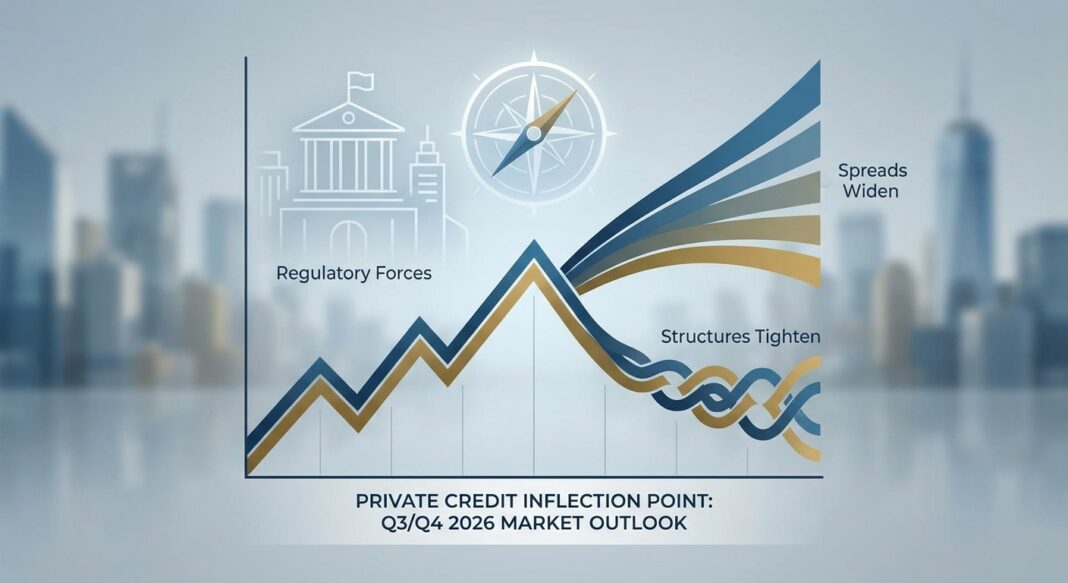
Private Credit at the Inflection Point: Spreads Widen, Structures Tighten, and Regulatory Forces Reshape the Lending Landscape
A convergence of spread repricing, regulatory realignment, and credit cycle maturation is recalibrating the risk-return framework for institutional investors and operating executives across the capital stack.
I. The Macro Signal: Price Discovery Returns to Private Markets
Private credit markets entered 2026 riding a period of historically compressed spreads and robust deal flow — and have since undergone a meaningful recalibration. A trifecta of forces triggered the shift: AI-driven disruption concerns sparked a risk-off sentiment and a sharp selloff in software-exposed credits; a geopolitical escalation in the Middle East elevated inflation risk and complicated the Federal Reserve’s rate path; and a wave of BDC redemption requests forced the market to confront liquidity mismatches in semi-liquid fund structures.
The result, documented by Valuation Research Corporation (VRC), is that private debt markets have entered a renewed phase of price discovery. Primary market activity slowed late in Q1 2026, while secondary spreads widened — particularly for technology and software-exposed credits — before stabilizing through Q2 as banks gradually reentered the upper middle market.
Yet despite near-term uncertainty, the structural thesis for private credit remains intact. Direct lending continues to generate high single-digit unlevered asset returns — an attractive premium relative to public credit markets — and the combination of base rates remaining elevated and potentially widening spreads presents a compelling gross yield outlook for disciplined lenders deploying capital today.
Critically, two divergent regulatory signals are reshaping the competitive landscape simultaneously. In December 2025, the OCC and FDIC rescinded the Obama-era 2013 Leveraged Lending Guidance, potentially re-opening the bank channel for leveraged credits. Concurrently, in May 2026, the Financial Stability Board published a comprehensive vulnerabilities report, warning that private credit’s complexity, leverage, and interconnectedness could amplify stress in adverse scenarios. These two forces — one deregulatory, one supervisory — are pulling the market in opposite directions and demand careful navigation.
II. Quantitative Market Snapshot
The following data box summarizes the key market metrics as of Q3/Q4 2026, sourced from publicly available institutional research, Federal Reserve data, and regulatory filings.
| Metric | Current Value | Prior Period | Change | Source |
|---|---|---|---|---|
| Core MM Unitranche Spread (S+ bps) | S+475 – S+550 | S+450 – S+525 (YE 2025) | +25 bps wider | Lincoln International / KadenWood, Aug 2026 |
| Lower-MM Unitranche Spread (S+ bps) | S+500 – S+700 | S+475 – S+650 (Q4 2025) | Wider; further 25–50 bps expected | ABF Journal / Private Equity Bro, May 2026 |
| Unitranche All-In Yield (spot) | 9.00% – 9.75% | ~11.5%–12.5% (late 2023 peak) | –250 bps from peak; still above pre-2022 norms | VRC, Private Markets Trends Q2 2026 |
| 3-Month Term SOFR (as of Oct 2, 2026) | ~3.76% | 4.33% (Sep 2025) | –57 bps YoY | SOFR Academy / FRED, Oct 2026 |
| U.S. HY Bond Spread (OAS) | ~320–355 bps | 314 bps (YE 2025) | +41 bps in Q1 2026 | J.P. Morgan / TPG Form 10-Q, Q1 2026 |
| Leveraged Loan Index Spread (U.S.) | ~484 bps | ~440 bps (YE 2025 est.) | +44 bps YTD | J.P. Morgan Leveraged Loan Index, Q1 2026 |
| Private Credit Default Rate (Proskauer, senior secured) | 2.51% (Q2 2026, TTM) | ~1.6%–2.0% (2025 avg.) | Rising; Fitch broader measure at 6.0% | Proskauer / Fitch via Investing.com, 2026 |
| Bank C&I Lending Standards (SLOOS, Large/MM Firms) | 0.0% net tightening (Q3 2026) | 8.1% net tightening (Q2 2026) | Fully eased; easier than historic midpoint | Federal Reserve FRED / SLOOS, Aug 2026 |
| Private Credit Market AUM | $1.5–$2.0 trillion | ~$1.3 trillion (2022–2023) | Significant expansion | FSB Report on Private Credit Vulnerabilities, May 2026 |
KPI Underwriting Standards: Leverage and FCCR Under Active Revision
The FSB’s May 2026 vulnerabilities report surfaced a concern that has been building in institutional underwriting rooms for months: borrowers in private credit funds report debt-to-EBITDA ratios of 5–6x, but UBS Credit Research — cited directly by the FSB — found that after accounting for common EBITDA add-backs, true leverage is closer to 7x. This EBITDA inflation compresses reported ratios and creates a structural blind spot in standard credit analysis.
On the positive side, Debt/EBITDA ratios across core middle market funds have been broadly stable, with no material upward drift — suggesting lenders have maintained underwriting discipline on borrower leverage over the last three years. Meanwhile, lenders are now seeing fewer PIK requests, less aggressive leverage, more covenants, and stronger documentation — defensive features that matter more than modest spread widening alone. For the Fixed Charge Coverage Ratio (FCCR), the market standard threshold of 1.1–1.2x is being stress-tested by lenders incorporating forward base rate assumptions, effectively constraining total debt capacity for borrowers with compressed operating cash flows.
III. Sector Analysis: Where Capital Is Flowing — and Where It Is Retreating
Credit Benchmark’s 2026 review of 20 major U.S. private credit funds finds sector exposures concentrated in Technology, Business Services, and Health Care — with loan spreads narrowing even as default risk drifts higher. But beneath those aggregate headlines, lender appetite is sharply bifurcated by subsector quality and cash flow durability.
🟢 Active Capital Deployment: Infrastructure, Business Services, Healthcare (Selected)
- Digital & Energy Infrastructure: Priority sectors identified by major direct lenders include energy infrastructure, digital infrastructure, defense/national security, and next-generation manufacturing — all requiring patient institutional capital. Private credit has been leading the development of financing structures for large-scale AI-related infrastructure, including landmark deals for Rogers Communications, Intel, and Meta in the digital infrastructure space.
- Business Services & Non-Cyclical Industrials: New investment commitments in direct lending have focused on senior secured loans to high-quality, sponsor-backed middle market companies with a defensive bias toward non-cyclical sectors like software and business services.
- Healthcare (Selective): Healthcare led all sectors for private credit in 2025, accounting for 19% of all direct lending deals. However, lender appetite has become more selective: Morgan Stanley Investment Management maintains a significant underweight to healthcare, which has led all sectors in loans placed on non-accrual status over the last year.
🔴 Tighter Credit Conditions: Software/SaaS, Consumer/Retail, Automotive
- Software & SaaS: The most acute repricing has occurred here. Software spreads widened by approximately 200 basis points since year-end 2024, driven by concerns that new AI tools could disrupt existing business models and following significant investor redemptions from private funds tied to technology asset valuation issues.
- Consumer, Retail & Automotive: The PwC Global Private Credit Survey 2026 highlights that managers expect credit stress to be most acute over the next one to two years in consumer and retail (56% of respondents), automotive (42%), and hospitality & leisure (27%).
- PIK Escalation as a Warning Signal: PIK use has more than doubled since 2022, and the FSB has flagged rising PIK reliance as evidence of deteriorating credit conditions in segments of the market where cash interest coverage is insufficient.
Structural Shift: Bank Re-entry and the Competitive Reset
On December 5, 2025, the OCC and FDIC rescinded the 2013 Leveraged Lending Guidance, declaring it overly restrictive and a driver of lending activity moving outside the regulatory perimeter. The rescission gives banks more freedom to make their own decisions around leveraged lending, though analysts at Winston & Strawn note that banks may continue to be constrained by capital requirements, liquidity considerations, and syndication risk. Consistent with this, banks have gradually returned to the upper middle market in Q2 2026, contributing to increased competition and alleviating some upward pressure on credit spreads. For the core and lower middle market — sub-$50M EBITDA — private credit lenders retain a structural origination advantage.
IV. Strategic & Operational Implications
For Borrowers & Operating Executives
The operating environment is materially more demanding than it was 18 months ago. With SOFR pinned near 3.76%–3.90% and lower-middle-market unitranche spreads at 500–700 bps over SOFR, interest coverage on cash-flow facilities remains compressed. Lenders are increasingly underwriting to collateral and conservative EBITDA definitions rather than to projected future earnings. Borrowers whose leverage was structured at 5–6x Debt/EBITDA at 2021–2022 rates face meaningful refinancing pressure as the 2021 loan cohort matures.
FCCR thresholds are being reset: a forward-looking FCCR incorporating floating rate sensitivity that yields below 1.1x is increasingly viewed as insufficient credit protection. Companies targeting new capital raises should stress-test covenants at SOFR +100 bps and ensure maintenance capex is properly segregated from growth investment in their financial presentations to lenders.
Lenders first see structural improvement — fewer PIK requests, more covenants, and stronger documentation — before meaningful spread widening appears. Borrowers who proactively offer stronger covenant packages and transparent EBITDA reporting are securing more favorable terms and lender certainty of execution in the current environment.
For Institutional Investors & Lenders
Core middle-market direct lending — particularly sponsored deals with robust covenant packages — continues to offer attractive yield pick-up relative to the broadly syndicated loan market. Wider spreads, higher-for-longer rates, and bank retrenchment in the lower middle market are improving pricing and terms for disciplined lenders.
The FSB’s May 2026 report introduces a medium-term regulatory risk that institutional allocators must factor into portfolio construction. The FSB identified valuation opacity, inconsistent default definitions, leverage stacked at both fund and portfolio company level, and redemption-liquidity mismatches inside semi-liquid vehicles as systemic concerns. Allocators should distinguish between managers with institutional-grade quarterly valuation processes and those relying on model-driven marks that may understate realized losses.
Partnerships between private credit and banks are becoming more prevalent, with private credit accessing banks’ origination, servicing, and product manufacturing infrastructure — a structural development that creates both opportunity (scale, origination volume) and risk (increased interconnectedness flagged by global regulators).
V. Forward-Looking View: Liquidity and Lending Dynamics (Next 3–6 Months)
Three-month SOFR is priced at approximately 3.90% at year-end 2026 and 4.04% at year-end 2027, suggesting the base rate environment will remain elevated by pre-2022 historical standards for an extended period. This underpins the gross yield case for direct lending while simultaneously maintaining pressure on borrower interest coverage.
LBO deal values in Q2 2026 fell to $68 billion — the lowest since Q2 2020 — reflecting ongoing geopolitical uncertainty. However, middle market private equity activity showed signs of improvement, with deal value increasing approximately 10.7% year-over-year and exit activity rising 14% over the same period. A recovery in M&A volumes through H2 2026 would provide the deal supply needed to absorb the significant dry powder sitting on the sidelines: the U.S. private credit market has over $400 billion in undeployed capital.
Private credit enters the second half of 2026 in a more selective and execution-driven phase: deal activity is expected to recover unevenly, pricing discipline should strengthen, and lender leverage is likely to improve as deployment pressure eases. The most durable returns will be generated by managers combining platform scale, disciplined underwriting, and sector-specific origination networks — particularly in the core middle market where bank competition remains structurally limited.
VI. Key Market Insights — Five Actionable Takeaways
- Spreads have reset lender-favorably, but execution quality is the differentiator. Core middle market unitranche spreads are 25+ bps wider than year-end 2025 at S+475–S+550 bps, and lower-middle-market spreads of S+500–S+700 bps offer the strongest risk-adjusted entry points in two years — but only for managers with disciplined covenant structures and independent valuation processes.
- The FCCR floor is rising implicitly. Lenders are stress-testing fixed charge coverage at forward rates, not spot SOFR, effectively constraining maximum leverage for any deal with a coverage ratio below 1.2x on a forward basis. Operators should model interest obligations at SOFR +100 bps to pressure-test covenant headroom before approaching lenders.
- Sector selection is paramount: Infrastructure and non-cyclical business services are open; software/SaaS and consumer/retail face elevated risk premiums and tighter structural terms. Healthcare remains high-volume but is bifurcating sharply by subsector quality, with non-accrual rates leading the market in certain subsegments.
- The OCC/FDIC deregulatory action creates a two-speed competitive market. Bank reentry into the upper middle market (EBITDA >$50M) is compressing spreads in large-cap direct lending. The core and lower middle market (EBITDA <$50M) remains the most defensible origination territory for private credit platforms, with the structural speed and flexibility advantages of direct lenders most pronounced below $1B transaction size.
- Regulatory risk is the most underpriced factor in institutional private credit portfolios. The FSB’s May 2026 report is a material signal: proposals for 24 surveillance metrics, standardized default definitions, and semi-liquid fund liquidity requirements are in development. Allocators should review exposure to managers with quarterly redemption windows and model-dependent valuations before any global regulatory framework crystallizes.


