
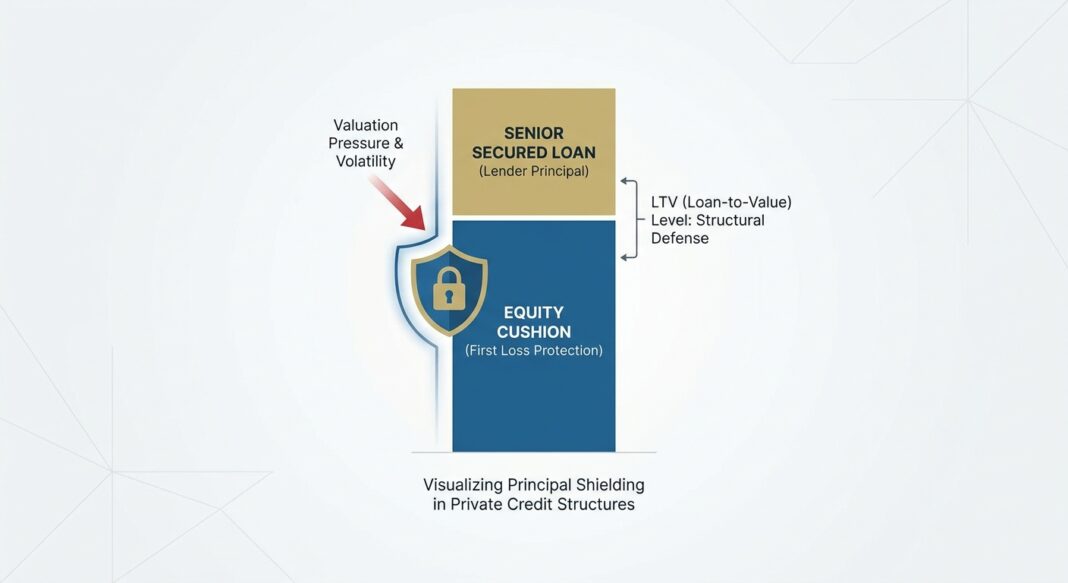
The First Line of Defense in Every Private Credit Deal
Before a private credit lender earns its first dollar of interest income, it has already built a wall of protection around its principal. That wall has a name: the equity cushion. Understanding how this cushion works — and why its size, quality, and composition matter more than any single spread or covenant — is foundational to evaluating private credit as both a lender and a borrower.
In today’s market, where default-rate headlines vary wildly depending on who is counting, the equity cushion is the structural feature that separates a lender likely to recover its capital from one exposed to real principal loss. This article explains how loan-to-value (LTV) protection is constructed, demonstrates it with concrete numbers, and connects it to live market data — so investors and business operators can make more informed decisions.
What Is the Equity Cushion — and How Does LTV Measure It?
Loan-to-value (LTV) is the ratio of total debt to the estimated enterprise value of the borrowing company. It answers a simple but critical question: if this business had to be sold today, how much of the proceeds would go to repay debt before equity holders see anything?
A deal with a 50% LTV means the lender is advancing $50 of debt against every $100 of enterprise value. The remaining $50 — owned by equity sponsors or founders — is the equity cushion. That cushion must be entirely wiped out before the lender suffers a single dollar of principal loss.
As Lord Abbett’s 2026 Midyear Private Credit Outlook explains, a lower loan-to-value means the lender is advancing a smaller portion of the company’s value, which provides a cushion if operating performance weakens or market valuations decline.
In private equity-sponsored transactions, equity cushions are deliberately large. LPL Research notes that private credit loans often feature LTVs in the range of 40–60%, meaning private equity sponsors contribute substantial equity — frequently 40–60% or more of the deal value. This alignment of interests is structural, not accidental.
How It Works: A Concrete Example with Numbers
Consider a mid-market software company with $10 million in annual EBITDA. A private equity sponsor acquires it at 10x EBITDA, or a $100 million enterprise value. The deal is financed as follows:
- Senior secured unitranche loan: $50 million (SOFR + 550 bps, ~5-year term)
- Equity contributed by the PE sponsor: $50 million
- LTV at closing: 50% ($50M debt ÷ $100M EV)
- Equity cushion: $50 million, or 50% of total capitalization
Now suppose business conditions deteriorate — revenue softens, EBITDA falls 30% to $7 million, and the market re-rates the company down to 8x EBITDA, compressing the enterprise value to $56 million. The lender’s $50 million loan is still fully covered, now at an LTV of approximately 89%. The equity sponsor’s $50 million has been reduced to roughly $6 million in residual value. The lender has not lost a cent — yet.
Only if the enterprise value falls below the $50 million loan balance does the lender begin to face potential loss. This is the power of the equity cushion: it absorbs business deterioration before credit losses materialize.
This is also why Morgan Stanley Private Credit research highlights that equity-sponsored transactions tend to produce lower loss rates for lenders — PE sponsors that contributed significant equity are financially motivated to inject additional capital and work with lenders in distress, improving recovery outcomes.
Current Market Relevance: What the Data Says in 2026
The equity cushion framework is not theoretical in today’s environment — it is actively being stress-tested.
| Metric | Current Reading | Source |
|---|---|---|
| CDLI 2025 annual return | 9.3% | Cliffwater, March 2026 |
| CDLI 22-year average annual return | 9.5% | Cliffwater, August 2026 |
| Typical middle-market unitranche LTV range | 40–60% | LPL Research, 2026 |
| Proskauer Private Credit Default Index (Q2 2026) | 2.51% across $195.6B in loans | Investing.com / Proskauer, 2026 |
| CDLI-Senior 15-year annualized loss rate | 0.29% | Angel Investors Network / Cliffwater data, 2026 |
| Global private credit AUM | ~$1.7 trillion (2026 est.) | Preqin / CTA Acquisitions, 2026 |
| Typical direct lending SOFR spread (middle market) | SOFR + 475–650 bps | Coyote Wealth, Q2 2026 |
The data tells a coherent story. According to Cliffwater’s August 2026 mid-year release, the CDLI returned 3.0% for the first half of 2026 and 7.7% for the trailing year — exceeding all major fixed income indices despite elevated macro uncertainty. Realized losses from defaults remain stable at roughly half their 1.0% long-term average.
The divergence between headline default rates and realized credit losses illustrates a critical point: a default event does not equal a dollar-for-dollar loss. When equity cushions are substantial and collateral positions are senior-secured, recovery rates can be high — and the CDLI’s methodology captures this nuance, measuring actual loss, not just count of defaults.
However, not all equity cushions are equal. Northleaf Capital’s Q1 2026 market update notes that in the IT sector, lower public-market valuations increased LTV ratios — but underwriting at conservative LTVs initially provided meaningful downside protection even as valuations compressed. This is the equity cushion doing exactly what it is designed to do.
Meanwhile, the Federal Reserve’s July 2026 SLOOS shows that bank lending standards for C&I loans are currently easier than the midpoint of their historic ranges for large banks — a dynamic that intensifies competition between banks and private lenders and puts premium on structural protections, including LTV discipline, in private credit underwriting.
Decision Framework: Investors and Operators
For Investors Evaluating a Private Credit Fund or BDC
- Ask for weighted average LTV, not just leverage multiples. A fund reporting 5x EBITDA leverage on a company with a 12x EBITDA purchase price has a meaningful cushion. One reporting 5x on an 8x multiple does not.
- Distinguish between LTV at origination and current LTV. Rising rates and softening earnings compress enterprise values. A loan originated at 45% LTV two years ago may now sit at 65%.
- Prioritize senior secured, first-lien exposure. The CDLI-Senior index’s 0.29% annualized loss rate over 15 years — versus the broader index’s 1.01% — illustrates the loss-mitigation value of seniority.
- Evaluate sponsor quality alongside LTV. PE-sponsored borrowers with meaningful equity at risk are more likely to inject capital in stress scenarios, reinforcing the cushion from the equity side.
For Business Operators Seeking Capital
- Understand that LTV governs your cost of capital. Lower LTV (more equity) typically earns a lower interest rate because the lender bears less risk. Operators who can increase their equity contribution at closing often unlock meaningfully better terms.
- Be precise about your enterprise value basis. Private credit lenders underwrite to a conservative enterprise value. If your business commands a high market multiple, document it — it directly expands the equity cushion and improves negotiating leverage.
- Know that a 50% LTV is not a ceiling. Unitranche structures in the middle market today commonly operate at 4.0–5.5x EBITDA leverage. For a business with stable, recurring cash flows, lenders may accept higher leverage in exchange for stronger covenant packages — a tradeoff operators should model explicitly.
Key Takeaways
- The equity cushion is the primary protection mechanism in private credit. It must be fully depleted before a lender faces principal loss — a structural advantage over unsecured or subordinated instruments.
- LTV is the single most direct measure of lender safety, but it must be paired with enterprise value methodology, industry context, and earnings trajectory to be meaningful.
- Senior secured first-lien private loans have a 15-year annualized loss rate of just 0.29% per Cliffwater CDLI-S data — a figure that reflects the real-world power of seniority and equity cushion protection.
- Not all equity cushions are durable. Enterprise value in middle-market lending is often based on earnings multiples, not hard assets. When earnings fall, collateral value falls simultaneously — underwriting conservatism at origination is the only durable defense.
- The current market is repricing risk in ways that favor disciplined lenders. Spreads on direct lending transactions have widened 25–50 basis points since late 2025 per market data, and lenders negotiating now are obtaining stronger structural protections alongside improved pricing.


