
The Acquisition Financing Decision That Defines Your Return
Picture a profitable lower-middle-market services business — $8M in EBITDA, a platform built through two organic acquisitions, and a third tuck-in identified at a $35M enterprise value. The operator needs $28M in debt financing and faces a binary structural choice: a single unitranche facility from one direct lender, or the classic three-party stack of senior bank debt layered with mezzanine and a modest equity check. Both paths close the deal. But they are not the same deal.
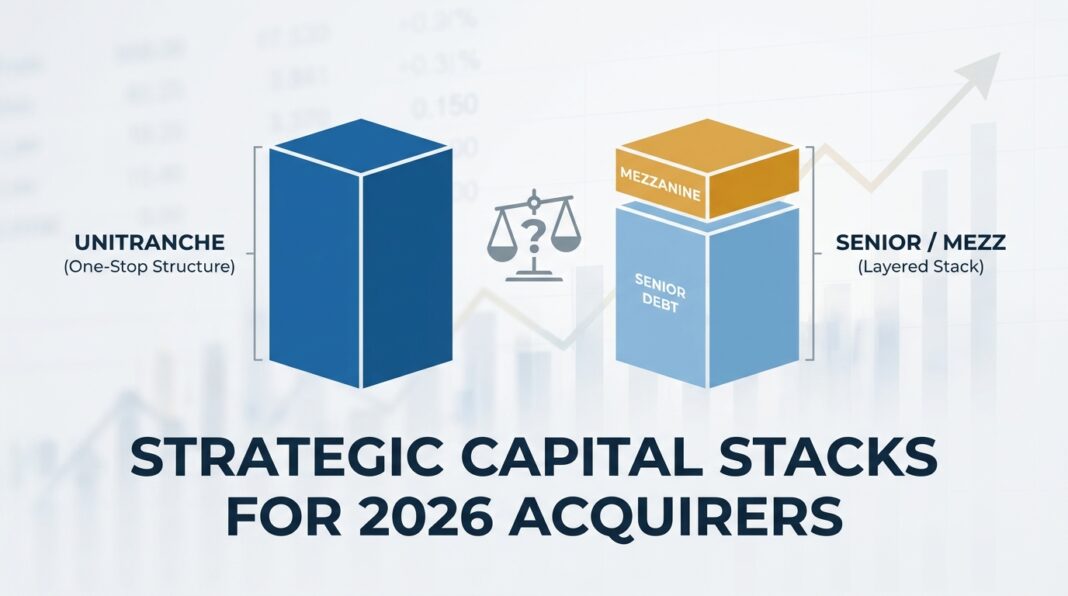
That structural choice — unitranche vs. senior/mezz — is the central capital-stack question for growth-stage acquirers in the $25M–$200M enterprise value range in 2026. It governs execution speed, annual cash interest burden, covenant headroom, prepayment flexibility, and how much equity the operator surrenders or retains. Getting it wrong costs returns. Getting it right accelerates them.
This article maps the full cost-of-capital spectrum for growth-stage acquisition financing, breaks down the mechanics and pricing of each structure with live market terms, and walks through the Gap Capital Playbook — how to quantify the financing need, prepare the process, run a competitive dual-track, and negotiate the final term sheet.
Structure Breakdown: The Two Dominant Paths
Path 1 — The Unitranche One-Stop
A unitranche loan is a single secured term loan that blends what would otherwise be a first-lien senior tranche and a second-lien or subordinated tranche into one instrument under one credit agreement, with one lender and one covenant package. The blended rate falls between standalone senior and mezzanine pricing, compensating the lender for taking the full credit risk of both layers.
In 2026, middle-market unitranche spreads run approximately SOFR + 475 to SOFR + 550 basis points for deals in the $40M–$100M EBITDA range, per Lincoln International’s Q1 2026 private market data, with total leverage typically landing at 4.0x to 5.5x EBITDA. Smaller lower-middle-market credits — the $3M–$10M EBITDA cohort — pay a premium, with spreads reaching SOFR + 600 to SOFR + 700 basis points and all-in costs of 9.35% to 11.35% at current SOFR levels. Original issue discount (OID) adds another 2%–3% upfront, and prepayment fees of 2%–3% decline over the first 24 months.
Illustrative Term Sheet — $28M Unitranche for a $35M EV Acquisition
- Facility: $25M Term Loan B + $3M Revolving Credit Facility
- Pricing: SOFR + 575 bps (all-in ~9.85% at current SOFR)
- OID: 2.0% ($500K upfront fee equivalent)
- Amortization: 1% per annum, bullet at year 6
- Prepayment: 3% / 2% / 1% declining call protection, years 1–3
- Leverage covenant: Total Net Leverage ≤ 5.25x, with 25% cushion to closing leverage
- FCCR covenant: Minimum 1.15x, tested quarterly
- Equity check (sponsor): ~$7M–$9M (20%–25% of EV)
Unitranche amortization is typically just 1% per year with a balloon at maturity, versus a traditional bank term loan that commonly requires 5% annual amortization — a materially lower annual cash drag for operators reinvesting in growth.
Path 2 — The Classic Senior / Mezz Split
The traditional three-layer stack pairs a senior bank or BDC cash-flow term loan (SOFR + 300–425 bps, 3.5x leverage) with a mezzanine tranche from a dedicated mezz fund or SBIC (11.5%–14% cash coupon + 1%–3% PIK + equity warrants covering 1%–5% of common equity). The operator’s equity check funds the residual gap.
The arithmetic on a split structure for the same $28M financing need: $18M senior at SOFR + 375 (~8.1% all-in) plus $10M mezz at 12.5% cash + 2% PIK + 3% warrant coverage. Blended cost: approximately 9.5%–10.2% — only marginally cheaper than unitranche, but with substantially more execution complexity, an intercreditor agreement to negotiate, and a mezz lender holding a board observer seat and a warrant position in your cap table.
Total mezzanine issuance to lower-middle-market sponsors in 2025 reached $28.3B per S&P LCD, the highest level since 2019 — a signal that bifurcated stacks remain active and relevant, particularly where senior bank capacity is constrained or where cost savings on the senior tranche justify the added mezz complexity.
How the Structures Compare: Trade-Offs That Actually Matter
| Dimension | Unitranche (2026) | Senior + Mezz (2026) |
|---|---|---|
| All-in blended cost | 9.35%–11.35% | 9.0%–11.0% blended (senior + mezz) |
| Execution timeline | 45–60 days | 75–120 days |
| Equity dilution | None (rare small warrant) | 1%–5% via mezz warrants |
| Covenant complexity | Single covenant package | Two separate packages + intercreditor |
| Annual amortization | ~1% (bullet structure) | 3%–5% on senior; mezz is interest-only |
| Lender relationships | One lender | Two lenders with intercreditor friction |
| Optimal EV range | $25M–$200M EV sweet spot | $15M–$100M; prevalent at lower sizes |
The unitranche premium — roughly 160 basis points above broadly syndicated loans as of late 2025 per KBRA data — purchases certainty: one closing, no syndication flex risk, no intercreditor negotiation. The 2026 Bain Global PE report found that unitranche-plus-equity has overtaken the classic senior-plus-mezz-plus-equity stack for deals above $20M EV, largely due to intercreditor simplification.
For operators doing roll-up acquisitions with multiple tuck-ins, the unitranche’s delayed draw term loan (DDTL) feature is particularly valuable: capacity for add-on acquisitions can be pre-committed, drawn as deals close, and governed by a single credit agreement rather than re-underwritten each time.
The senior/mezz split makes its strongest case when: (a) a borrower can access bank senior debt at SOFR + 300–400 bps for the base layer and needs only a modest mezz tranche to bridge the gap; (b) the mezz warrant coverage is negotiated down to under 2% and the PIK toggle is available; or (c) the deal involves real estate or hard assets that support ABL pricing on the senior layer, reducing the blended cost materially below unitranche all-in.
Current Market Terms: 2026 Benchmarks and Structural Shifts
The private credit market entered 2026 with near-record origination volumes but a distinct structural evolution. Dealmakers sustained deal activity in 2025, but did fewer and larger transactions amid intensifying competition and tightening spreads, with average LBO deal size for direct lending rising approximately 29% to reach roughly $380 million, compared with about $295 million in 2024.
For operators in the lower and core middle market, the following 2026 benchmarks define the current negotiating environment:
- Unitranche pricing for LMM deals ($3M–$10M EBITDA): SOFR + 500–700 bps all-in, with OID of 2%–3% and declining prepayment protection of 3%/2%/1% over 36 months. Total leverage typically 4.0x–5.5x EBITDA.
- Mezzanine pricing (LMM): 11.5%–14% cash coupon, 1%–3% PIK toggle, warrants covering 1%–5% of common equity, interest-only with a bullet at year 5–7. An all-in yield of 13%–17% is a reasonable 2026 benchmark per market data.
- Covenant norms (private credit): More than 75% of middle market loans include financial covenants, compared to less than 10% of loans in the broadly syndicated loan market. For deals under $50M EBITDA, borrowers should anticipate at least one financial maintenance covenant — typically a total leverage ratio — with a 25% cushion above closing leverage tested quarterly.
- Covenant-lite creep: Covenant-lite deals are estimated to have constituted one-third of all 2025 deals with more than $50M in EBITDA, and a majority of large-cap deals. Private credit lenders have maintained firmer positions on covenant inclusion for mid-market transactions, even as large-cap private credit deals increasingly mirror syndicated market terms to win business.
- New loans are structuring more conservatively in 2026: New loans are increasingly coming with better credit structures — less leverage, more covenants, fewer PIK requests, and tighter documentation, representing a lender-friendly reset after the compressed spread environment of 2023–2024.
The Gap Capital Playbook: Running the Process
The best structure on paper is irrelevant if the process is run poorly. Here is the four-step playbook for a growth-stage operator executing an acquisition financing in the current market.
Step 1 — Quantify the Gap
Start with the purchase price and work backwards. Map total sources and uses: purchase price + transaction costs + post-close working capital reserve. Senior debt capacity is generally 3.0x–4.5x EBITDA for bank cash-flow loans. If total financing need exceeds that ceiling, the gap above senior capacity is your mezzanine or unitranche decision point. Document the EBITDA clearly — most lenders will normalize for run-rate adjustments, but addbacks must be defensible and auditable.
Step 2 — Prepare the Financing Package
A complete financing package for a $25M–$100M acquisition includes: three years of audited or reviewed financials, trailing-twelve-month management accounts, a detailed management presentation covering the business model and competitive position, a lender financial model with base/downside scenarios, and a clear use-of-proceeds memo. For unitranche lenders, the sponsor track record and management quality carry significant underwriting weight — prepare a brief sponsor/operator profile.
Step 3 — Run a Dual-Track Process
Approach 3–5 unitranche direct lenders simultaneously and 2–3 senior bank / mezz combinations in parallel. The goal is not to pit every lender against every other — it is to generate 2–3 credible term sheets that create genuine negotiating leverage. Unitranche lenders can typically deliver a term sheet in 10–15 business days from initial materials. Banks with mezz syndication may take 20–30 days. Set a term sheet deadline and enforce it.
Step 4 — Negotiate the Structure, Not Just the Spread
Most operators focus exclusively on the interest rate. The terms that drive enterprise value over the hold period are: covenant headroom (the cushion above closing leverage in the maintenance test), DDTL availability for future acquisitions, EBITDA definition (scope of addbacks and pro forma adjustments), excess cash flow sweep mechanics (50%–75% sweep above a threshold, stepping down to 25% at lower leverage), and prepayment protection periods. A 25 basis point reduction in spread is worth far less than a properly structured EBITDA definition that protects against a first-year integration shortfall triggering a covenant breach.
Structuring Guidance: Key Negotiation Points
For Operators
- EBITDA definition is the most important term in the document. Push for a trailing-twelve-month look-back window on addbacks, inclusion of synergies from closed acquisitions, and a 12-month run-rate adjustment for new contract wins. Lenders may resist — this is where your legal counsel earns its fee.
- Negotiate the DDTL upfront. If your acquisition strategy involves 2–3 tuck-ins over the hold period, pre-committed delayed draw capacity eliminates the need to return to market for each add-on. An acquisition-driven platform doing three to five add-ons over five years typically uses a unitranche with a delayed draw term loan feature — lock this in at close, not later.
- Model the covenant under stress. Run the financial model at 80% of projected EBITDA and confirm that all maintenance covenants pass comfortably. If they do not, negotiate higher headroom before signing, not after the first quarterly miss.
For Investors and Lenders
- Covenant structure determines early-warning capacity. Maintenance covenants provide proactive triggers when performance deteriorates — they provide lenders with regular tests of key metrics to monitor a borrower’s financial health. Incurrence-only covenants remove that tripwire; they only test when the borrower takes an affirmative action like issuing new debt or making an acquisition.
- PIK usage is a stress signal, not a feature. There has been a significant increase in use of payment-in-kind facilities since 2022, indicating borrowers struggling with the interest burden. In a 2026 structure, PIK should be reserved as a toggle mechanism for temporary stress — not baked in as a default coupon component on the full loan amount.
Key Takeaways
- Unitranche dominates the $25M–$200M EV acquisition market in 2026. One document, one lender, and 45–60 day execution have made it the default structure, with pricing at SOFR + 500–700 bps and all-in costs of 9.35%–11.35% at current SOFR levels.
- The senior/mezz split is still viable — but only when the economics justify the complexity. A blended cost of 9%–11% all-in is achievable, but the intercreditor agreement, warrant dilution, and extended execution timeline are real costs that must be quantified and weighed explicitly.
- Covenant design is a structural risk variable, not a legal formality. More than 75% of middle market private credit loans still include financial maintenance covenants — far higher than in the broadly syndicated market. Borrowers should model covenant headroom under a downside scenario before signing any term sheet.
- The DDTL feature is the growth acquirer’s most valuable structural tool. Pre-committed delayed draw capacity within a unitranche eliminates re-underwriting friction and execution risk on each subsequent tuck-in acquisition.
- Process discipline drives pricing. Running a structured dual-track process with a firm term sheet deadline across 3–5 unitranche lenders and 2–3 senior/mezz combinations is the single most reliable way to compress spread, improve covenant headroom, and extract DDTL capacity in the current market.


