
The Loan That Changed Middle-Market Finance
Imagine you need $50 million to finance an acquisition. In the traditional model, you would spend months negotiating with two separate lender groups — a senior secured lender at one rate, and a mezzanine lender at a much higher rate — each with their own lawyers, credit agreements, and intercreditor arrangements. Now imagine collapsing all of that into a single conversation, a single document, and a single closing. That is what the unitranche loan made possible, and it is the structural innovation most responsible for the explosive growth of private credit over the past decade.
The private credit market reached roughly $1.7 trillion in global assets under management at the start of 2026, up from $970 billion in 2019, according to Preqin’s 2026 Global Alternatives Report. At the center of that growth is the unitranche structure, which has become the defining instrument of the asset class. For investors evaluating private credit allocations and for business operators considering their financing options, understanding how unitranche loans actually work — not just that they exist — is foundational literacy.
What a Unitranche Loan Actually Is
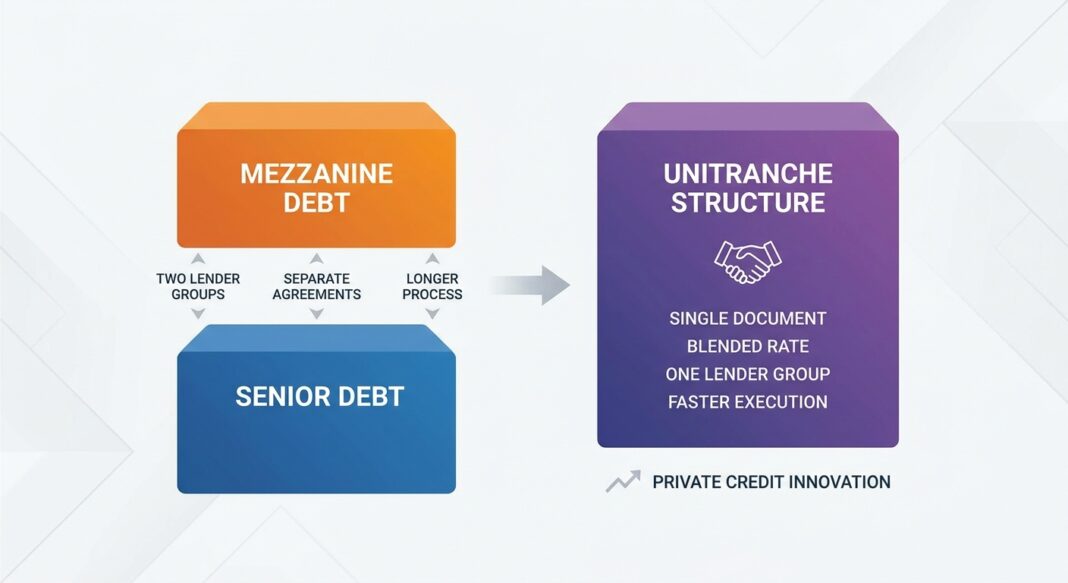
Unitranche financing is a single term loan that combines what would traditionally be senior secured debt and subordinated (mezzanine) debt into one instrument, at one blended interest rate, under one credit agreement, provided by a direct-lending (private credit) fund rather than a syndicate of banks.
The key word is blended. A unitranche lender is not simply offering a senior loan at a cheaper rate. It is pricing in the risk of both the senior and junior portions of a conventional capital stack and charging an interest rate that reflects that combined exposure. The unitranche typically occupies the senior secured term loan position with a first-priority lien, effectively replacing a first-lien plus second-lien or mezzanine stack.
The simplification is real: key advantages for borrowers include faster execution, greater certainty of funding, simplified documentation, and more flexible covenant and repayment structures compared with traditional syndicated bank financing. For private equity sponsors running competitive auction processes, that speed and certainty is often worth more than a marginally lower interest rate from a bank syndication.
The First-Out / Last-Out Split: One Loan to the Borrower, Two to the Lenders
Here is where unitranche structures get genuinely sophisticated, and where most educational summaries stop too early. The “single tranche” the borrower signs often is not a single risk position on the lender side at all. It is frequently split internally among multiple lenders through what practitioners call an “AB unitranche” or first-out/last-out structure, governed by an agreement among lenders that the borrower typically never sees and has no say in.
The governing document is called an Agreement Among Lenders (AAL). A unitranche structure involves a single secured credit facility in which two or more groups of lenders share in the same security interest on the borrower’s collateral but agree among themselves to a payment priority. The structure is intended to provide the “first out” lender reduced risk and return, providing the “last out” lender increased risk and return (as compared to the first out lenders), and the borrower with a single, streamlined credit facility.
The payment waterfall is the critical mechanism:
- First-Out Tranche: The first-out tranche takes a lower yield and ranks ahead in the payment and recovery waterfall — it is repaid in full before the last-out receives anything. This position functions similarly to a conventional senior secured loan.
- Last-Out Tranche: The last-out tranche takes a higher yield and stands behind, absorbing the first loss if the credit defaults. Together the two reconstitute the blended coupon the borrower pays and the full amount it drew. The borrower is unaware of the split: it signs one credit agreement, faces one agent and pays one margin.
A Concrete Example With Numbers
Consider a sponsor-backed software company with $10 million in EBITDA seeking $50 million in acquisition financing (5.0x leverage). Here is how a traditional two-tranche structure compares to a unitranche:
Traditional Two-Tranche Structure:
- $35M First-Lien Term Loan @ SOFR + 3.50% (3.5x leverage)
- $15M Mezzanine Loan @ 12.00% fixed (1.5x leverage)
- Two credit agreements, two lender groups, 60–90 day timeline
- Blended all-in cost: approximately 9.5%–10.5%
Unitranche Structure (same company):
- $50M Unitranche @ SOFR + 5.00% (blended rate reflecting combined risk)
- One credit agreement, one lender group, 30–45 day timeline
- All-in cost: approximately 9.5%–10.5% at current base rates
- Behind the scenes: The lender internally splits into a $20M first-out piece and a $30M last-out piece via AAL
The borrower pays roughly the same all-in rate — but gains weeks of execution time, negotiating with one counterparty instead of two. The private credit lender, meanwhile, uses the AAL to manage its internal risk profile without burdening the borrower with the complexity.
Current Market Conditions: Where Unitranche Pricing Stands in 2026
The unitranche market in 2026 is navigating a notable pricing recalibration after years of spread compression:
| Metric | Data Point | Source |
|---|---|---|
| Unitranche coupon spreads (Q2 2026) | SOFR + 4.75% to 5.50% | VRC, Q2 2026 |
| New-issue unitranche spreads (Q1 2026) | ~SOFR + 525 bps | CTA Acquisitions / PitchBook LCD, 2026 |
| Lower-middle-market LBOs using unitranche (2025) | ~80% of deals | S&P Global Market Intelligence via CTA, 2026 |
| Median private credit loan spread (2026) | 4%–5% over base rate | Credit Benchmark, 2026 |
| BCRED avg. loan-to-value at underwrite | 42% | Blackstone BCRED SEC Filing, 2026 |
| Bank C&I lending standards (Q2 2026) | Basically unchanged; easier than historic midpoints | Federal Reserve SLOOS, July 2026 |
Unitranche structures continue to dominate new issuance, with coupon spreads generally ranging from 4.75% to 5.50%, nearly 25 basis points higher than year-end levels, and original issue discounts holding steady between 98.75 and 99.25 for standard transactions.
A borrower-friendly environment had previously seen spreads grind tighter, leverage move higher, and loan documents become more flexible. In practical terms, spreads have widened by roughly 50 to 100 basis points since late 2025, while defensive terms have also improved, according to PitchBook.
Crucially, the bank lending backdrop remains a structural tailwind for private credit unitranche providers. The Fed’s July 2026 SLOOS reported that, on balance, the levels of standards are currently at the tighter end of the range for all loan categories except C&I loans. When banks remain cautious on most credit categories, private credit lenders fill the gap — and unitranche is the delivery mechanism.
Roughly 80% of lower-middle-market leveraged buyouts closed in 2025 used a private credit unitranche rather than a syndicated bank loan, per S&P Global Market Intelligence. That figure signals that unitranche has moved from an alternative financing tool to the default choice for sponsor-backed transactions below a certain deal size.
Decision Framework: Investors and Operators
For Investors Evaluating Private Credit Funds
When reviewing a fund’s unitranche portfolio, sophisticated allocators consider the following:
- First-Out vs. Last-Out Exposure: The “blended rate” hides a real split: last-out lenders can price at SOFR + 850 bps or more and can recover far less than first-out lenders in a default. In a fund, the question is what share of the book is last-out. Funds that do not disclose this split warrant deeper due diligence.
- Loan-to-Value Discipline: Loan-to-value helps frame the margin of safety around principal repayment. A lower loan-to-value means the lender is advancing a smaller portion of the company’s value, which can provide a cushion if operating performance weakens. Blackstone’s BCRED, for example, reported an average LTV of 42% at underwrite — a figure investors can benchmark across managers.
- Covenant Quality: In the lender-friendly reset of 2026, wider spreads, higher-for-longer rates and bank retrenchment are improving pricing and terms for disciplined lenders. Evaluate whether a fund’s current vintage benefits from improved documentation.
- Concentration Risk: Performance remains notably weaker in the software sector, where secondary spreads are approximately 245 basis points wider than year-end levels, based on PitchBook LCD data as of June 2026. Sector diversification within a unitranche book matters significantly.
For Business Operators Considering Unitranche Financing
Operators and their advisors evaluate unitranche against alternatives along these dimensions:
- Speed to Close: When an acquisition timeline is compressed, the single-lender, single-document nature of unitranche structures offers a material execution advantage over bank syndications.
- All-In Cost vs. Complexity Trade-off: Unitranche all-in pricing is typically higher than a pure senior bank loan, but operators consider whether the premium is worth avoiding the intercreditor complexity and covenant rigidity of a two-tranche bank deal.
- Covenant Flexibility: More flexible covenant and repayment structures compared with traditional syndicated bank financing can provide runway for companies in growth or transition phases that might temporarily breach maintenance covenants under a conventional bank credit agreement.
- Confidentiality: Unitranche became dominant because it gives private equity sponsors speed, certainty of close and confidentiality — the terms of the financing, including the AAL, are not publicly disclosed the way syndicated deals are.
Key Takeaways
- One loan, two risk positions. A unitranche is a single facility to the borrower, but frequently splits into first-out and last-out tranches via a private Agreement Among Lenders (AAL) that the borrower never sees. Understanding which position a fund holds is essential due diligence.
- Unitranche dominates the middle market. Approximately 80% of lower-middle-market LBOs in 2025 used a unitranche structure rather than syndicated bank debt, reflecting how decisively private credit has displaced banks in this segment.
- Spreads are resetting lender-friendly. After years of compression, unitranche spreads have widened roughly 50–100 basis points since late 2025, with new-issue coupons ranging from SOFR + 4.75% to 5.50% — a better entry vintage for investors deploying capital today.
- Bank caution is a structural tailwind. The Federal Reserve’s July 2026 SLOOS confirmed that bank standards remain at the tighter end of their 20-year historical range for most loan categories, keeping private credit unitranche lenders in a structurally advantaged origination position.
- LTV discipline is the underwriter’s primary defense. With average LTVs in major BDC portfolios running around 42%–47% at origination, the equity cushion beneath unitranche debt remains a critical — and trackable — indicator of downside protection across fund managers.


