
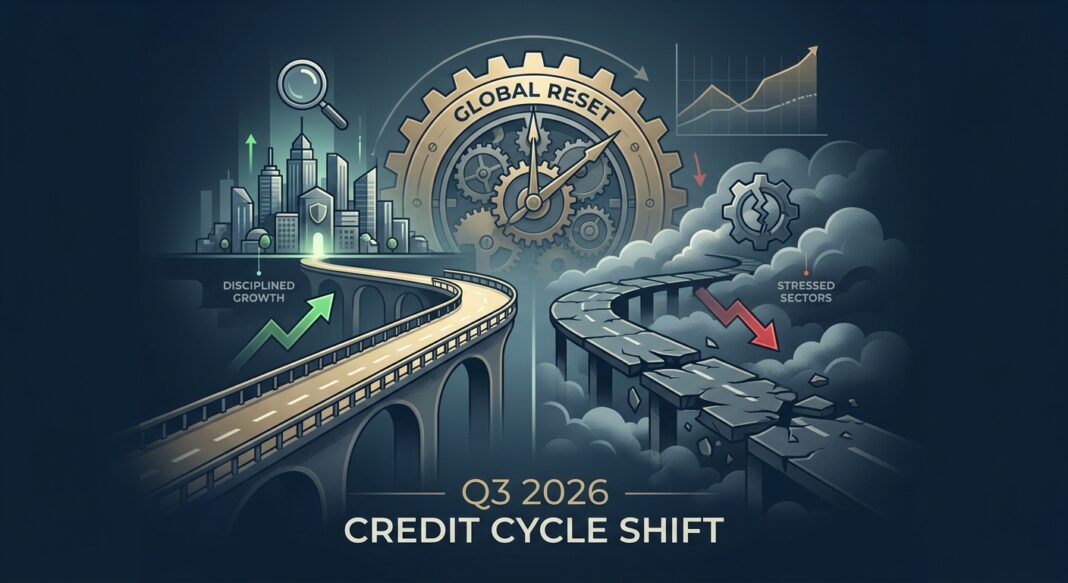
Market Headline: The Lender-Friendly Reset Is No Longer a Forecast — It Is Here
For institutional investors and operating executives who rely on credit markets to finance acquisitions, recapitalizations, and balance-sheet growth, Q3 2026 marks a measurable inflection point. The multi-year borrower-friendly era — defined by compressed spreads, covenant erosion, and aggressive leverage — has given way to a structurally recalibrated environment in which lenders are recovering lost ground on pricing, documentation, and risk transfer.
Three macro forces are driving this shift simultaneously. First, private credit spreads are materially wider: spreads have widened by roughly 50 to 100 basis points since late 2025, while defensive structural terms have also improved, according to PitchBook data. Second, bank lending standards are diverging by borrower type: the July 2026 SLOOS reveals that, on balance, the levels of standards are currently at the tighter end of the historical range for all loan categories except C&I loans, for which standards are generally easier than their midpoints — a constructive signal for large and middle-market corporate borrowers relative to other credit segments. Third, regulatory oversight is escalating at the global level: the Financial Stability Board published its Report on Vulnerabilities in Private Credit on 6 May 2026 as part of its ongoing work on non-bank financial intermediation, taking stock of a fast-growing market and exploring how authorities can monitor risks not fully captured by existing regulatory data.
The result is a market that rewards selectivity, structural discipline, and platform scale — while penalizing undercapitalized borrowers, 2021-vintage excess leverage, and AI-disruption-exposed software credits. Private credit has entered a more selective and execution-driven phase rather than a renewed expansion. The year ahead will reward underwriting discipline, structural control, and platform scale as deal activity returns unevenly and performance dispersion widens.
Quantitative Market Snapshot
The following data box synthesizes the most current available market metrics across public and private credit instruments as of Q2–Q3 2026. All figures are sourced from public regulatory filings, institutional research, and primary government survey data.
| Metric | Current Value (Q2–Q3 2026) | Prior Period | Change / Signal | Source |
|---|---|---|---|---|
| 1-Month SOFR (Base Rate) | 3.65% | 3.69% (Dec 2025) | ▼ Modestly lower; forward curve has shifted upward amid inflation risk | FS Credit REIT 10-Q, Jun 2026 |
| Direct Lending Spread (SOFR+) | +400 to +600 bps (typical first-lien senior secured) | ~+375 to +575 bps (year-end 2025) | ▲ ~25 bps wider on new unitranche originations in 2026 | Goldman Sachs Private Credit Corp. SC TO-I/A, 2026 |
| Direct Lending All-In Yield (Unlevered) | High single digits; 8.0–8.5% trough projected | ~9–10% peak (2023–2024) | ▼ Compressing but remains historically elevated; attractive premium vs. public credit | Morgan Stanley IM, 2026 Private Credit Outlook |
| U.S. High Yield Bond Spread (OAS) | ~355 bps (Q1 2026 close); ~320 bps sub-IG average (Mar 2026) | 314 bps (Jan 1, 2026) | ▲ +41 bps wider in Q1 2026; geopolitical and inflation-driven repricing | TPG Private Equity Opportunities 10-Q, Q1 2026 |
| U.S. Leveraged Loan Index Spread | 484 bps (yield: 8.4%) at Q1 2026 close | ~440–450 bps (year-end 2025 est.) | ▲ B-rated secondary spreads ~43 bps wider than year-end; software credits ~245 bps wider | VRC Private Markets Trends, Q2 2026 |
| Private Credit Debt/EBITDA (Typical) | 5–6x (external reports); max covenant ~4x on new originations | ~5–6x (2024–2025); above the ~4x in leveraged loans | → Stable on average; new originations showing covenant tightening | FSB Report on Vulnerabilities in Private Credit, May 2026 |
| Bank C&I Lending Standards (Net % Tightening) | 0.0% (Q3 2026) — Standards stabilized | 8.1% tightening (Q2 2026); 5.3% (Q1 2026) | ▼ Tightening cycle pausing; easing for large/mid corporates relative to historical range | Federal Reserve SLOOS / FRED, Aug 2026 |
| Private Credit Direct Lending Default Rate | ~1% outright; ~5% including selective defaults & distressed exchanges | ~1.6–4.7% range (2025 est.) | ▲ Rising when broader measures applied; 2021-vintage stress concentrated | FSB Report on Vulnerabilities in Private Credit, May 2026 / Moody’s, Mar 2026 |
| Private Credit AUM / Market Size | ~$1.5–$2.0 trillion (direct lending); dry powder $450–$550 billion | ~$1.5 trillion (2024) | → Stable to modestly growing; deployment shifting toward infrastructure & asset-backed | Chambers Global Practice Guide, Private Credit 2026 |
Data Box Note: All values are drawn from primary sources cited. Direct lending spread ranges reflect typical core middle-market first-lien senior secured transactions. SOFR-based rates reflect 1-month tenor unless noted. Default rate ranges reflect definitional variation across sources.
Sector Analysis: Where Capital Is Flowing — and Where It Is Retreating
🟢 Hot Sectors: Healthcare, Digital Infrastructure & Energy Infrastructure
Healthcare is commanding the largest share of new direct lending activity. According to Octus Data, healthcare led the way for private credit last year, accounting for 19% of all 2025 direct lending deals — and was the only major industry not to see significant disruption. Demographic shifts and non-cyclical service models continue to attract lenders seeking stable cash flows. Private credit has increasingly filled financing gaps for hospitals, physician platforms, behavioral health providers, and post-acute operators — supporting capital projects, acquisitions, technology investments, and balance-sheet refinancing — fueled by healthcare’s defensive demand characteristics and predictable cash flows.
Digital and energy infrastructure are the highest-conviction sectors among large-platform lenders. Priority sectors for 2026 include energy infrastructure, digital infrastructure, defense and national security, and next-generation manufacturing — all requiring patient institutional capital. Morgan Stanley estimates private credit could supply more than half the $1.5 trillion needed for global data center buildouts through 2028, according to a Reuters analysis of the AI-driven data center boom. In infrastructure, private credit is being used to fund large-scale projects such as renewable energy developments that require significant capital investment.
🔴 Cold / Stressed Sectors: Software / SaaS, Legacy Tech & Office CRE
Software and SaaS credits face the most severe repricing in the current cycle. Performance remains notably weaker in the software sector, where secondary spreads are approximately 245 basis points wider than year-end levels and roughly 229 basis points above the broader B-rated loan index, based on PitchBook LCD data as of June 19, 2026, reflecting continued uncertainty related to AI-driven disruption. Secondary software and tech loan prices remain depressed, with average prices below 90.
Credit dispersion is widening, with risk concentrated in older vintages and certain sectors. While most portfolios continue to perform, stress is concentrated in 2021–2022 vintages and software-related exposures, where higher borrowing costs, weaker fundamentals, and AI-related disruption are contributing to increased use of restructurings and liability management strategies.
The maturity cliff is arriving: Looming private credit maturities are driving restructurings and refinancing activity, and liquidity pressures are fueling record activity in continuation and secondary funds. Based on VRC’s data, approximately 10% of private credit portfolios reviewed have already undergone amendments, restructurings, cash-to-PIK conversions, or amendment-and-extend transactions.
🟡 Evolving Sector: Banks Re-entering Large-Cap, Private Credit Ceding Ground
As banks begin to re-enter the lending market and private equity M&A activity shows signs of recovery, upward pressure on credit spreads has moderated. Banks have demonstrated continued relevance in large-cap financing; JPMorgan’s $20 billion acquisition financing for Electronic Arts exemplifies banks’ enduring capability to underwrite and syndicate jumbo acquisition finance transactions. Simultaneously, direct lending accounted for 58.4% of all private debt capital raised globally in 2024, but by Q1 2026 that had fallen to roughly 31%, as allocators spread into infrastructure debt, real estate credit, special situations, and asset-backed strategies.
KPI Underwriting Shift: FCCR, Leverage Multiples & Covenant Standards Under Active Revision
The structural reset in underwriting standards extends beyond spread pricing into the core financial KPIs that govern credit availability.
Leverage (Debt/EBITDA): External sources indicate private credit leverage levels at 5–6x debt-to-EBITDA — higher than the approximately 4x leverage observed in leveraged loans. This more elevated leverage may also contribute to growing investor demand, as it is often accompanied by higher yields. However, a typical direct lending transaction now features a first-lien senior secured loan floating at SOFR plus 400 to 600 basis points, with maximum leverage covenants around 4x EBITDA and minimum interest coverage near 2.5x on new originations.
Covenant Quality: Before meaningful spread widening typically appears, lenders often first see better defense: fewer PIK requests, less aggressive leverage, more covenants, and stronger documentation. These defensive features have improved in recent months — and for lenders deploying new capital today, the most important shift is not just that potential income has improved, but that the underlying credit structure has improved as well.
Underwriting Discipline: Debt/EBITDA ratios have been stable with no material upward drift, suggesting lenders have maintained underwriting discipline on borrower leverage over the last three years. At the fund level, debt-to-equity ratios have increased to approximately 1.0x — still manageable, but warranting continued monitoring particularly if leverage trends toward 1.2x, as higher levels can amplify losses during periods of market stress.
Regulatory Dimension: Spreads on new direct lending originations have moved wider through the course of 2026, with new-issue unitranche spreads approximately 25 basis points wider than at year-end 2025. Loan structures on new originations reflect this shift — tighter financial covenants, stronger call provisions, and more comprehensive lender remedies are increasingly standard. Following the Federal Reserve’s decision to raise the federal funds rate to 3.75–4.00% in Q3 2026, base rates have moved higher, further supporting all-in yields across floating-rate portfolios.
Regulatory & Macro Forces: FSB Oversight Enters a New Phase
The regulatory backdrop for 2026 is no longer passive. The FSB report does not propose new rules or present private credit as a current source of systemic stress, but it does highlight areas where supervisory scrutiny may intensify as private credit markets become larger, more leveraged, and more interconnected.
Among other things, the report flagged concerns about credit quality amid high leverage and high sector concentration, along with a lack of transparency when it comes to valuation in the trillion-dollar market. “Valuation opacity and reliance on private credit ratings can amplify strains in stress,” the FSB warned.
The FSB does not characterize private credit as an imminent risk but stresses that the market has not been tested at its current size, scope, and sectoral concentration in a severe economic downturn. The practical implication for institutional platforms: the FSB has proposed approximately 24 core surveillance metrics covering market size, borrower leverage, redemption frequency, retail and institutional ratios, sector concentration, and cross-border activity. Compliance teams and fund CFOs should expect these metrics to evolve toward binding reporting requirements within 12–18 months.
On the bank side, the most recent SLOOS signal is constructive: the Federal Reserve’s July 2026 SLOOS shows that bank lending standards to businesses of all sizes were steady during the second quarter. In commercial real estate, banks eased lending standards the most since early 2022 — a sign that some appetite for risk is returning.
Strategic & Operational Implications
For Borrowers & Operating Executives
- Model for wider spreads and tighter coverage tests. Spreads on broadly syndicated and high yield loans widened by approximately 15–30 basis points on new issues from Q4 2025 to Q1 2026. Borrowers closing refinancings or acquisition financings in H2 2026 should budget for all-in costs 25–50 bps above year-ago assumptions.
- Leverage assumptions from 2021–2022 vintage deals may no longer be achievable. New originations are underwriting to maximum leverage of ~4x EBITDA with minimum interest coverage near 2.5x. Businesses with trailing leverage above 5x EBITDA will face a narrower lender universe and higher risk premiums.
- Amendment and extension transactions are increasingly common. Approximately 10% of private credit portfolios reviewed have already undergone amendments, restructurings, cash-to-PIK conversions, or amendment-and-extend transactions — operators facing maturity walls should proactively engage lenders 12–18 months in advance.
For Institutional Investors & Lenders
- The illiquidity premium is under scrutiny, but the deployment runway is significant. When marrying the current funding gap with upcoming loan maturities, there is close to a $1.7 trillion financing need over the next four years, suggesting private credit has ample deployment runway.
- Structural differentiation is now the primary return driver. Across multiple rate cycles, private credit has delivered 200–400 basis points of excess return over liquid credit markets, reflecting compensation for illiquidity, structural protections, and active underwriting. In the current environment, that premium is only available to platforms with the covenant discipline to enforce it.
- Sector concentration requires active portfolio management. “Concentration arises from significant exposure to sectors such as technology, healthcare, and services,” the FSB noted — while healthcare is constructive on fundamentals, tech-software exposure at 2021-vintage terms warrants active monitoring and reserve building.
Forward-Looking View: The Next 3–6 Months
Combining current base rates and spreads, direct lending continues to generate high single-digit unlevered asset returns — an attractive premium relative to public credit markets. The combination of interest rates remaining elevated and potentially widening spreads presents an attractive outlook for gross private credit yields.
Volatility is creating opportunity. Wider spreads, higher-for-longer rates, and bank retrenchment are improving pricing and terms for disciplined lenders. The Fed’s Q3 2026 rate increase to 3.75–4.00% reinforces the floating-rate advantage of direct lending — SOFR floors embedded in existing loan portfolios are now providing meaningful income protection for lenders.
Global M&A deal volume increased in Q2 2026, driven by large and mega deals, and software investors are becoming more selective, though valuations are recovering as buyers reassess AI disruption risks. A gradual improvement in M&A clearance rates should support new-money direct lending opportunities in Q4 2026 and H1 2027, particularly in healthcare services, industrial technology, and defense-adjacent sectors.
The primary risk to this constructive scenario remains the maturity cliff: recent deterioration of investor sentiment in the private credit market has raised concerns that a contraction in credit availability may curtail the ability of some middle-market firms to obtain financing. For the system as a whole, the resolution of 2021-vintage stress — through refinancing, restructuring, or impairment — will be the defining credit story of the next 12 months.
Key Market Insights
- 🔑 Spreads are resetting in lenders’ favor: New unitranche and direct lending originations are pricing approximately 25–100 bps wider than year-end 2025, with stronger covenant packages and fewer PIK accommodations — the most borrower-discipline-oriented environment since 2020.
- 🔑 Bank standards have stabilized, not eased: The July 2026 SLOOS confirms bank C&I tightening has reached 0.0% net — a pause, not a pivot. Non-depository financial institutions still face the tighter end of historical standards, creating durable opportunity for private credit in middle-market segments.
- 🔑 Software credits require surgical underwriting: B-rated software loan spreads remain ~245 bps wider than the broader index as of mid-2026. Any deal with significant AI-disruption exposure or legacy SaaS multiples must be stress-tested against a materially lower ARR growth assumption before credit approval.
- 🔑 FSB reporting requirements will reshape platform infrastructure: The FSB’s proposed 24-metric surveillance framework — covering leverage, redemption frequency, sector concentration, and cross-border activity — will likely transition to mandatory reporting within 12–24 months. Fund CFOs and compliance officers should begin data architecture reviews now.
- 🔑 Healthcare and digital infrastructure are the highest-conviction deployment targets: Healthcare accounted for 19% of 2025 U.S. direct lending deal volume and is accelerating in 2026; digital infrastructure financing needs through 2028 are estimated at $1.5 trillion globally. Both sectors offer the durable cash flows and structural complexity that justify the illiquidity premium private credit commands.


