
The Financing Gap That Doesn’t Fill Itself
A growth-stage company pursuing a bolt-on acquisition faces a structural tension that sits at the heart of every deal: the purchase price almost always exceeds what senior debt alone can fund. Fill the gap with too much dilutive equity and the founders surrender the upside the acquisition was designed to capture. Fill it with too much high-coupon debt and cash flow constraints strangle the combined business before synergies materialize.
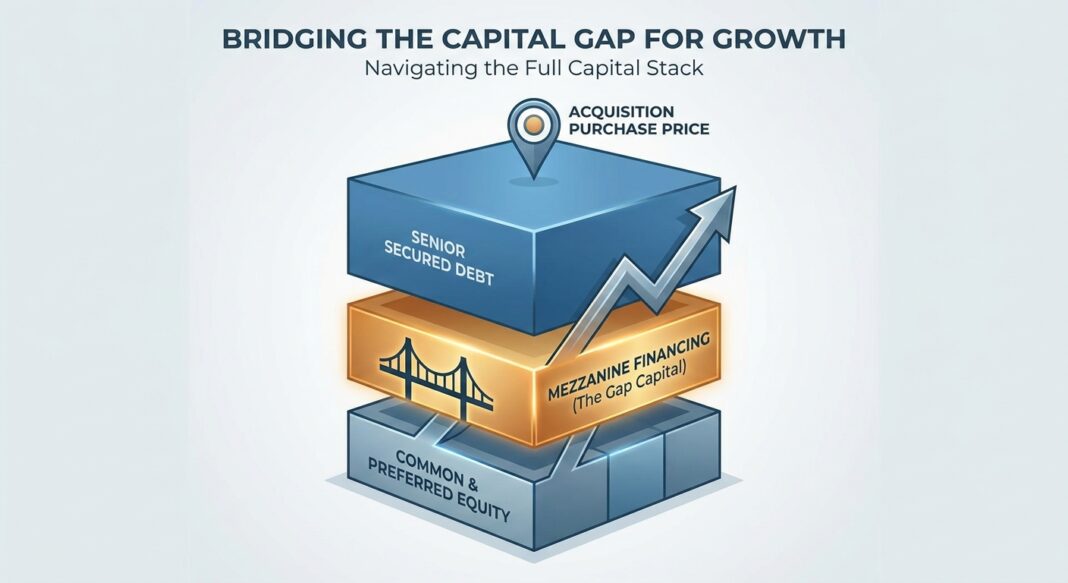
This is precisely the problem mezzanine financing — subordinated debt sitting between senior secured loans and equity in the capital stack — was built to solve. In the current market, it is one of the most structurally active layers in private credit. Mezzanine fundraising rebounded approximately 26 percent after a sharp 80 percent decline in 2024, reflecting renewed appetite from both lenders deploying capital and operators who need flexible gap financing without surrendering majority ownership. The private credit market now extends beyond senior loans to include junior lending with equity upside, mezzanine financing, infrastructure debt, real estate lending, and asset-backed finance.
Understanding how to deploy mezzanine capital precisely — where it sits in the stack, what it costs, when it is optimal, and how to negotiate its terms — is one of the highest-leverage skills in acquisition structuring for growth-stage operators and their advisors.
The Capital Stack, Layer by Layer
Before structuring any acquisition, an operator must map the full capital stack and assign each layer its role, cost, and sizing constraint. The architecture below represents the standard layering for a growth-stage acquisition in 2026.
Layer 1 — Senior Secured Debt (Lowest Cost, Highest Priority)
Senior secured debt — whether from a bank or direct lender — carries the lowest cost, first priority on collateral, and the most restrictive leverage constraints. Bank facilities are typically priced at SOFR plus 250–450 basis points, while direct lending unitranche facilities price at SOFR plus 500–700 basis points, sized at 2.5×–4.0× EBITDA depending on business quality and sector. Senior lenders set the floor on total leverage and the ceiling on everything subordinated below them. They will not stretch beyond their underwriting box, regardless of deal quality.
Layer 2 — Mezzanine / Subordinated Debt (The Gap Capital Layer)
Mezzanine and subordinated debt function as the gap capital layer. All-in pricing typically ranges from 13%–18%, structured as a cash-pay coupon plus a payment-in-kind (PIK) component and warrant coverage of 1%–5% of fully diluted equity. It is subordinated to senior lenders in payment and collateral priority, but senior to all equity in the waterfall.
The three-pillar anatomy of a mezzanine instrument generally includes: a cash interest component providing regular payments (typically 8–12%); a PIK toggle allowing optional interest accrual to preserve near-term cash flow; and an equity kicker in the form of warrants or conversion rights providing equity upside, typically 3–8% of loan amount.
Layer 3 — Preferred Equity or Seller Notes (Bridge Layer)
Preferred equity or seller notes are used when the debt stack is fully stretched but the equity check would be prohibitively dilutive. Seller notes are underutilized: a motivated seller who accepts 20%–30% of the purchase price as a structured note reduces the buyer’s day-one equity requirement materially.
Layer 4 — Common Equity (Most Expensive in Dilution Terms)
Common equity — whether from a sponsor, management team, or equity rollover — is the most expensive layer in dilution terms and is best sized as the residual once debt capacity and seller participation are fully deployed.
A Worked Example: $100M Enterprise Value Software Acquisition
Consider a $100M enterprise value acquisition of a software business generating $10M of EBITDA. Senior lenders will extend 3.0× EBITDA — $30M — against a first lien on ARR and operating assets. That leaves a $70M gap between senior debt capacity and the purchase price. A $20M mezzanine facility bridges a significant portion of that gap without requiring a full equity raise — preserving founder and sponsor ownership while keeping total leverage within a serviceable range.
Mezzanine vs. Alternatives: Trade-Offs and Decision Points
Mezzanine vs. Unitranche (All-in-One Senior Facility)
A unitranche blends senior and junior debt into a single instrument under one credit agreement, simplifying intercreditor dynamics. A unitranche prices roughly SOFR + 450 to 650 bps versus SOFR + 250 to 350 bps for a plain first-lien term loan in 2025. The premium buys a single lender, a fast close, and no syndication flex risk. However, unitranche leverage caps — typically 4×–6× EBITDA — may still fall short of the total funding need in high-multiple acquisitions, leaving a residual gap that mezzanine or preferred equity must fill.
The deal-size sweet spot for unitranche is $25M–$200M EV. Below $25M EV, SBA 7(a) and traditional senior bank loans dominate because unitranche minimum check sizes don’t pencil. Above $200M EV, broadly syndicated loans become competitive on price and the unitranche premium isn’t justified. For growth-stage acquisitions in the $50M–$150M EV range, a unitranche as the senior layer combined with a purpose-built mezzanine strip is often the most efficient structure.
Mezzanine vs. Equity Raise
In 2026, the all-in cost of mezzanine runs 10–14%, composed of a cash coupon of 8–11% plus PIK of 2–4% plus warrant coverage. At a total IRR of 16–22% including the equity component, mezz is expensive — but it avoids the permanent dilution of a priced equity round. Warrants typically convert or expire; equity once issued compounds in perpetuity. For a business with a clear three-to-five year exit path, paying a 200–400 bps premium on subordinated debt to avoid 15–25% dilution is often the right economic decision.
When Mezzanine Is Optimal
Mezzanine is most appropriate when: (1) the acquisition purchase price exceeds senior debt capacity by $5M–$40M; (2) the business generates stable, recurring cash flows capable of servicing a blended cash-pay coupon; (3) the holding period is sufficient to amortize the warrant kicker through exit proceeds; and (4) the operator has a defined use-of-proceeds narrative that lenders can underwrite against specific assets or revenue streams.
Current Market Terms: What Structures Are Trading in 2026
The mezzanine and private credit landscape has shifted meaningfully over the past 18 months. Borrowers and advisors running processes today should benchmark against the following market data:
- Senior unitranche spreads (upper middle market): Unitranche facilities typically price at SOFR + 425–475 basis points for sponsored upper middle market transactions, with core middle market credits commanding 50–100 basis points higher, according to Capstone Partners’ Winter 2025 Leveraged Finance Report.
- Middle market unitranche (Q1 2026): Current middle-market unitranche spreads run approximately S+4.75% to S+5.50% for deals in the $40M–$100M EBITDA range, according to Lincoln International’s Q1 2026 private market data.
- Unitranche all-in cost (2026): Unitranche pricing in 2026 runs SOFR + 500–700 bps, plus a 2–3% original issue discount (OID) and a 2–3% prepayment fee declining over the first 24 months. All-in cost of capital for a typical 5× leverage deal: 9.5–11% blended.
- PIK usage is rising: Payment-in-kind (PIK) usage has risen notably in private credit in recent years, with public BDCs now receiving an average of 8% of investment income via PIK. Once limited to mezzanine and subordinated debt, PIK is increasingly appearing in senior secured loan documentation.
- Covenant bifurcation by size: KBRA DLD Research and ABF Journal data show that 98% of lower-middle-market loans with borrower EBITDA below $50M retain full financial maintenance covenant packages, while Proskauer Rose’s private credit deal data found that only 15% of direct lending transactions tracked in 2024 were cov-lite. Borrower size is the single most reliable predictor of covenant structure — smaller credits get maintenance tests; larger credits increasingly negotiate incurrence-only packages.
- Scale of the direct lending market: Semi-liquid vehicles for the wealth channel now command almost a third of the $1 trillion US direct lending market. Capital availability is not the constraint — structure and process execution are.
The emergence of covenant-lite unitranche facilities for stronger credits has further blurred the lines between middle market and broadly syndicated loan terms. Borrowers with sub-$50M EBITDA should not expect to replicate BSL-style cov-lite packages — but they can negotiate meaningful structural flexibility on PIK toggles, permitted acquisition baskets, and restricted payment carve-outs.
The Gap Capital Playbook: Quantify, Prepare, Run, Negotiate
Step 1 — Quantify the Gap with Precision
Start with the all-in funding need: purchase price, transaction fees (typically 2–4% of deal size), integration reserve (6–12 months of net cash burn), and working capital normalization. Subtract maximum achievable senior debt capacity — underwritten at realistic leverage multiples given your sector and EBITDA quality, not optimistic projections. The residual is your structural gap. Size the mezzanine tranche to fill this gap with a 10–15% buffer; do not size it to the minimum and run thin on closing day.
Step 2 — Prepare a Lender-Ready Use-of-Proceeds Package
A mezzanine lender is underwriting a specific use of their capital, not a general business plan. Your materials should include: a precise sources-and-uses table; a three-year operating model with two downside scenarios (20% and 35% EBITDA compression); a pro-forma capital structure showing leverage ratios at close, at Year 1, and at exit; and a clear articulation of why this acquisition is accretive and on what timeline. Product innovation increasingly combines highly structured asset-based financing to deliver strategic funding solutions that are cheaper than raising equity but more expensive than raising traditional debt. Successful managers are providing bespoke financing solutions with flexibility, speed, and certainty of execution — and they expect the same precision from borrowers.
Step 3 — Run a Targeted, Competitive Process
Send the full lender package to six to ten direct lenders simultaneously, selected by check size, sector focus, and structural appetite for PIK or equity features. Request indicative term sheets within 15 business days. Use competing term sheets to sharpen pricing, not as a negotiating bluff — experienced mezzanine lenders will walk if the process feels manufactured. Approximately 7,541 companies received venture capital financing in the first half of 2026 according to the PitchBook-NVCA Venture Monitor, with deal value reaching record levels of $412.7 billion as of Q2 2026 — the capital market is open, but underprepared borrowers lose to prepared ones on terms and timeline.
Step 4 — Stress-Test the Full Stack Before Closing
Stress-test the full capital stack before closing. Any structure that fails a 20%–30% EBITDA compression scenario at reasonable probability should be restructured pre-close, not managed with post-close amendments. Model debt service coverage under both scenarios at every coupon payment date. If PIK is needed in Year 1 under the base case, negotiate the toggle right up front — not as an emergency amendment after closing.
Structuring Guidance: What to Negotiate and What to Concede
For Operators and Borrowers
Priority 1 — Negotiate the PIK toggle aggressively. A PIK toggle for Years 1–2 preserves integration-period cash flow without permanently increasing the coupon. European unitranche loans commonly feature payment-in-kind interest options, minimal financial maintenance covenants, and structural flexibility that aligns with private equity investment strategies — US middle market borrowers should expect similar optionality on subordinated instruments.
Priority 2 — Incurrence covenants on the mezz tranche. In private credit, covenants serve as functional tools for risk management. Maintenance covenants provide early warning signals, and incurrence covenants prevent actions that increase lender risk. For mezzanine tranches specifically, push for incurrence-only covenants on leverage and restricted payments, with no quarterly maintenance testing. This preserves operational flexibility through the critical 12–24 month integration window.
Priority 3 — Warrant strike price and coverage percentage. Warrants struck at the pre-money equity value of the combined company at close are standard. Push for a lower coverage percentage (1–2%) rather than a lower strike price — warrant dilution is permanent if the equity value compounds. A 1% warrant at a $50M equity value is materially less costly at a $150M exit than a 3% warrant struck at a 20% discount.
Priority 4 — Prepayment flexibility. Key characteristics distinguishing quality unitranche and mezzanine facilities include flexible amortisation schedules, covenant packages tailored to sponsor requirements, and the ability to accommodate bolt-on acquisitions and growth capital needs within the existing facility. Negotiate a 12–18 month soft call period with step-down prepayment fees (3-2-1), not a hard lockout that prevents refinancing into cheaper capital if the market improves.
For Investors and Lenders Evaluating Structure
On the lender side, the structural priority in 2026 is covenant quality, not just headline pricing. Moody’s Default Research Database and S&P Global Ratings data both point to the same directional finding: lenders who can act early, armed with a maintenance covenant, consistently recover more than lenders who discover the problem only at payment default. The differential averages 10 percentage points across multiple default cycles and widens during periods of rapid economic deterioration when enterprise values fall fastest. A maintenance covenant set with reasonable headroom (15–25% above the current ratio) is structurally superior to an incurrence-only package regardless of spread differential.
Key Takeaways
- Map the full stack before approaching any lender. Senior debt capacity, mezzanine sizing, and equity residual must be modeled simultaneously — each layer defines the constraints on the ones below it.
- Mezzanine fills the gap between senior debt ceiling and purchase price — all-in pricing runs 13%–18% in 2026, composed of a cash coupon, PIK component, and warrant coverage of 1%–5% of fully diluted equity. It is expensive but avoids the permanent dilution of a priced equity round.
- PIK toggles and incurrence-only covenants are the two highest-leverage negotiating points for borrowers in the mezzanine layer — secure both in the term sheet, not the definitive documentation.
- Covenant architecture bifurcates by borrower size. Sub-$50M EBITDA credits retain full maintenance covenant packages in nearly all cases; larger borrowers can negotiate incurrence-only structures. Know which category you occupy before running the process.
- Stress-test the full stack under a 20–35% EBITDA compression scenario before close. A structure that fails the downside case pre-close is a restructuring waiting to happen post-close — and restructurings destroy the equity value the acquisition was designed to build.


