
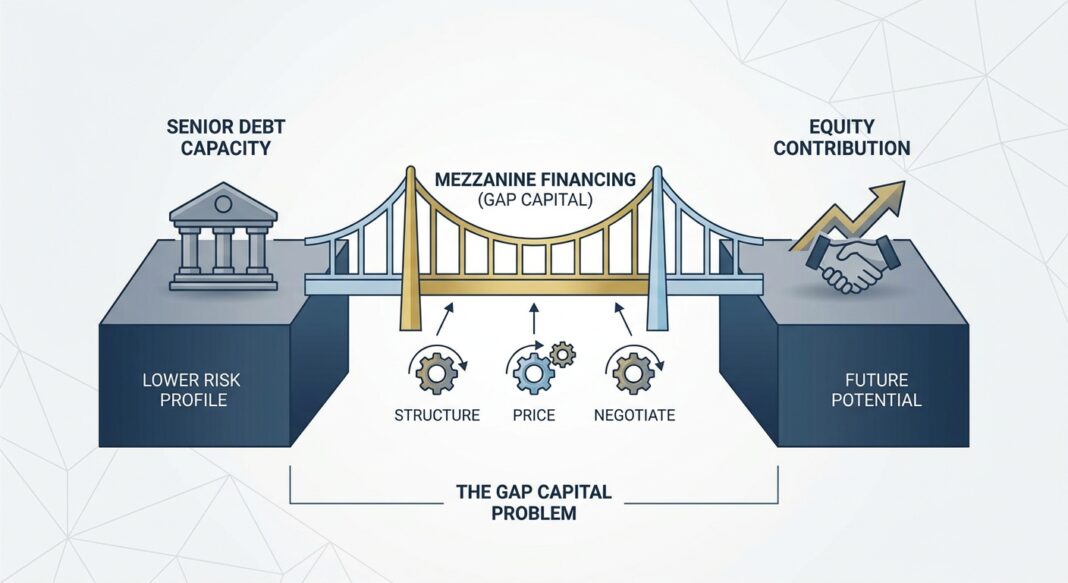
The Financing Challenge: When Senior Runs Out and Equity Costs Too Much
Picture a $12M EBITDA professional services business executing a platform acquisition. The target adds $4M of pro-forma EBITDA, bringing the combined entity to roughly $16M. The acquiring company’s bank extends a senior secured facility to 3.0x EBITDA, call it $36M. The all-in enterprise value of the combined entity is $80M at a 5.0x multiple. The math leaves a structural hole of $8–10M that the bank won’t touch, and the owner refuses to give away 15–20% of the cap table to a new equity partner to fill it.
This is the gap capital problem, and it shows up at virtually every growth-stage acquisition. The gap is real, the options are constrained, and the wrong choice is expensive. That residual slice of the capital stack, sitting subordinate to senior debt and senior to common equity, is the domain of mezzanine financing.
Mezzanine debt is a hybrid financing solution positioned between senior debt and equity, offering growth capital with flexible terms and equity kickers. Understanding how to navigate this layer (how to size it, price it, covenant it, and negotiate it) is one of the highest-leverage structural skills a growth-stage operator or deal advisor can build.
Structure Breakdown: Components, Mechanics, and a Live Example
Mezzanine debt has three defining structural features that distinguish it from senior debt: its subordinated and unsecured position in the capital stack, its payment-in-kind (PIK) interest optionality, and its equity kicker, almost always in the form of stock warrants or conversion rights. Each feature carries a distinct economic implication for the borrower.
Component 1: Cash-Pay Coupon
A mezzanine facility is typically structured as a subordinated loan with a base cash interest rate paid monthly or quarterly, typically 8% to 14% per year depending on the company’s risk profile and market conditions. This cash coupon is the non-negotiable minimum current yield the lender requires to justify holding a subordinated, illiquid instrument.
Component 2: PIK Interest
PIK interest accrues on the principal balance instead of being paid in cash, compounding over the life of the facility and increasing the effective cost of borrowing over time. For borrowers, PIK preserves near-term cash flow, critical during an integration phase, but compounds the exit obligation. If the anticipated liquidity event is delayed, the growing PIK balance creates a larger refinancing burden at bullet maturity, a risk that worsens in deteriorating markets. Borrowers should model at least two delay scenarios before accepting a high PIK-to-cash-pay split.
Component 3: Equity Kicker (Warrants)
Warrants are typically penny warrants for 1% to 5% of fully diluted equity in current 2026 structures. Every warrant granted to a mezzanine lender dilutes existing common equity. The kicker is not “free upside”; it is deferred cost. In a successful exit at a premium multiple, those warrants convert into real money leaving the cap table.
Worked Example: $10M Mezzanine Tranche on an $80M Platform Acquisition
The capital stack for the $80M acquisition described above might be structured as follows:
| Tranche | Amount | % of Stack | Pricing / Terms |
|---|---|---|---|
| Senior Secured (First Lien) | $36M | 45% | SOFR + 475bps; 1 maintenance covenant |
| Mezzanine / Sub Debt | $10M | 12.5% | 10% cash-pay + 3% PIK; 2% warrant; 5-yr bullet; NCl-103 call schedule |
| Seller Note | $6M | 7.5% | 6% PIK; 5-yr maturity; fully subordinated |
| Equity (Sponsor / Owner) | $28M | 35% | Common equity; residual waterfall |
The all-in mezzanine cost, 10% cash + 3% PIK + warrant value, lands in the typical 2026 pricing range of 10%–14% for performing lower-middle-market credits. The structure gives the borrower five years of runway before any principal repayment and preserves cash for post-close integration.
Mezzanine vs. The Alternatives: Trade-Offs Across the Capital Spectrum
Before committing to mezzanine, every operator should price the full spectrum. The cost of capital runs roughly: bank senior debt → private credit unitranche → mezzanine / second lien → preferred equity → common equity.
Mezzanine vs. Unitranche
Unitranche debt combines what would otherwise be senior debt and mezzanine into one instrument with one lender and one credit agreement, typically priced at SOFR + 500–700bps. For a $50M–$150M EV deal with clean cash flows, unitranche is often the cleaner execution, one negotiation, faster close, no intercreditor friction. The trade-off: unitranche lenders typically cap leverage at 4.0–5.0x and may demand tighter covenants than a split structure allows. When you need to push leverage above 5.0x or when the senior lender is a relationship bank unwilling to cede ground to a direct lender, the senior-plus-mezzanine split preserves the bank relationship while layering in the gap capital separately.
Mezzanine vs. Preferred Equity
Preferred equity sits below mezzanine in the capital stack but above common. It avoids the debt-service obligation (no contractual cash interest) in exchange for a higher return expectation, typically 18–22% IRR. For borrowers who cannot service even PIK-accruing debt safely, preferred equity reduces near-term risk but comes at a higher long-run cost and typically involves more governance rights for the preferred holder.
When Mezzanine Wins
Mezzanine financing is most commonly used by established, profitable businesses with strong cash flow and clear growth ambitions that have often reached the limit of what traditional banks will lend but still need additional capital to fund acquisitions without giving up ownership or control. The ideal mezzanine borrower: EBITDA above $3M, margins above 15%, recurring revenue component, identified exit pathway within five to seven years.
Current Market Terms: What the Data Says in Mid-2026
The mezzanine and subordinated debt market has shifted meaningfully since the 2023–2024 peak of lender competition. Five market data points operators should anchor on today:
- All-in pricing: Mezzanine debt for business acquisitions in 2026 carries a 10%–14% all-in cost, structured as a cash coupon plus a PIK component, depending on leverage, credit quality, and sector.
- Warrant coverage: Warrants are typically penny warrants for 1% to 5% of fully diluted equity in current structures. Warrant size is inversely correlated with cash coupon, a lender willing to take more current yield will negotiate fewer warrants.
- Covenant structure: Roughly 65% of 2025 lower-middle-market deals used a single financial covenant rather than the traditional four-covenant package. The market has moved from total leverage + senior leverage + fixed charge coverage + interest coverage to a single total-leverage maintenance test, preserving operator flexibility for add-on M&A without consent requirements.
- Covenant divergence by market: In the broadly syndicated loan market, approximately 90% of new loans in 2024 remained covenant-lite, while private credit lenders maintained firmer positions on covenant inclusion, particularly for mid-market transactions. Mezzanine lenders in the lower middle market almost universally retain at least one maintenance covenant.
- Direct lending competitive pressure: Direct lending spreads widened by roughly 50 to 100 basis points since late 2025, alongside a return to stronger lender protections, after a period where heavy fundraising had left too much capital chasing too few deals. The lender-friendly reset is creating better-documented deals, important for borrowers who want clean, waivable covenants rather than aggressive structures they cannot manage through a correction.
The Gap Capital Playbook: Quantify, Prepare, Run the Process, Close
Mezzanine is not a product you buy off a shelf; it is a negotiated instrument. Operators who run a structured process achieve structurally better outcomes than those who accept the first term sheet. Here is the sequence:
Step 1: Quantify the Gap
Build your sources-and-uses table before approaching any lender. Senior capacity (bank or non-bank) will anchor to 2.5–3.5x EBITDA for most asset-light businesses. Seller notes or earnouts can fill a portion. The gap is the residual after senior debt and any seller participation, and this number drives the mezzanine sizing conversation. Knowing the gap number precisely before outreach signals deal readiness and avoids the costly mistake of sizing a mezzanine facility too large (unnecessary warrant dilution) or too small (undercapitalized integration).
Step 2: Prepare Three Core Documents
First, a use-of-proceeds memo, a one-page schedule mapping sources to uses, demonstrating EBITDA accretion from the acquisition. Second, a three-year integrated financial model with revenue, EBITDA, debt service, and free cash flow, including sensitivity tables on revenue growth and margin compression. Third, a management presentation covering strategic rationale, competitive moat, customer concentration, and exit pathway. Mezzanine providers hold positions for five to seven years and must underwrite the eventual refinancing or sale event at the outset.
Step 3: Run a Competitive, Simultaneous Process
Target 12–18 mezzanine providers simultaneously. Filter by check size ($5M–$30M), sector expertise, sponsor/non-sponsor flexibility, and geography. Issue a bid process letter with a hard IOI deadline to create genuine competition. Select two to four finalists for management presentations before advancing to term sheets. Golub Capital reported a 62-day average from term sheet to funding on 2025 deals, a realistic timeline for operators to plan against.
Step 4: Negotiate the Term Sheet
The four highest-leverage negotiation points are: (1) Covenant package: push hard for a single total-leverage covenant at 5.5–6.0x with 15–20% cushion to the closing case; (2) PIK toggle: negotiate the right to elect PIK at your option rather than having it mandated by the lender; (3) Warrant coverage: seek 1–2% rather than 3–5%, offering a higher cash coupon to reduce dilution; and (4) Call schedule: the NC1-103-102-101 structure is market standard, but negotiating a shorter non-call window (6 months vs. 12 months) preserves early refinancing flexibility if the business outperforms. The single biggest structural swing an advisor can generate is on the covenant package.
Key Takeaways
- Mezzanine fills the gap between senior debt capacity and equity contribution: It is specifically designed for situations where bank leverage runs out before total funding need is met, allowing acquisitions and recapitalizations to close without excessive equity dilution.
- PIK interest is deferred cost, not free cash flow: Every dollar of PIK that accrues compounds the balloon payment at maturity. Model the compounded PIK balance across multiple delay scenarios, not just the base case, before accepting a high PIK-to-cash split.
- Warrant coverage is negotiable and inversely correlated with cash coupon: A borrower willing to pay a higher cash coupon (which the lender receives today) can negotiate fewer warrants (which the lender would receive at exit). This trade-off is worth modeling explicitly when exit multiples are expected to be high.
- Covenant package is the most consequential structural negotiation: The shift toward single-covenant structures in 2025–2026 is borrower-friendly. Push for a single total-leverage test with meaningful cushion rather than a four-covenant package that constrains future add-on M&A and dividend recapitalization capacity.
- Run a competitive process with 12–18 providers simultaneously: Mezzanine is a negotiated instrument where process design, not just credit quality, determines terms. Simultaneous competitive outreach, hard IOI deadlines, and a clean three-document preparation package are the inputs that produce the best structural outcomes.


