
The Moment the Capital Stack Becomes Real
For most growth-stage operators, capital strategy is abstract until the moment it isn’t. That moment usually arrives in the form of an acquisition target: a complementary business, a competitor, or a bolt-on that accelerates the roadmap by three years. The founder’s first instinct is to call their bank. The bank’s first instinct is to say no, or to offer a facility sized at 60 cents on the dollar of what the deal actually requires.
This is the gap. And the gap is where mezzanine financing lives.
Understanding how to navigate this layer of the capital stack (how to size it, price it, document it, and negotiate it) is one of the highest-leverage skills a growth-stage operator can develop. This article is a practitioner’s guide to doing exactly that.
The Capital Stack in a Growth-Stage Acquisition: Layer by Layer
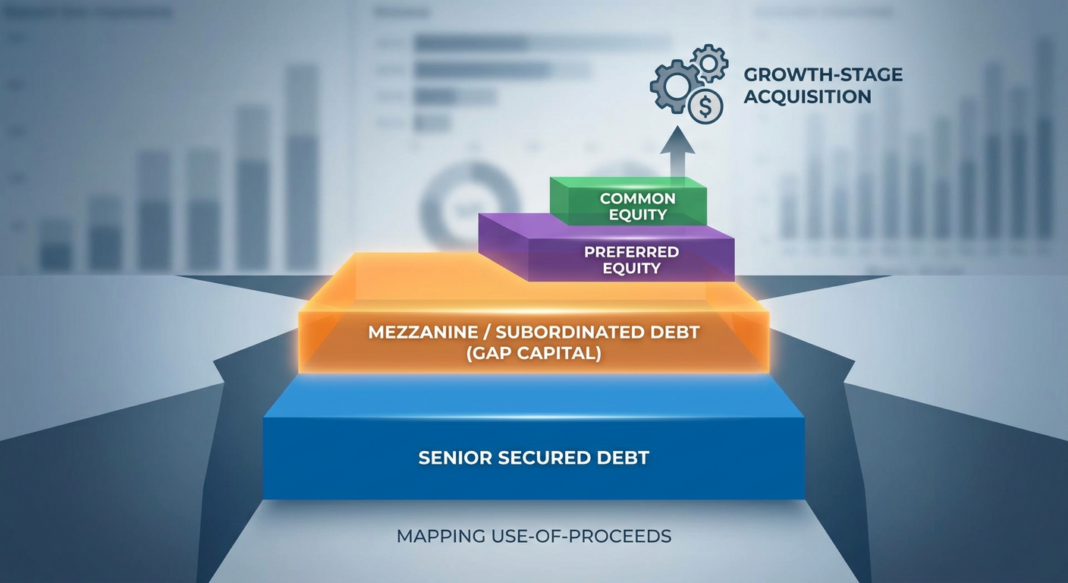
In a typical growth-stage acquisition, the capital stack comprises three to four distinct layers. Each carries a different cost of capital, a different structural expectation, and a different risk tolerance. Moving from most senior to most junior:
- Senior secured debt (bank or non-bank): The cheapest layer in cash-pay terms. Typically priced at SOFR plus a credit spread, with a first lien on operating assets, and sized to 2.0x–3.5x EBITDA depending on the lender’s appetite and the company’s revenue quality. Senior lenders set the floor (and the ceiling) for everything below them.
- Mezzanine / subordinated debt: The gap capital layer. All-in pricing typically ranges from 13%–18%, often structured as a cash-pay coupon plus a PIK (payment-in-kind) component and warrant coverage of 1%–5% of fully diluted equity. Subordinated to senior lenders but senior to all equity. Covenant packages are negotiated, some mezz providers accept incurrence-only covenants; others require maintenance tests. As documented in Bond Capital’s acquisition financing framework, evaluating total cost of constraint, not just total cost of coupon, is the correct comparison metric when selecting between providers.
- Preferred equity or seller notes: A bridge layer used when the debt stack is fully stretched but the equity check would be prohibitively dilutive. Seller notes in particular are underutilized: a motivated seller who accepts 20%–30% of the purchase price as a structured note reduces the buyer’s day-one equity requirement materially.
- Common equity (sponsor, management, or rollover): The most expensive layer in dilution terms. Sized as the residual once debt capacity and seller participation are fully deployed. The structuring objective is to minimize this layer, without over-levering the business, because every dollar of equity saved at acquisition is a dollar that compounds at the business’s internal rate of return.
A worked example makes this concrete. Consider a $100M enterprise value acquisition of a software business generating $10M of EBITDA. Senior lenders will extend 3.0x EBITDA, $30M, against a first lien on ARR and operating assets. That leaves a $70M gap between senior debt capacity and the purchase price. A $20M mezzanine facility at 15% all-in (12% cash pay, 3% PIK) with 3% warrant coverage closes a further $20M of that gap. A $5M seller note at 8% over five years closes another $5M. The equity check drops from a theoretical $70M to $45M, a 36% reduction in required equity capital, achieved entirely through disciplined stack construction.
Why Mezzanine, and When It Isn’t the Right Answer
Mezzanine debt earns its place in the stack when three conditions are met simultaneously: (1) the business generates enough cash flow to service a blended debt cost without impeding operations, (2) the equity dilution avoided by using mezzanine exceeds the incremental cost of the mezzanine instrument itself, and (3) the business has enough operating predictability that warrant coverage is a bounded risk rather than an open-ended giveaway.
When those conditions are not met, the alternatives deserve serious consideration. A preferred equity instrument (typically unscheduled, covenant-light, and priced at 14%–18%) can be structurally less constraining than a mezzanine facility, even if nominally more expensive. As Bond Capital’s gap capital playbook makes clear, a 14% mezz facility with quarterly maintenance covenants can be more constraining than a 16% preferred with no covenants and no scheduled amortization. The analysis must be holistic: cash-pay burden, PIK accrual, covenant headroom, and warrant dilution, evaluated simultaneously against the business’s projected free cash flow trajectory.
For businesses earlier in their maturity curve (pre-acquisition, pre-EBITDA, or still scaling toward profitability) revenue-based financing, venture debt, or staged SAFEs and bridge instruments may be more appropriate before the business has the cash flow coverage ratios that senior and mezzanine lenders require. Sequencing matters: the right instrument at the wrong stage creates structural friction that limits future options, as capital structures compound across funding rounds in ways that are difficult to unwind.
The Gap Capital Playbook: Quantify, Prepare, Run the Process
Executing a mezzanine raise is a structured process, not a relationship call. Operators who treat it as the latter leave price and terms on the table. The playbook has four sequential steps:
- Quantify the gap precisely. Build a sources-and-uses schedule that maps every dollar from capital sources to acquisition costs: purchase price, transaction fees, integration reserves, and working capital. The gap is the residual after senior debt and any seller participation. This number drives the mezzanine sizing conversation.
- Prepare three core documents. First, a use-of-proceeds memo: a one-page schedule mapping sources to uses, demonstrating EBITDA accretion from the acquisition. Second, a three-year integrated financial model with revenue, EBITDA, debt service, and free cash flow, including sensitivity tables on revenue growth rate and margin compression. Mezzanine providers need to underwrite how much degradation the structure absorbs before covenants trip. Third, a management presentation covering strategic rationale, competitive moat, customer concentration, and exit pathway. Mezz providers typically hold positions for five to seven years and must underwrite the eventual refinancing or sale event.
- Run a structured process with multiple providers simultaneously. Approach four to six mezzanine providers with a defined response window, 10 to 15 business days is standard. Require each provider to specify pricing, PIK/cash-pay split, warrant coverage, covenant structure, and call protection in their response. Simultaneous processes create competitive tension; sequential ones do not.
- Evaluate across all five structural dimensions, not just price. All-in yield, PIK/cash split, warrant coverage percentage, covenant package (maintenance vs. incurrence), and prepayment terms. A provider quoting 50 basis points more but offering incurrence-only covenants and no warrant coverage may be the structurally superior choice over a five-year hold.
Negotiation: The Five Points That Move the Most Value
Once you have competing term sheets, negotiation shifts from price discovery to structural optimization. Five points move the most value:
- PIK toggle flexibility. Negotiate the right, not the obligation, to PIK interest in years one and two. This preserves cash during the integration period without triggering default. Full PIK mandates accrue faster than operators anticipate; a toggle gives optionality without locking in the accrual.
- Warrant coverage percentage and strike price. 1%–5% of fully diluted equity is the standard range, but the strike price matters as much as the percentage. A warrant struck at current enterprise value versus a warrant struck at a step-up to projected exit value has a materially different dilutive impact. Negotiate both.
- Covenant headroom. If maintenance covenants are unavoidable, negotiate the specific test levels with 20%–25% headroom above your base-case projections, not your upside case. Covenants set at tight multiples create technical defaults during integration dips that have nothing to do with fundamental business deterioration.
- Call protection structure. Most mezzanine instruments include a no-call period of 12–24 months followed by a declining premium. Negotiate the shortest possible no-call period and the steepest possible decline; this preserves your ability to refinance at lower cost once the business has seasoned.
- Information rights and board observation. Mezz providers frequently request board observation rights as a condition of the facility. Observation is generally acceptable; formal board seats for debt providers are not standard and should be resisted. Establish clear information rights (quarterly financials, annual audited accounts, covenant compliance certificates) and cap them there.
Key Takeaways
- The gap is structural, not a failure. Senior debt rarely funds more than 30%–35% of an acquisition’s enterprise value. Mezzanine and subordinated instruments exist precisely to bridge the remainder without forcing excessive equity dilution.
- Total cost of constraint outweighs total cost of coupon. A lower-rate mezzanine facility with tight maintenance covenants can be more expensive in operational terms than a higher-rate instrument with incurrence-only tests. Evaluate all five structural dimensions simultaneously.
- Simultaneous process, not sequential. Approaching four to six mezzanine providers with a defined response window creates the competitive tension necessary to move pricing and terms. One-at-a-time conversations do not.
- PIK toggle, not PIK mandate. The right to PIK in early years preserves integration-period cash flow without committing to compounding accrual. Negotiate optionality, not obligation.
- Sequence the stack before you start the process. Every capital decision constrains the next. The mezzanine terms you accept today shape your refinancing options, acquisition capacity, and equity dilution profile for the next five to seven years. Design forward, not just for the current transaction.


