
The Story: Two Weeks From a VC Round, the Pandemic Hit, and Everything Changed
In early 2020, Simon Turner was two weeks away from closing an equity round. Myagi, his retail sales enablement platform, had been gaining real traction with global retail brands, and a venture capital injection felt like the logical next step. Then the world shut down. The round evaporated overnight.
What happened next surprised even Turner. Demand for Myagi’s digital training platform surged. Retailers locked out of physical field operations suddenly needed exactly what he had built. Myagi posted its best six months of growth on record, without a single dollar of new outside capital.
The near-miss forced a reckoning. Turner had spent years watching the venture capital playbook up close. He’d grown skeptical of it. “Venture capitalists will challenge you to grow at all costs,” he reflected after the company’s eventual exit. “One thing venture capital doesn’t take into account is that many businesses have a natural cadence at which they grow. For many companies, growing too fast can be detrimental.”
By early 2021, Turner needed capital, but not a new set of shareholders. He needed fuel, not a new co-pilot. The distinction would end up making him considerably wealthier.
The Decision: Structuring Growth Against Revenue, Not Against Ownership
Turner’s options in early 2021 were familiar to any founder at his stage. He could return to the venture market, likely surrendering 20–25% of his cap table at a post-pandemic valuation, and accept the board seats, milestone pressure, and growth-at-all-costs mandate that typically accompanies institutional equity. Or he could pursue a different instrument entirely.
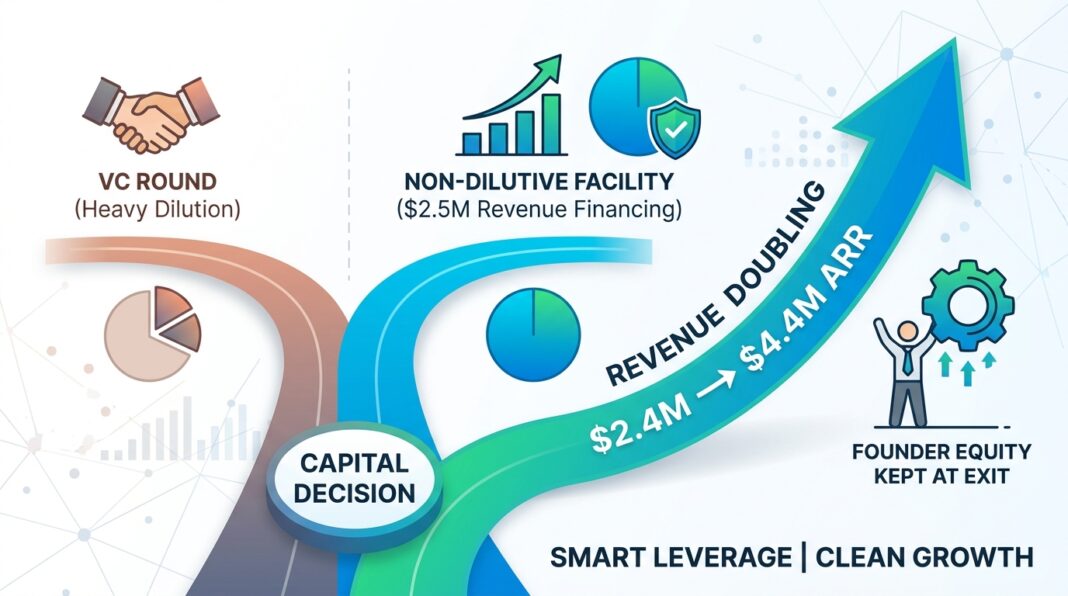
He chose the latter. Turner turned to TIMIA Capital for a $2.5 million non-dilutive investment facility structured against Myagi’s recurring revenue. The terms were clean: no equity surrendered, no board seats granted, no warrants attached. Repayment was tied to the company’s actual cash generation, aligning the cost of capital with the business’s natural rhythm rather than a VC fund’s return timeline.
The capital went into the right places: sales expansion, software capability improvements, and the land-and-expand customer success model that was already Myagi’s core growth engine. No forced pivots. No externally imposed headcount ramps. Just more fuel for a machine that was already running.
The counterfactual matters here. Had Turner raised a $2.5 million venture round instead, a 20–25% dilution at a plausible 2021 valuation would have transferred a significant, permanent slice of his exit proceeds to a fund with its own return requirements. The cost of that equity would not have been fixed. It would have compounded, every dollar of value Myagi created post-investment would have partially belonged to someone else.
The Outcome: ARR Doubles, Founders Win at Exit
The results of the TIMIA facility were not subtle. Myagi’s annual recurring revenue climbed from $2.4 million to $4.4 million: an 83% increase that materially repositioned the company’s valuation ahead of any acquisition conversation. In 2023, Rallyware acquired Myagi, absorbing its platform into a performance enablement suite for large-scale sales forces. Turner’s equity was largely intact. The founding team walked away whole, per TIMIA Capital’s documented case study.
The story didn’t end there. Around the same time, a father-son team in Florida (Greg and Timothy Holifield) deployed the identical logic at their AI-based weapons detection company, SafePointe. Facing capital intensity from hardware costs embedded in SaaS contracts, they secured a $1 million TIMIA debt facility in September 2022. Within twelve months, SafePointe had tripled its monthly recurring revenue and was acquired by SoundThinking, Inc. (Nasdaq: SSTI), the Holifields’ fourth successful exit, as documented by Bond Capital.
Greg Holifield’s post-exit commentary was blunt: “They think the interest rate is too high, but when there are no warrants associated with debt, it is truly fantastic money, and much cheaper than equity. I love this class of debt.” The equity investors who co-invested alongside TIMIA made 10x their money in nine months. TIMIA’s debt cost a fraction of that in real economic terms: a fixed, finite obligation that cleared easily at exit, leaving the majority of proceeds with the founders.
The Contrast: When Debt Becomes a Trap
No story about non-dilutive capital is complete without its cautionary mirror. In January 2025, rent-to-own startup Divvy Homes sold to Brookfield Properties for approximately $1 billion. The founders received $0. So did most employees. So did many of the venture investors who had poured money in at a $2.3 billion peak valuation.
Divvy had raised over $400 million in venture equity, then layered in approximately $735 million in debt financing in October 2021, at the height of the zero-interest-rate era. When rates surged in 2022, the model fractured. Three rounds of layoffs followed. By 2023, new home acquisitions had paused entirely. The $1 billion Brookfield acquisition looked like a rescue from the outside. From the inside, the waterfall was devastating: debt repayment first, transaction costs second, preferred liquidation preferences third. Nothing remained for common shareholders or founders, as CEO Adena Hefets confirmed in a letter to shareholders, per SaaStr.
The distinction between Myagi and Divvy isn’t simply “debt good” or “debt bad.” It’s structural. Myagi’s $2.5 million facility was additive, sized against existing, serviceable recurring revenue, deployed into proven growth levers, and designed to clear comfortably at any realistic exit. Divvy’s $735 million was transformative, structurally required for the core business model to function, dependent on a specific macro environment, and sized against an opportunity rather than a business.
The Lessons: A Framework for the Capital Decision
The Myagi and SafePointe outcomes aren’t luck. They reflect a set of structural disciplines that any founder can apply before signing a term sheet.
1. Model your waterfall before you sign anything. At every plausible exit price ($5M, $20M, $50M) what do you actually receive after debt, transaction costs, and liquidation preferences are satisfied? Your lenders and investors have already run this model. You should too.
2. Size debt to the business, not the opportunity. Myagi drew $2.5M against $2.4M in ARR. SafePointe drew $1M against a hardware-enabled SaaS business with government contract visibility. The debt was sized to what the business could realistically service, and what any reasonable exit would easily clear.
3. Distinguish additive debt from transformative debt. Revenue-based financing accelerates a business that is already working. It is an operational multiplier. Debt that is structurally required to fund core operations is a different instrument entirely, with a fundamentally different risk profile.
4. Remember that dilution compounds. The cost of surrendering equity is not a one-time event. Every dollar of enterprise value you create after the dilution event is partially owned by someone else. Non-dilutive capital preserves the full compounding of your future growth.
5. Non-dilutive doesn’t mean free; it means senior. Interest payments must be serviced. At exit, debt sits ahead of you in the waterfall. The advantage is that the cost is fixed and finite. The risk is real if sizing is wrong. Know the difference before you sign.
Key Insights
- Non-dilutive, revenue-secured debt preserves founder ownership without sacrificing growth capital: Myagi grew ARR 83% and exited with equity intact using a $2.5M facility instead of a VC round.
- The true cost of equity is variable and compounding: a 20–25% dilution at funding translates into a permanent, growing claim on every dollar of future value created.
- Debt sized to serviceable cash flow is a multiplier; debt sized to an opportunity is a risk transformation: the Divvy Homes outcome illustrates what happens when the latter is confused for the former.
- Modeling the exit waterfall before signing is non-negotiable: founders who internalize the debt-first, preference-second waterfall structure make better capital decisions than those who discover it at the closing table.
- Natural business cadence is a strategic asset: founders who use capital to accelerate existing momentum, rather than force growth the market can’t sustain, tend to build better businesses and capture more of the exit.


