
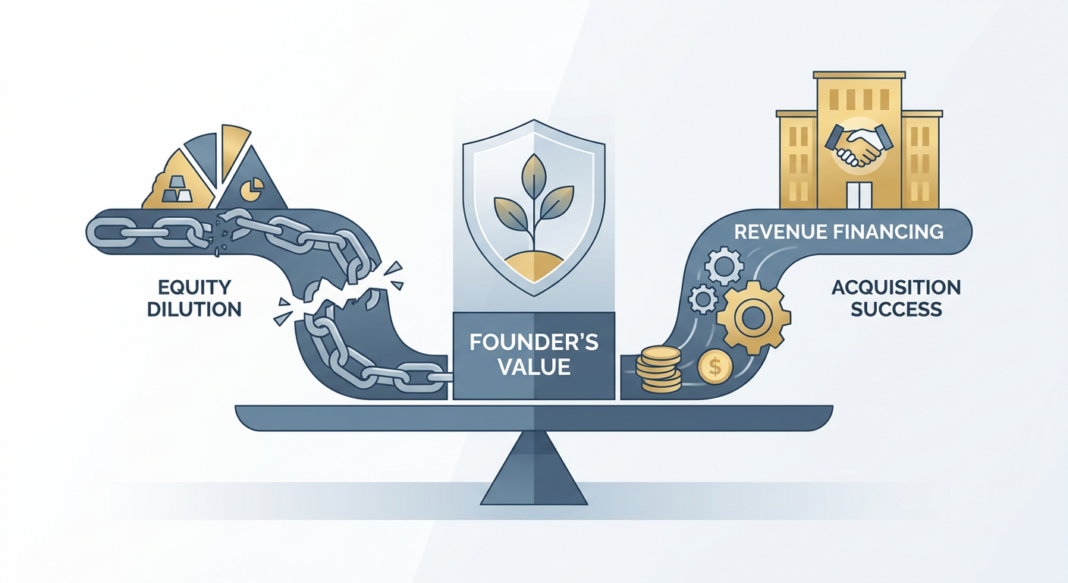
The Story: The Karate Kid and the Capital Stack
Simon Turner didn’t set out to become a case study in optimal capital allocation. He set out to fix something broken in retail: the slow, expensive, human-intensive process of getting frontline salespeople the product knowledge they needed to close deals. Inspired by a line from The Karate Kid, “No such thing as a bad student, only a bad teacher”, Turner co-founded Myagi, a retail sales enablement platform built to make every frontline rep customer-ready, every day.
By early 2020, Myagi was gaining traction with global retail brands. Then the pandemic hit. Turner’s planned equity round evaporated overnight. What happened next, however, surprised him: demand for Myagi’s digital training platform surged. Retailers, locked out of physical field sales operations, suddenly needed exactly what Myagi offered. The company posted its best six months of growth on record, and Turner realized something critical: he didn’t need a VC round. He needed a cash injection, not a new set of shareholders.
In early 2021, Turner turned to TIMIA Capital for a $2.5 million non-dilutive debt facility. Two years later, Myagi was acquired by Rallyware, with Turner’s equity largely intact.
The Decision: When Venture Capital Becomes the Wrong Tool
Turner had run the full gamut of growth capital options across his entrepreneurial career. He understood the venture capital playbook intimately, and he’d grown skeptical of it. “Venture capitalists will challenge you to grow at all costs,” he reflected after the Myagi exit. “One thing venture capital doesn’t take into account is that many businesses have a natural cadence at which they grow. For many companies, growing too fast can be detrimental.”
Instead of accepting VC terms that would have set an aggressive, externally-imposed growth clock (and heavily diluted his cap table ahead of an exit) Turner structured Myagi’s next phase around TIMIA’s $2.5 million investment facility. The capital was non-dilutive: no equity surrendered, no board seats granted, no warrants attached. Repayment was structured against Myagi’s recurring revenue, aligning the cost of capital with the company’s actual cash generation capacity.
The contrast with the equity alternative is stark. Venture capital at Myagi’s stage, a few million dollars into a growth-phase SaaS company, would typically have priced in the 20–30% ownership range, depending on valuation. That ownership stake, at exit, would have represented a significant transfer of value away from the founding team. Debt structured against recurring revenue kept that value where Turner had built it.
“Debt is a powerful tool for capital-efficient businesses when used under the right circumstances,” Turner said. That qualifier, the right circumstances, is the crux of the entire capital structure debate.
The Outcome: ARR Doubles, Founders Win at Exit
With TIMIA’s facility deployed into sales, marketing, and customer success, the core levers of Myagi’s land-and-expand model, the results arrived quickly. Annual recurring revenue climbed from $2.4 million to $4.4 million, an 83% increase that materially repositioned Myagi’s valuation ahead of any acquisition conversation. In 2023, Rallyware acquired the company, absorbing Myagi’s platform into its performance enablement suite for large sales forces.
Compare that trajectory to the equity counterfactual. Had Turner raised a $2.5 million venture round in 2021 (assuming he could have, post-pandemic) he might have surrendered 20–25% of the company to do it. At acquisition, that dilution would have translated directly into dollars leaving his pocket and entering a VC fund’s. Instead, the cost of TIMIA’s debt facility was fixed, finite, and a fraction of the equity value created.
Myagi’s story isn’t isolated. Around the same time, father-son founders Greg and Timothy Holifield deployed a similar strategy at SafePointe, their AI-based weapons detection startup. Facing capital intensity from hardware costs embedded in SaaS licenses, they secured a $1 million debt facility from TIMIA Capital in September 2022. Within 12 months, SafePointe had tripled its monthly recurring revenue and was acquired by SoundThinking, Inc. (Nasdaq: SSTI), the Holifields’ fourth successful exit. Greg was blunt about the math: “When there are no warrants associated with debt, it is truly fantastic money, and much cheaper than equity.” The equity investors who came in alongside TIMIA made 10x in nine months. TIMIA’s debt cost a small fraction of that by comparison, according to TIMIA Capital’s case study.
Scaling the Model: From SaaS to Global Commerce
The non-dilutive playbook scales beyond pure SaaS. Jonathan Benjamin, founder and CEO of UnityLab (formerly Unity Laundry Systems), used revenue-based financing from Sage Growth Capital across multiple stages of growth to build a global commercial appliance business, without surrendering control prematurely. When Sage first invested in August 2020, UnityLab had 47 customers and under $1 million in annual revenue. By 2024, the company had grown more than 10x, opened subsidiaries in China and Italy, achieved a 40% reduction in gross margin costs, and completed a strategic acquisition of Hoffman-NewYorker, all while using non-dilutive capital as the primary growth instrument at each inflection point.
Benjamin’s sequencing was deliberate: use revenue-based financing to prove the thesis, then raise equity from a position of demonstrated strength. Sage’s capital enabled the Hoffman acquisition in Q1 2022, which in turn supported a $6.6 million Series A at a favorable valuation in Q3 2022. “We found ourselves seeking non-dilutive funding that would allow us to prove our thesis… This strategy proved successful, allowing us to secure our Series A financing at a favorable valuation,” Benjamin explained, as detailed by Sage Growth Capital.
Even at the smaller end of the market, the principle holds. Ken Hoppe, CEO of Modigi, used $400,000 in revenue financing from Founderpath to fund his first sales and customer success hires, reaching $1.7 million ARR profitably with just six employees, while retaining 100% ownership. “It’s my own money and my co-founder’s money,” Hoppe told Founderpath. “Founderpath helped us keep control of the company while still getting the capital we needed to grow.”
The Lessons: A Framework for Capital-Efficient Founders
What connects Turner, the Holifields, Benjamin, and Hoppe isn’t just the instrument they used, it’s the philosophy behind the choice. Each of them recognized that capital is not inherently neutral. Equity capital comes packaged with incentives, timelines, and control mechanisms that can fundamentally redirect a business. Debt, structured appropriately against recurring revenue, simply costs money, and leaves everything else intact.
The framework these founders implicitly followed breaks down into four principles:
- Match the instrument to the revenue model. Non-dilutive revenue financing works best when a business has predictable, recurring cash flows: SaaS subscriptions, long-term contracts, or recurring service revenue. The cost of capital is calibrated against your ability to repay from operations, not your investor’s exit expectations.
- Use debt to prove the thesis before equity sets the valuation. Benjamin’s sequencing at UnityLab is the template: deploy non-dilutive capital to hit a milestone, then raise equity from a position of demonstrated traction. The result is a higher valuation and less dilution.
- Understand the true cost of equity. Greg Holifield’s observation about SafePointe’s equity investors making 10x in nine months isn’t just an anecdote, it’s the calculation every founder should run before signing a term sheet. Equity is the most expensive capital available; it just doesn’t feel that way because the cost is deferred and denominated in ownership, not interest payments.
- Preserve optionality as a strategic asset. The sevdesk story (a German accounting SaaS platform that secured non-dilutive Growth Loans from RAC in September 2024 to extend runway ahead of a planned equity raise, then was acquired by Cegid in 2025) illustrates how non-dilutive capital creates strategic breathing room. As sevdesk’s CFO noted, the instrument gave the team “open and reliable conversations on what fits our business best,” according to RAC’s case study. That optionality, not the capital itself, was the real asset.
Key Insights
- Debt structured against recurring revenue is frequently cheaper than equity: not just in interest rate terms, but in total founder value surrendered at exit. The SafePointe example, where equity investors made 10x while TIMIA’s debt cost a fraction, makes the math visceral.
- Non-dilutive capital works best as a milestone-to-milestone instrument, not a permanent substitute for equity. The most successful founders use it to reach the next proof point, then raise equity at a materially better valuation, as UnityLab demonstrated across four distinct financing rounds.
- Venture capital imposes growth velocity that may not match the market’s natural cadence. Turner’s critique of VC, that it forces growth at all costs, reflects a structural misalignment between fund economics and company-specific realities that founders ignore at their peril.
- Ownership retained at exit is the most direct measure of capital strategy success. Myagi’s acquisition by Rallyware, SafePointe’s acquisition by SoundThinking, sevdesk’s acquisition by Cegid, in each case, the founders arrived at exit with significantly more equity than a traditional VC-backed path would have allowed.
- Optionality has quantifiable value. Non-dilutive financing doesn’t just preserve equity; it extends the decision horizon. Founders who aren’t forced into a VC-mandated exit timeline can wait for the right acquirer, the right valuation, and the right strategic fit. That patience, funded by debt, is often worth more than any single growth milestone.


