
The Cycle Has Turned: Private Credit’s Lender-Friendly Reset Is Underway
For institutional investors and operating executives who rely on credit markets to finance acquisitions, recapitalizations, and growth, mid-year 2026 marks a decisive inflection point. After roughly two years in which abundant dry powder and subdued deal flow tilted negotiating leverage decisively toward borrowers — compressing spreads, loosening covenants, and inflating leverage multiples — the structural pendulum is swinging back.
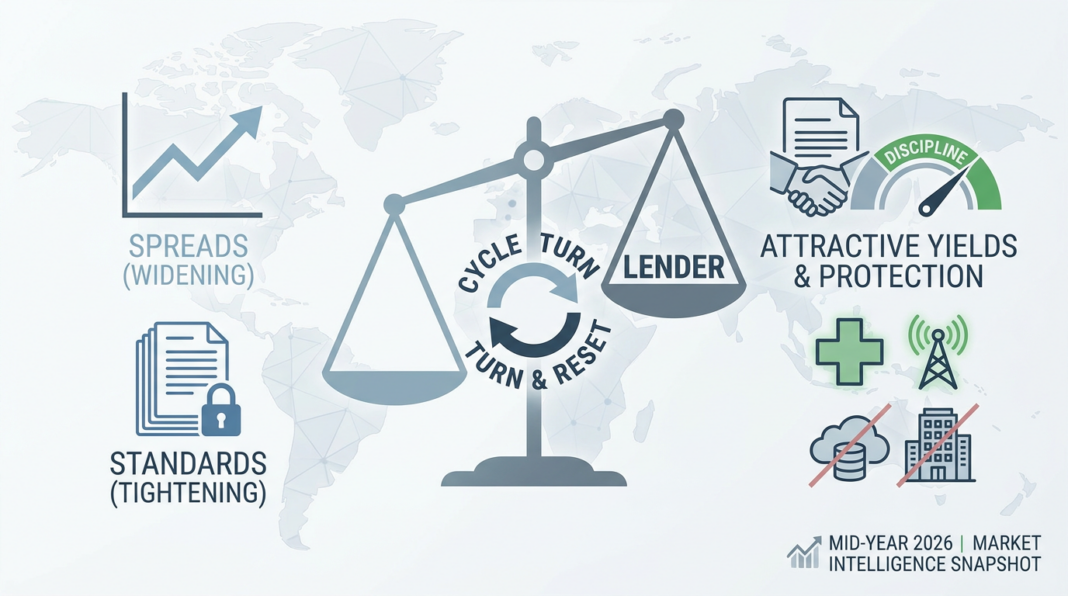
Three converging forces are driving this reset. First, according to PitchBook data cited by Lord Abbett, private credit spreads have widened by roughly 50 to 100 basis points since late 2025, while loan documentation and covenant quality are materially improving. Second, the Federal Reserve’s April 2026 SLOOS confirmed that bank C&I lending standards tightened for firms of all sizes in Q1 2026 — and non-depository financial institution (NDFI) standards tightened across all loan categories over the past year — reinforcing the structural advantage of well-capitalized private lenders. Third, macro disruptions — including geopolitical volatility and an AI-driven reassessment of software credit quality — are making capital more selective, handing disciplined lenders the leverage they ceded in 2024 and 2025.
The result is a market in which new loans are increasingly coming with better credit structures: less leverage, more covenants, fewer PIK requests, and tighter documentation. For disciplined lenders with dry powder, this is potentially the most attractive entry environment since the 2022–2023 rate shock.
Quantitative Market Snapshot — Q2 2026
| Metric | Current (Q2 2026) | Prior Period | Δ Change | Source |
|---|---|---|---|---|
| Middle Market Direct Lending Spread (new-issue) | SOFR + ~525–575 bps | SOFR + ~475–525 bps (YE 2025) | +50–100 bps wider | PitchBook / Lord Abbett (Jun 2026) |
| Global Direct Lending Median Spread (new-issue) | ~544 bps (YE 2025 base) | 596 bps (YE 2024) → 716 bps (Mar 2023 peak) | –172 bps from peak | McKinsey / Kroll / PitchBook (2026) |
| All-in Gross Yield — Direct Lending (1L, unlevered) | ~9.5%–10.0% | ~8.0%–8.5% trough expected mid-2026 | Attractive vs. history | Angel Investors Network / Cliffwater CDLI (Jun 2026) |
| Private Credit vs. BSL Spread Premium | ~150 bps (private over BSL) | ~230 bps (2022–23 peak) | Compressed ~80 bps | Angel Investors Network (Jun 2026) |
| BDC Non-Accrual Rate (median, cost basis) | 2.5% at cost / 1.3% at FV | <2.0% (YE 2024) | ↑ YoY, still contained | KBRA BDC Compendium Q3 2025 / Q1 2026 |
| Projected Direct Lending Default Rate (annualized, year-end 2026) | ~2.0% (rising) | 1.5% (2025 full year) | +50 bps projected rise | KBRA / Northleaf Capital Q1 2026 |
| Fed Funds Rate (target range) | 3.50%–3.75% (on hold) | 4.25%–4.50% (pre-cut cycle) | Rate pause signaled; hike risk flagged | Federal Reserve / Northleaf Q1 2026 |
| Institutional Leveraged Loan Volume (Q1 2026 YoY) | –22.5% YoY | Near-record 2025 issuance | Sharp contraction | PitchBook U.S. Credit Markets Q1 2026 / Capstone Partners |
Data current as of Q1–Q2 2026. Sources as cited. All rates and spreads reflect market estimates and observable deal data; individual transaction terms will vary.
Reading the Numbers
The quantitative picture is one of a market in transition rather than distress. Northleaf Capital’s Q1 2026 update confirmed that combining current base rates and spreads, direct lending continues to generate high single-digit unlevered asset returns — an attractive premium relative to public credit. Simultaneously, the Federal Reserve’s April 2026 SLOOS found that banks reported tighter lending standards for C&I loans to firms of all sizes in Q1 2026, and for the first time disclosed that standards have tightened across all non-depository financial institution (NDFI) loan categories over the prior year. This dual dynamic — banks pulling back, private lenders repricing favorably — reinforces the structural opportunity in middle-market direct lending for the remainder of 2026.
Importantly, KBRA’s Q1 2026 BDC Compendium noted that despite heightened volatility and credit quality concerns, the rated BDC sector demonstrated relative financial stability, with BDCs continuing to operate with conservative leverage profiles and reliable access to debt capital markets. Capital formation, however, slowed considerably, with capital raises at the top five perpetual-life BDCs declining approximately 50% year-over-year — a signal that the retail channel is under redemption pressure even as institutional demand remains firm.
Sector Analysis: Where Capital Is Flowing — and Where It Is Retreating
🟢 Hot Sectors: Healthcare, Infrastructure & ABF, AI-Adjacent Hard Assets
Healthcare leads all private credit sectors for deal volume, driven by non-cyclical cash flows, demographic tailwinds, and defensive revenue models. According to Octus data, healthcare accounted for 19% of all 2025 direct lending deals and was the only major sector to avoid significant year-over-year price tightening, with Q4 2025 spreads landing at approximately SOFR + 500 bps. Healthcare M&A momentum is expected to carry through H1 2026, providing ongoing underwriting opportunities. Creative Planning’s 2026 market analysis notes that demographic shifts and non-cyclical service models continue to attract lenders seeking stable, predictable cash flows — exactly the FCCR profile that disciplined lenders currently require.
Infrastructure and Asset-Backed Finance (ABF) represent the most significant structural growth story in private credit. McKinsey’s 2026 Global Private Markets Report highlights infrastructure credit as a particularly fast-growing ABF segment, driven by enormous capital needs from the AI build-out, including data centers, fiber networks, and power generation. The scale is illustrated by Meta’s use of private markets to secure $29 billion to finance a Louisiana data center. S&P Global Market Intelligence (April 2026) additionally flags U.S. utilities as increasingly engaging private credit providers to fund large-scale infrastructure capital programs, a trend reflecting private credit’s expanding mandate beyond middle-market corporate lending.
🔴 Cold Sectors: Software / SaaS, Office CRE, Energy-Intensive Industrials
Software and SaaS face the sharpest repricing of any major sector. VRC’s Q1 2026 update confirmed that technology and software services loans continue to price at wider-than-average premiums, given risk-off conditions and lower implied enterprise values driving higher loan-to-value ratios. Lord Abbett’s mid-year 2026 analysis (citing PitchBook data) notes that software represents approximately 20% of private market exposure versus ~13% in liquid leveraged finance markets — making portfolio concentration a key differentiator between stronger and weaker BDC performers. The critical distinction for underwriters: profitable, cash-generative software companies with mission-critical products are fundamentally different from pre-profitability ARR borrowers whose revenue base may face AI substitution risk.
Office CRE continues to see lender retreat. S&P Global Market Intelligence (April 2026) reports that private credit lenders are retreating from office property exposure as uncertainty around future demand, compounded by technological and workplace changes, increasingly influences lending decisions. Appetite for office assets has diminished relative to other property and infrastructure-linked segments.
Energy-intensive industrials and manufacturing have attracted tighter underwriting following geopolitical disruptions in the Middle East and elevated energy costs. Capstone Partners’ Q1 2026 Middle Market Leveraged Finance Report confirmed that lenders responded to these shocks by tightening underwriting standards for businesses whose leverage was predicated on stable energy costs — and that oil price movements will remain a key variable for deal structuring over the next several quarters.
KPI Underwriting Shift: FCCR & Leverage Multiples Under Active Revision
Across sectors, the most operationally significant shift is in how lenders are underwriting financial KPIs. Lincoln International’s analysis documents that lenders are now underwriting to a forward-looking Fixed Charge Coverage Ratio (FCCR) that incorporates expectations for interest rates — constraining the amount of debt a company can support and, by extension, reducing available leverage multiples. A forward-looking FCCR stress test — adding 100 bps to floating rate debt and reclassifying 25% of projected capex as maintenance — that yields a ratio below 1.1x is increasingly viewed as insufficient early-warning protection in the current environment. Loan documentation standards are also tightening: Bernstein’s research notes that through Q3 2025, nearly half of middle market deals carried two or more maintenance covenants, compared to only 10% for larger transactions — a structural advantage in early credit cycle detection for core middle market lenders.
Strategic & Operational Implications
For Borrowers & Operating Executives
The era of borrower-favorable terms is receding but has not ended — particularly in the large-cap segment where public markets continue to compete aggressively. The December 2025 rescission of the OCC/FDIC Leveraged Lending Guidance gives private credit lenders greater flexibility to underwrite a broader range of deals, which may modestly improve availability at deeper leverage levels for well-structured transactions. However, operators should expect more rigorous FCCR testing on a forward basis, more conservative EBITDA add-back treatment, and closer scrutiny of PIK election requests. Companies in healthcare, infrastructure, and stable industrial sectors will continue to attract competitive pricing; software-dependent businesses face a higher bar and wider pricing in the current environment. For the $300–$350 billion in leveraged and private credit entering its refinancing window, early engagement with lenders — well ahead of maturity dates — remains the most critical operational priority.
For Institutional Investors & Lenders
The mid-2026 environment is structurally more attractive for patient, discipline-driven lenders than the compressed conditions of early 2025. Lord Abbett’s mid-year assessment argues that the most durable advantage comes from better documentation, more conservative leverage, and the time to conduct stress analysis before capital is deployed. The concentration of redemption pressure in retail-oriented perpetual-life BDC vehicles creates a divergence worth monitoring: McKinsey’s 2026 Global Private Markets Report notes that redemption requests hit approximately 16% of NAV in Q1 2026, with five BDCs exceeding their 5% quarterly caps. Institutional capital with no forced-selling pressure is well-positioned to capitalize on improved terms. Portfolio managers should prioritize non-accrual trends, PIK usage ratios, and 2021–2022 vintage concentration as key credit stress indicators for the remainder of 2026.
Forward-Looking View: H2 2026 Liquidity & Lending Dynamics
The second half of 2026 is likely to be defined by dispersion — between sectors, managers, and vintages — rather than broad directional moves. Northleaf Capital projects that greater bifurcation in credit performance will drive a modest increase in defaults from historically low levels, with KBRA projecting the annualized default rate to rise from 1.5% in 2025 to 2.0% by year-end 2026 — elevated but not systemic. The Financial Stability Board’s May 2026 vulnerability report on private credit flagged opacity, interconnectedness with banks and insurers, leverage risks, and liquidity mismatches in semi-liquid retail fund structures as systemic watchpoints — a formal signal that regulatory scrutiny is intensifying as the asset class approaches $2.1 trillion in global AUM.
Three structural forces provide medium-term support: the ongoing retreat of regional banks from middle-market C&I lending (confirmed by consecutive SLOOS tightening reports); the growing maturity wall for 2021-vintage loans creating new refinancing demand at market rates; and the continued build-out of AI infrastructure requiring long-duration, flexible capital that only private markets can efficiently provide. Within Intelligence projects that as Europe implements Basel IV, a major shift away from bank lending — currently approximately 70% of total European credit — toward private debt funds will generate a multi-year origination tailwind for well-positioned platforms on both sides of the Atlantic.
For institutional allocators and operating executives alike, the watchword for H2 2026 is precision: as McKinsey concludes, private credit is becoming less about deploying capital at pace and more about deploying it with precision.
⚡ 5 Key Market Insights — Bond Capital Intelligence Desk
- Spreads have reset, not collapsed. Private credit new-issue spreads are 50–100 bps wider than late 2025 levels, all-in yields remain in the 9.5%–10% range, and the private premium over broadly syndicated loans sits at ~150 bps. The lender-friendly reset is real, but spreads remain below 2022–2023 peaks, meaning selectivity — not desperation — is the appropriate posture. (Source: PitchBook / Lord Abbett)
- FCCR and forward-looking leverage constraints are the new underwriting gating criteria. Lenders are now structuring FCCR floors on a forward-looking, rate-stress-adjusted basis. Borrowers entering Q3 2026 negotiations should model forward FCCR sensitivity to a 100 bps rate shock and be prepared to justify EBITDA add-backs rigorously; overly optimistic adjustments are receiving significantly more scrutiny. (Source: Lincoln International)
- Healthcare and infrastructure are the consensus overweights; software requires binary underwriting. Healthcare commands ~19% of direct lending deal flow with stable SOFR + 500 bps pricing. Infrastructure and ABF are scaling rapidly. Software must be evaluated on cash generation and AI-disruption exposure, not ARR multiples alone. Office CRE and energy-intensive industrials face active lender retreat. (Source: Octus / S&P Global Market Intelligence)
- The retail BDC redemption cycle is a risk to monitor, not a crisis to flee. Capital raises at top-5 perpetual-life BDCs fell ~50% YoY in Q1 2026, and redemption requests hit ~16% of NAV. However, KBRA maintains Stable Outlooks across the rated BDC universe, non-accruals remain below 2.5% at cost, and institutional direct lenders with locked-up capital are experiencing none of the same pressure. Distinguish between vehicle-structure risk and underlying credit risk. (Source: KBRA / McKinsey)
- The $300–$350 billion refinancing wall is the H2 2026 and 2027 defining event. Loans originated in the 2020–2022 low-rate environment are entering their refinancing window at materially higher all-in costs. Borrowers without viable exit options are fueling demand for new loans at market rates, expanding lender opportunity sets. Operators should initiate refinancing processes 9–12 months ahead of maturity to preserve negotiating leverage and avoid distressed-price execution. (Source: Verdence Capital / Octus)
Bond Capital Market & Sector Intelligence | Published 27 June 2026 | Data sourced from PitchBook LCD, McKinsey Global Private Markets Report, Lord Abbett, Federal Reserve SLOOS (April 2026), KBRA BDC Compendium Q1 2026, Northleaf Capital, Capstone Partners, Octus, S&P Global Market Intelligence, Valuation Research Corp., Financial Stability Board, and Lincoln International. All market data points reflect publicly available institutional research and observable deal-level data as of the date of publication.


