
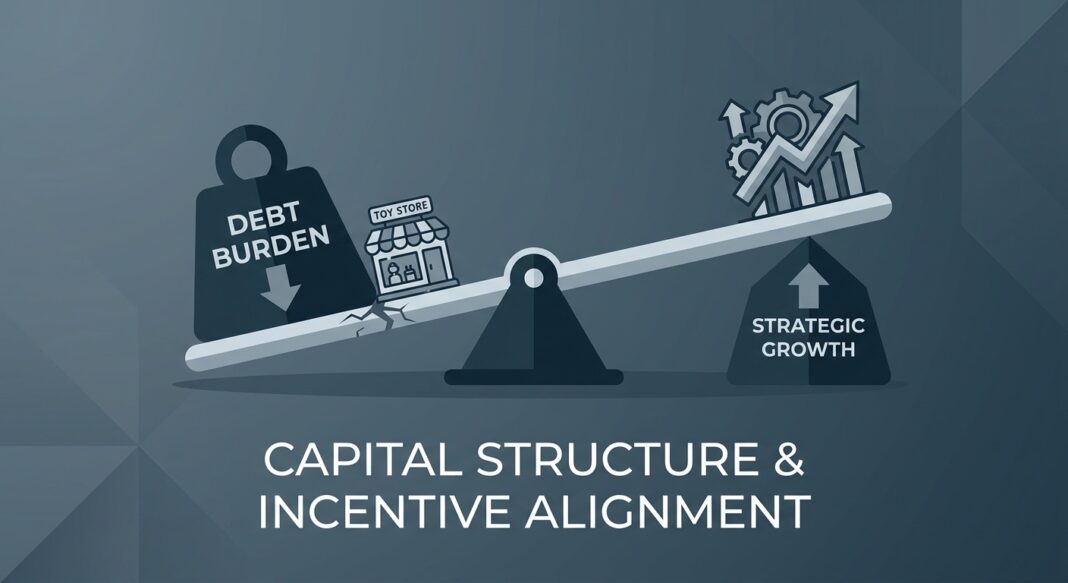
The Story: A Toy Store That Couldn’t Play Defense
It is 2005. Toys “R” Us is an American institution: 1,500 stores globally, a brand burned into the memories of every child from the 1970s onward. But the business is struggling. Amazon is beginning to eat its lunch online. Walmart and Target have turned their toy aisles into discount weapons. The board needs a path forward.
Enter KKR, Bain Capital, and Vornado Realty Trust, three of the most sophisticated capital allocators on the planet. Their pitch: take the company private, restructure operations, and exit in five to seven years at a premium. The deal closes at $6.6 billion. It sounds like salvation.
What came next is one of the most studied cautionary tales in modern finance. As a result of the buyout, the retailer woke up with over $5 billion in debt on its balance sheet. This financial burden completely shifted executive priorities. Rather than fighting Amazon and Walmart with capital investment, management spent the next decade fighting its own balance sheet.
In a cruelly ironic twist, the numbers that looked clean at closing (enough to satisfy lenders, enough to pass legal review) were always a death sentence. In a good year, after servicing debt, Toys had about $100 million to reinvest in a company that needed to build an e-commerce business from scratch. In a flat-to-down year, it had nothing. The competitive disruption it faced was not a surprise. The debt load that prevented any response was the deal they chose.
Toys “R” Us filed for bankruptcy in 2017. The LBO returned a 0.0x MOIC to LPs. Thirty-three thousand jobs disappeared. The brand was eventually sold off in pieces.
The Decision: Leverage as Architecture, Not Arithmetic
To understand what went wrong at Toys “R” Us, you have to understand what the capital structure was actually designed to do, and for whom.
The deal didn’t fail because the sponsors made a mechanical error. It failed because of math that was visible on day one, and because the structure let the sponsors get paid while the company, and their own LPs, did not.
The structure was as follows: KKR, Bain, and Vornado purchased Toys “R” Us in a $6.6 billion leveraged buyout, and more than $5.3 billion of the purchase price was paid using debt. The equity check, the sponsors’ actual skin in the game, was approximately $1.3 billion. That $1.3 billion of sponsor equity eventually went to zero.
But here is the critical distinction between a well-structured LBO and a predatory one: the annual interest payments, running into the hundreds of millions, should have been the cash reserve used to finance a digital pivot. It was the only money the company had to fight Amazon and upgrade logistics. The debt load consumed the entire margin needed for strategic investment.
The sponsors were not blind to this. PE firms pitch themselves as turnaround experts, but in practice, the model often prioritizes financial engineering over operational health. At Toys “R” Us, the company was treated as an asset to be mined: its real estate holdings were leveraged, its revenues were diverted to service debt, and its future was mortgaged in exchange for the quick returns private equity investors expect.
The lesson here is not that leverage is wrong. The lesson is that leverage imposed on a business that cannot carry it, in service of an exit timeline that prioritizes the sponsor’s fund cycle over the company’s strategic needs, is not capital structure. It is extraction.
The Contrast: The Same Instrument, A Completely Different Outcome
Two years after the Toys “R” Us deal closed, Blackstone signed one of the most audacious leveraged buyouts in history. In July 2007, fourteen months before Lehman Brothers failed, private equity giant Blackstone bought Hilton Hotels Corporation for $26 billion. Blackstone structured the deal as a leveraged buyout: $20.5 billion was financed through debt and $5.6 billion through equity. The debt-to-equity ratio was nearly identical to the Toys “R” Us deal.
Then the financial crisis hit. Hilton’s revenues fell by 15%, and at the same time the equity value held by Blackstone fell by a full 70%. By any conventional logic, the deal should have been over. The timing was catastrophic. The leverage was extreme.
But Blackstone did something Toys “R” Us’s sponsors never did: they doubled down on the business. Instead of attempting to quickly sell Hilton or significantly reduce investments, the fund chose to maintain ownership and continue transforming the company. Most of Hilton’s difficulties resulted from the global economic environment rather than a structural deterioration of its business model. Blackstone believed that the company’s intrinsic value remained intact.
The April 2010 restructuring bought back $1.8 billion of mezzanine debt for $819 million, a 54% discount, funded by a second Blackstone equity check. They didn’t extract. They invested. Debt was gradually reduced through the cash flows generated by the company, while the overall value of the group increased.
The result: Blackstone’s funds put in $6.5 billion of equity across two tranches and took out roughly $20.2 billion: a gain of about $14 billion, completed with a final share sale on May 18, 2018. Blackstone’s private equity investment in Hilton has been described as “the most profitable private equity deal in history… badly timed but brilliantly executed.”
Same instrument. Opposite philosophy. Opposite outcome.
The Lessons: What Separates Leverage That Builds from Leverage That Destroys
The TXU story delivers a similar verdict at industrial scale. The LBO was structured with around $8 billion in equity and more than $37 billion in debt. The thesis was simple: energy demand in Texas was expected to rise, natural gas prices were high, and TXU’s coal-fired generation assets were seen as undervalued. But natural gas prices, which had underpinned the deal’s economic logic, began to fall as U.S. shale production surged. The heavily leveraged capital structure left little room for error, and TXU, renamed Energy Future Holdings, found itself unable to meet its debt obligations as revenues declined. EFH filed for Chapter 11 bankruptcy in 2014, and the sponsor consortium’s ~$8 billion of equity was wiped out completely.
Across these three deals (Toys “R” Us, TXU, and Hilton) the variable that separates survival from collapse is not leverage itself. It is the relationship between debt load, the business’s cash flow durability, and whether the sponsor’s incentives are aligned with the company’s survival.
Current market data reinforces why this matters for operators and founders evaluating debt options today. The private credit market was estimated at $2.1 trillion in 2025 and is expected to grow at a CAGR of 10.7% between 2026 and 2035. Private credit sits between bank lending and equity in the capital stack, and often in cost. Typical direct lending rates for growth companies in 2026 run in the 9–12% range depending on credit quality and collateral availability, more expensive than bank prime lending but significantly less dilutive than equity at early valuations.
For founders and family business owners, this explosion in private credit means the menu of options is genuinely wider than the binary of VC equity or bank debt. Non-sponsor finance has also grown in selective geographies where founder-owned companies prefer non-dilutive capital and service-oriented partners. A leveraged recapitalization, for example, allows a company to take on new debt and use the proceeds to pay a special dividend or buy out a co-owner, with the owner receiving cash without selling the business outright, while retaining operational control and a continuing equity stake.
But (and this is the point that every Toys “R” Us postmortem underscores) LBOs and leveraged recaps require disciplined leverage. The 4–6x range is right for most lower middle market deals; 6x+ over-leverage destroys outcomes more often than it amplifies returns. Higher-for-longer interest rates are forcing buyout firms to face facts: struggling since 2023 to sell companies purchased in the long decade of ultra-cheap debt, they’ve tried to placate investors with clever financial engineering to keep some money turning over. The era of cheap debt masking bad structure is over.
The Framework: Three Questions Before You Touch the Lever
If you are a founder, operator, or family business owner considering leverage (whether a leveraged recap, a PE-backed majority sale, or a private credit facility) the stories above suggest three questions that should precede any term sheet:
- Can the business carry the debt in a bad year, not just a good one? Toys “R” Us had roughly $100 million left after debt service in a good year. In a flat year, it had nothing. Run the downside scenario first. If the covenant structure or interest burden consumes your strategic flexibility in the median case, it will consume your company in the downside case.
- Does the capital serve the business, or does the business serve the capital? Blackstone’s Hilton deal worked because the sponsor’s investment thesis was built around Hilton’s intrinsic hospitality franchise value and long-term operational improvements. The Toys “R” Us deal worked for fee income and management charges in the short term while the franchise eroded. Know whether your capital partner profits from your survival or merely from the transaction.
- What does leverage cost you if the macro shifts? Both TXU and Toys “R” Us were destroyed by shifts that were visible (shale gas, e-commerce) but that the debt structure made it impossible to respond to. Leverage removes optionality. Every dollar of interest expense is a dollar you cannot spend on the next competitive move. Price that cost explicitly before you sign.
The good news for operators in 2026: the private credit market reached roughly $1.7 trillion in global assets under management at the start of 2026, up from $970 billion in 2019. That capital is increasingly accessible to founder-owned and family businesses, not just PE-sponsored platforms. Regulatory constraints on U.S. banks created a gap in financing, especially for middle-market firms, that private credit filled. The options are there. The discipline to use them correctly is what separates the Hiltons from the Toy stores.
Key Insights
- Leverage is not the villain, misalignment is. Hilton and Toys “R” Us carried similar debt-to-equity ratios at closing. One sponsor invested through the crisis; the other extracted. Capital structure only tells you the weight of the load, not the direction it pushes.
- The downside year is the only one that matters at the LBO table. A deal that breaks even in a flat year and leaves nothing for reinvestment in a bad year is not a capital solution; it is a slow-motion liquidity crisis. Model the stress case before the base case.
- Debt removes optionality; misaligned PE removes control. Founders considering a majority recap must understand that they are not just adding debt; they are accepting a board boss whose fund cycle, not the company’s competitive clock, governs the exit timeline.
- Private credit’s $2 trillion scale changes the founder’s menu. Leveraged recaps, dividend recaps, and direct lending structures are now accessible to founder-owned businesses with consistent cash flow, allowing partial liquidity and growth capital without the control transfer of a majority PE sale.
- The best capital structure is the one the business can survive, not the one that maximizes proceeds today. Whether it is Blackstone buying back mezzanine debt at 54 cents or a founder calibrating a leveraged recap to 4x EBITDA, the winners are those who size leverage to the business, not the ambition of the deal.


