
Part One: The Party That Never Had to End
In 2012, private equity firm Thomas H. Lee Partners acquired Party City in a leveraged buyout, taking it to the stock market three years later. The deal looked like a textbook PE play: a recognizable consumer brand with national retail footprint, steady seasonal cash flows from Halloween and birthday party staples, and a thesis that better management could unlock value. But there was a problem baked into the structure from day one.
Party City’s debt load from the LBO was $2.2 billion: an amount roughly on par with its annual revenue. As one retail analyst later observed, “Party City had a super defensible moat, but they blew it.” The moat was real. The math was not.
For a few years, the numbers held. The company hit its revenue high-watermark in 2018 at $2.43 billion. As long as growth continued, the debt was manageable. Then came the cracks. In 2019, a nationwide helium shortage devastated one of the chain’s most profitable and Amazon-proof services: on-site balloon inflation. A year later, COVID arrived, and with it, a complete shutdown of the gatherings and celebrations that were Party City’s entire reason for existing.
The debt didn’t bend with the business. It just kept compounding.
The Decision: Extraction Over Investment
Here is where the incentive structure of the leveraged buyout reveals its hidden tension. The LBO model is, by design, a vehicle for financial return to the acquiring sponsor, not a partnership in the long-term health of the operating business. The debt loaded onto Party City’s balance sheet wasn’t capital meant to make the company stronger. It was the financing mechanism of the acquisition itself, now sitting as an obligation on the company’s income statement.
The consequences were predictable in hindsight. Interest payments from the LBO amounted to $102 million in 2022 alone: Party City’s last full year before its first Chapter 11 filing. That capital, extracted every year in the form of interest service, was capital that never became new stores, never became e-commerce infrastructure, never became inventory optimization. As one industry observer noted bluntly: “If you had a lousy online presence, you couldn’t hide from that during COVID.”
This is the core misalignment in poorly structured PE leverage: the company services the cost of its own acquisition, while the sponsor has often already recovered meaningful capital through fees, dividend recapitalizations, and partial exits. The operating business absorbs all the downside risk. The sponsor’s equity is a call option on the upside.
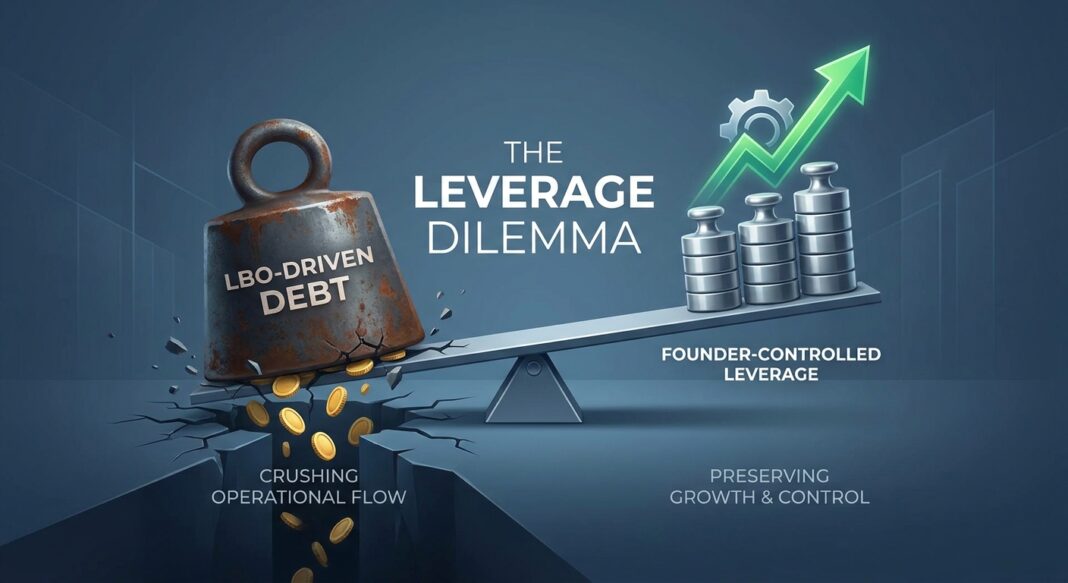
Compare this to a well-structured leveraged recapitalization initiated by an owner-operator: the same debt mechanics, but oriented entirely toward the owner’s benefit. In a founder-led leveraged recap, the company takes on new debt and distributes the proceeds to shareholders as a dividend or equity repurchase, while the owner retains control and continues operating the business they understand deeply.
The Outcome: Bankruptcy Twice, Then Gone
Party City filed for Chapter 11 bankruptcy protection in January 2023, facing a major payment on a long-term liability. The restructuring eliminated almost $1 billion in debt. But it still had $800 million in debt remaining when it emerged from bankruptcy protection nine months later, and no credible operational turnaround plan to justify that remaining burden.
In December 2024, Party City filed for bankruptcy a second time. This time, there was no restructuring. It was a full wind-down: 700 stores, 12,000 employees, and a brand that had once been genuinely defensible, all liquidated under the weight of obligations that were never calibrated to what the business could actually sustain in a stress scenario.
Now consider the counterfactual through a different story. Ken Hoppe, CEO of Modigi, built a profitable SaaS company inside the Salesforce ecosystem without a single venture dollar. When he needed working capital to hire his first sales and customer success headcount, he used revenue-based financing, $400,000 drawn against his MRR contracts, funded in under 72 hours, with no equity surrendered and no board seats created. The result: $1.7 million in ARR achieved profitably with six full-time employees, and 100% ownership retained by the founding team.
Or consider FanDuel, a cautionary tale from the opposite direction of capital structure misalignment. FanDuel’s founders raised $416 million, reached a valuation of $1.3 billion, and sold the company for $465 million in 2018. The founders walked away with nothing. The cap table was structured so that preferred shareholders held $559 million in accumulated liquidation preferences: more than the sale price. Every dollar of that $465 million went to late-stage investors. The common shareholders, including the people who built the company, received zero. Today, the combined entity is worth over $30 billion. The founders are suing.
The Party City story is a failure of overleveraged extraction. The FanDuel story is a failure of excessive dilution and misaligned preferred terms. Both paths (reckless debt and unchecked equity issuance) can produce the same catastrophic outcome: founders and operators left with nothing.
The Lessons: Debt Is a Tool, Not a Strategy
The Party City collapse is not an argument against leverage. It is an argument against leverage that is sized for a sponsor’s return model rather than the business’s actual capacity to service it. There is a profound difference between a debt load that a business can absorb, invest through, and grow out of, and a debt load that consumes the company’s operational oxygen from day one.
Middle market leveraged recapitalizations, for instance, typically close at 3x to 5x EBITDA in total debt, a level calibrated to what the business generates. When a company carries debt at or near 1x its annual revenue, that is not a capital structure built to serve the company. It is a capital structure built to serve the transaction.
The broader private credit market in 2025 and 2026 has witnessed a surge in owner-initiated dividend recapitalizations, not as instruments of extraction, but as legitimate tools for founder liquidity. PitchBook LCD tracked roughly $76 billion in dividend recap loans during 2024, the third-highest annual total on record. In the first quarter of 2025 alone, dividend recap issuance reached $31 billion, putting the year on pace to challenge the 2021 peak of $88 billion. Much of this activity reflects a stalled exit market where sponsors and founders alike need alternative paths to liquidity, without surrendering the asset or the upside.
For founders and owner-operators, the lesson from both Party City and FanDuel is the same, even if the mechanisms differ: whoever controls the capital structure controls the outcome. A founder who borrows against their own business to de-risk personally, while retaining operational control, is in an entirely different position than a founder who sells preferred equity to institutional investors who hold liquidation preferences that can legally erase a common shareholder’s payoff at exit. And both are in a different position than a company that carries leverage it cannot realistically service through a downturn.
A Framework for the Decision
When evaluating whether to take on debt, issue equity, or pursue a leveraged recap, the operative questions are:
- Who does this capital serve? Debt structured to serve the business (fund growth, fund liquidity) versus debt structured to serve a transaction (fund an acquisition at a stretched multiple) are fundamentally different instruments.
- What does the stress scenario look like? Party City was fine in 2018. Two black swan events later, its interest obligations alone were consuming $102 million per year, capital that could have been reinvested in the business. Debt sized to your best year is a liability in your worst.
- What are you actually giving up? Equity rounds that feel painless at the time of signing can become catastrophic at exit. Liquidation preferences, participating preferred structures, and successive rounds of dilution can reduce a founder’s economic interest to near zero, even on a headline-successful outcome.
- Do you need a partner or just capital? Non-dilutive debt, revenue-based financing, and founder-initiated leveraged recaps provide capital without governance interference. If you need operational expertise, a PE partner may add value. If you just need money, selling governance is a very expensive price to pay for it.
Key Insights
- Leverage sized to the transaction, not the business, is a structural failure waiting for a catalyst. Party City’s $2.2 billion debt load at 1x revenue left no margin for operational adversity, the helium shortage and COVID didn’t create the problem, they revealed it.
- Equity dilution can be just as destructive as over-leverage. FanDuel’s founders built a company now worth over $30 billion, raised $416 million, and received zero at exit, because liquidation preferences consumed the entire sale price before common shareholders saw a dollar.
- Owner-initiated leverage recaps are a fundamentally different tool than PE-driven LBO debt. When the founder uses debt to take personal liquidity while retaining operational control, the incentives are aligned. When a sponsor loads debt onto a company to finance their own acquisition, the company absorbs the risk while the sponsor holds the upside optionality.
- The middle market dividend recap surge reflects rational demand for a better path. With M&A exit markets constrained and IPO windows volatile, owner-operators and sponsors are increasingly using structured debt to generate liquidity without forcing asset sales at depressed valuations, a tool that works when calibrated to EBITDA, not ambition.
- The founders who win are the ones who control the waterfall from the start. Non-dilutive capital (whether revenue-based financing, private credit, or a founder-led leveraged recap) preserves ownership percentage and decision-making authority. The question isn’t whether to use leverage. It’s who structures it, who it serves, and whether the business can carry it on its worst day.


