
The Story: A Luxury Empire Built on Sand
In late 2024, Hudson's Bay Company (HBC) announced what looked like a defining power move in American luxury retail. It would acquire the Neiman Marcus Group (home to Neiman Marcus, Bergdorf Goodman, and Last Call) for $2.7 billion, folding it into its Saks Fifth Avenue portfolio to create Saks Global: the largest multi-brand luxury retailer in the United States.
On paper, the thesis was compelling. Consolidation would generate synergies. A combined portfolio of 70-plus flagship locations, five e-commerce platforms, and 8.4 million square feet of prime real estate would give the new entity unrivaled scale in the highest-margin segment of American retail.
But beneath the headline sat a capital structure that was, from day one, deeply fragile. The deal was funded primarily through debt. According to public filings and reporting, HBC raised $2 billion in debt to complete the acquisition, with Apollo Global Management affiliates providing an additional $1.5 billion in financing. That stack sat on top of two businesses (Saks and Neiman Marcus) neither of which had, in the words of one retail analyst, a healthy underlying P&L before the deal closed.
The rest of the story unfolded with brutal speed. Within twelve months of closing, Saks Global had missed a $100 million interest payment, filed for Chapter 11 bankruptcy in January 2026, and entered restructuring with approximately $3.4 billion in prepetition funded debt. By June 2026, a bankruptcy court confirmed a plan that converted $1.24 billion in DIP financing into equity, cutting the total debt load by 75%. Original equity holders were wiped out. The Saks OFF 5TH banner was wound down entirely.
What happened was not a mystery. It was a textbook case of leverage misapplied: too much debt, too little free cash flow, and too narrow a margin for error when execution stumbled.
The Decision: When Structure Becomes the Strategy
The fundamental flaw in the Saks Global deal was not ambition; it was the assumption that debt could substitute for operational readiness. The acquisition closed in December 2024 and was financed with $2.2 billion in senior secured notes alongside an asset-based credit facility, with Amazon and Authentic Brands Group taking minority equity stakes to facilitate the transaction.
That capital structure left essentially no room for integration risk, consumer softness, or macroeconomic headwinds. Luxury retail (with its seasonality, vendor-relationship dependency, and high fixed costs) is precisely the kind of business where debt-service obligations compress operational optionality most severely.
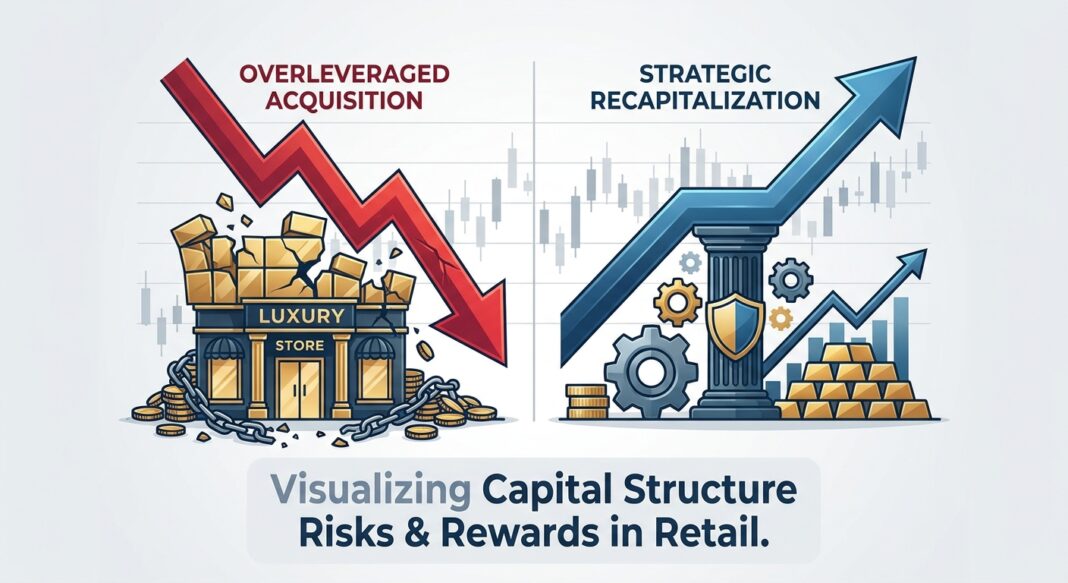
Contrast this with how a disciplined operator might have approached a similar capital need. A leveraged recapitalization (where an owner-operated company replaces a portion of its equity with new debt and uses the proceeds for shareholder liquidity or strategic reinvestment) is structurally designed around what the business can actually service. The owner extracts cash without a change of control. The lender underwrites against demonstrated cash flows. The business retains its operating independence. The key distinction is alignment: in a well-structured recap, the borrower stays in the seat because they know the business best, and the debt is sized to what the business can genuinely carry.
In the Saks deal, the debt was sized to what the deal required, not to what the combined business could service. That is the critical inversion that destroys capital.
According to Pepperdine's Private Capital Markets data, lower middle market leveraged recapitalizations typically close at 3x to 5x EBITDA in total debt, a range calibrated to sustainable debt service. The Saks Global structure, layered onto two operationally challenged retailers facing a softening luxury consumer, almost certainly exceeded that threshold materially from the day the ink dried.
The Outcome: The Math Breaks When the Assumptions Do
The timeline of Saks Global's collapse illustrates exactly how high-leverage acquisitions come undone in sequence. By mid-2025, the company was already exploring asset sales, moving to sell the Beverly Hills Neiman Marcus flagship real estate and weighing a Bergdorf Goodman minority stake sale to reduce debt. By November 2025, it had shuttered nine Saks OFF 5TH stores. Vendors reported delayed payments. Inventory shortfalls exceeded $550 million. Then came the missed $100 million interest payment in December 2025, and the Chapter 11 filing on January 13, 2026.
The counterfactual matters here. Had HBC structured the Neiman Marcus acquisition more conservatively (using less debt, taking longer to integrate, or staging the transaction) the combined entity might have had the operational bandwidth to execute. Instead, the debt-service clock started ticking from day one, constraining every operational decision. High debt constrained digital investment and caused inventory shortfalls and vendor payment delays, worsening cash flow in a self-reinforcing spiral.
The reorganization plan confirmed June 5, 2026 converted DIP lender claims into majority ownership of the reorganized company. Original equity, including HBC's controlling stake, was effectively extinguished. Compare that outcome to a scenario where a founder-owned or sponsor-owned retail operator used a disciplined leveraged recap at 4x EBITDA to fund a partial exit or targeted acquisition: the owner retains control, the business retains flexibility, and the debt matures on a timeline the cash flows can support.
The broader market data reinforces the discipline gap. According to McKinsey's 2025 Global Private Markets Report, all-in new-issue yields in private credit fell to approximately 9.3% in 2025, meaning capital is available and not prohibitively expensive. The question is never whether to use leverage. It is whether you are using it against the right business, at the right sizing, with the right structure.
The Lessons: Four Principles Every Operator Should Carry
The Saks Global story is extreme, but its mechanics appear constantly in smaller deals. Here is what it teaches:
1. Cash Flow Is the Only Honest Underwriter
Leverage only works when it is sized to what the business actually generates, not what it is projected to generate after synergies materialize. Pro forma EBITDA adjustments are common in deal financing, but as one analysis of leveraged loan markets notes, strip out creative add-backs and many loans that appear at 5x leverage are actually closer to 6.5–7x. When the operating environment tightens, that gap is where equity disappears.
2. Ownership Alignment Is a Risk Mitigant, Not a Soft Benefit
The leveraged recapitalization (where the original operator stays in place, retains majority control, and has personal skin in the outcome) structurally reduces execution risk. Carlyle's 2026 credit outlook notes strong demand from family- and founder-owned businesses looking to recapitalize without giving up control. The reason lenders accept that structure is because retained ownership correlates with better operational outcomes. The Saks deal had no such anchor: it was a change-of-control transaction with integration risk baked in from day one.
3. The Dividend Recap Market Is Telling You Something
According to PitchBook LCD data, leveraged loan issuance tied to sponsored dividend recapitalizations grew to $74.3 billion in 2025, an 11% year-over-year increase following a 326% surge in 2024. The reason is structurally sound: in a stalled exit market, the dividend recap lets owners monetize partial value without relinquishing control or accepting a discounted sale price. That is a rational, well-tested tool, when the debt is sized correctly and the business has the cash flows to carry it.
4. The Cost of Capital Has Fallen; the Cost of Misuse Has Not
Base rates declining to an average SOFR of 4.35% in 2025, down from 5.27% in 2024, have made leverage cheaper. But cheaper capital deployed against the wrong asset (or at the wrong size) still destroys equity. The market does not care how low your spread is if your interest coverage ratio is below 1.0x.
The Framework: Three Questions Before You Take the Debt
- Can the existing cash flows service this debt under a stress scenario? Not the pro forma. The last twelve months of actual performance, with a 20% revenue haircut applied.
- Does ownership alignment remain intact? If control is changing hands alongside the capital event, execution risk compounds. If the original operator remains in the seat, that is a meaningful structural safeguard.
- Is the debt sized to the business or to the deal? These are not the same thing. A deal that requires 7x leverage to close is a deal that is telling you something. Listen.
Key Insights
- Debt sized to the deal, not the business, is where equity goes to die. Saks Global's $3.4 billion in prepetition debt was structured around acquisition price, not sustainable cash flow, a distinction that cost original equity holders everything.
- The leveraged recapitalization is the founder's alternative. It provides partial liquidity, preserves control, and aligns debt service with actual cash generation, the structural opposite of an overleveraged acquisition.
- The dividend recap market hit $74.3 billion in 2025 because rational operators are choosing controlled liquidity over risky exits, and lenders are willing to fund businesses where ownership alignment remains intact.
- Cheaper capital is not safer capital. Falling base rates and tighter spreads in 2025 lower the cost of leverage but do not lower the consequence of getting sizing wrong. Interest coverage below 1.5x is a warning, not a negotiating point.
- Structure is strategy. The capital decision (how much, from whom, at what seniority, against what cash flows) determines the outcome as much as operations. Saks Global is not a retail story. It is a capital structure story told through a retail lens.


