
The Story: A Billion-Dollar Exit, Zero Dollars for the Builders
In January 2025, Divvy Homes sold to Brookfield Properties for approximately $1 billion. For any founder, a ten-figure exit sounds like the finish line. For Divvy’s founders, it was the cruelest kind of finish line, one they crossed without a prize.
The founders received $0. The employees received $0. Even most of the venture investors (including names like a16z and Tiger Global) walked away with nothing. A company that once commanded a $2.3 billion valuation and helped 2,000 American families on a path to homeownership was sold for a billion dollars, and the people who spent years building it were wiped out entirely.
As reported and analyzed by SaaStr’s Jason Lemkin, Divvy Homes was a rent-to-own startup founded in 2016 with an elegant, high-impact model: buy a home on a customer’s behalf, rent it back to them, and set aside a portion of monthly payments toward a future down payment. After three years, the renter could buy the home outright. The mission was real. The social impact was tangible. But the model was brutally capital-intensive, because it required buying actual houses, at scale, in a rising rate environment.
This is not simply a failure story. The assets were genuinely worth $1 billion. This is a capital structure story, and specifically, a cautionary lesson about the hidden cost of debt layered on top of equity liquidation preferences.
The Decision: $735 Million in Debt on Top of Preferred Equity
Over its lifetime, Divvy raised more than $400 million in venture equity from top-tier firms, culminating in a $200 million Series D led by Tiger Global in 2021 that pushed the company to its $2.3 billion peak valuation. Each equity round came with liquidation preferences, meaning preferred shareholders would get paid back before common shareholders, including founders, saw a single dollar.
Then, in October 2021, Divvy took on approximately $735 million in debt financing to fund home acquisitions. The logic was reasonable at the time: interest rates were near zero, the housing market was booming, and the company needed capital to match demand. Debt appeared cheaper than further dilution.
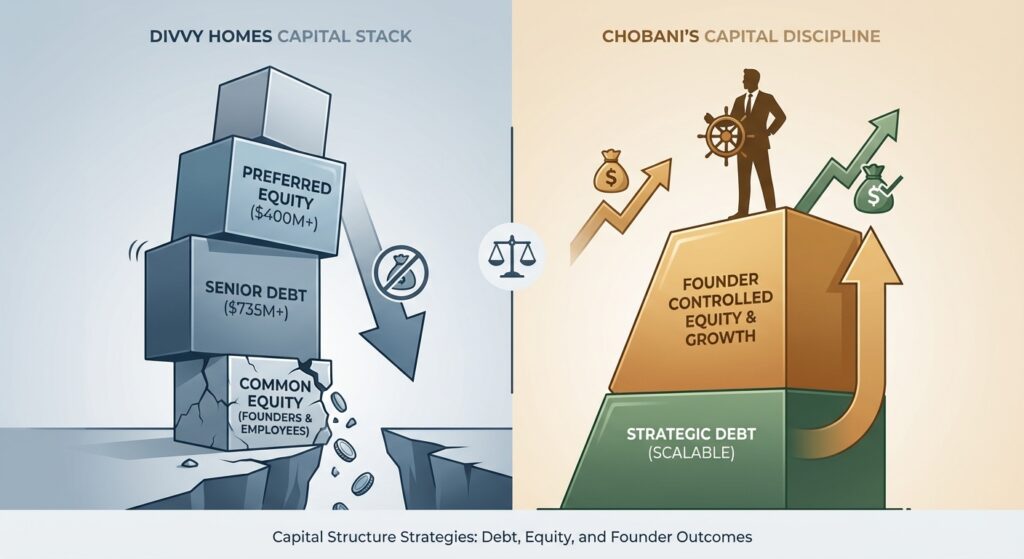
But the capital stack had quietly become a trap. Here is what the structure looked like in simplified terms:
- $735M+ in senior debt: first in line at any exit or liquidation
- $400M+ in preferred equity: with full liquidation preferences, second in line
- Common equity (founders & employees): last in line, effectively holding an option on whatever was left
When interest rates surged through 2022 and 2023, Divvy’s model cracked. Higher rates increased borrowing costs while simultaneously cooling the housing market. Three rounds of layoffs followed. New home acquisitions were paused entirely by 2023. By the time Brookfield acquired the company for $1 billion in early 2025, the debt holders consumed the proceeds first, the preferred equity holders absorbed the remainder, and common shareholders, including the founders, received nothing. CEO Adena Hefets confirmed this in a letter to shareholders, noting that after repaying debt, covering transaction costs, and fulfilling liquidation preferences, common and founders’ preferred stock would receive no proceeds.
The Outcome: Compare This to Chobani’s Debt Discipline
Now consider a starkly different deployment of debt. In 2005, Kurdish immigrant Hamdi Ulukaya purchased a defunct Kraft yogurt factory in upstate New York using a Small Business Administration (SBA) loan: government-backed debt for a small business. No pitch deck. No cap table. No board of venture investors. Just debt, a vision, and a willingness to back himself.
By 2012, Chobani had reached $750 million in revenue without a single dollar of venture capital. As documented by Creators Blueprint, Chobani recently raised at a $15 billion valuation with roughly $3 billion in annual revenue, and Ulukaya still controls the company he built.
The pivotal moment came in 2014. Chobani needed capital to scale infrastructure: manufacturing capacity, distribution networks, supply chain depth. Instead of issuing equity and diluting his ownership to 20–30%, Ulukaya raised $560 million in debt from TPG Capital with warrant coverage (reportedly around 20% of the company). He paid interest instead of surrendering ownership. He retained majority control and decision-making authority. The debt was serviceable because the business was genuinely profitable.
The contrast is instructive. Divvy used debt to fund an asset-heavy, rate-sensitive model without a reliable hedge. Chobani used debt to scale a cash-generative consumer business with durable demand. Same instrument. Radically different outcomes, determined not by the debt itself, but by the business model underneath it.
The Lessons: A Framework for Capital Structure Decisions
The stories of Divvy and Chobani, alongside smaller but equally instructive cases like SafePointe and Myagi, both of which used non-dilutive venture debt to triple revenue and achieve successful acquisitions before ever giving up meaningful equity (timiacapital.com, timiacapital.com), point to a durable framework operators can use when evaluating their own capital decisions:
1. Match debt tenor and structure to your business model’s cash flow certainty.
Debt is not inherently dangerous. But debt layered on an interest-rate-sensitive, asset-heavy model without predictable recurring cash flow is existentially dangerous. Before taking on leverage, ask: Can this business service this debt in a stress scenario where rates rise 300 basis points?
2. Understand the full liquidation waterfall before you sign.
Many founders celebrate an equity raise without fully internalizing what liquidation preferences mean in a downside scenario. Every dollar of preferred equity with a 1x liquidation preference is debt in disguise; it gets paid before you see a cent at exit. When you layer actual debt on top of that structure, you’ve created a mountain founders must climb before they collect anything.
3. Non-dilutive capital wins in asset-light, recurring-revenue businesses.
Inkle, a financial operations platform for startups, avoided two rounds of dilution and retained 90% founding team equity by using revenue-based financing from Efficient Capital Labs instead of raising a traditional seed round (ecaplabs.com). For businesses with predictable, recurring revenue streams, non-dilutive structures (venture debt, revenue-based financing, SBA loans) can be meaningfully cheaper than equity over a five-to-ten year horizon.
4. Debt is a tool for operators who understand their unit economics, not a shortcut for those who don’t.
Hamdi Ulukaya took on $560 million in debt because he knew, with conviction, that Chobani’s margins and demand could service it. Simon Turner of Myagi described it precisely: “Debt is a powerful tool for capital-efficient businesses when used under the right circumstances.” The emphasis belongs on capital-efficient.
Key Insights
- A billion-dollar exit can produce zero founder proceeds when senior debt and preferred equity liquidation preferences consume the entire waterfall, Divvy Homes is the defining modern case study.
- Debt preserves control when cash flows are durable: Chobani’s Hamdi Ulukaya built a $15B company while retaining majority ownership precisely because he chose debt over VC at every critical inflection point.
- Non-dilutive capital is not just about preserving ownership percentage: it is about preserving decision-making authority, timeline flexibility, and exit optionality that equity investors structurally oppose.
- The hidden cost of venture equity is the liquidation preference stack, not the dilution percentage on the cap table, founders often learn this only at exit, when it is too late.
- Smaller, disciplined debt facilities: like the $1M and $2.5M venture debt facilities that powered SafePointe and Myagi to acquisition exits, can create more founder value than a $20M equity round that dilutes ownership and resets board control.


