
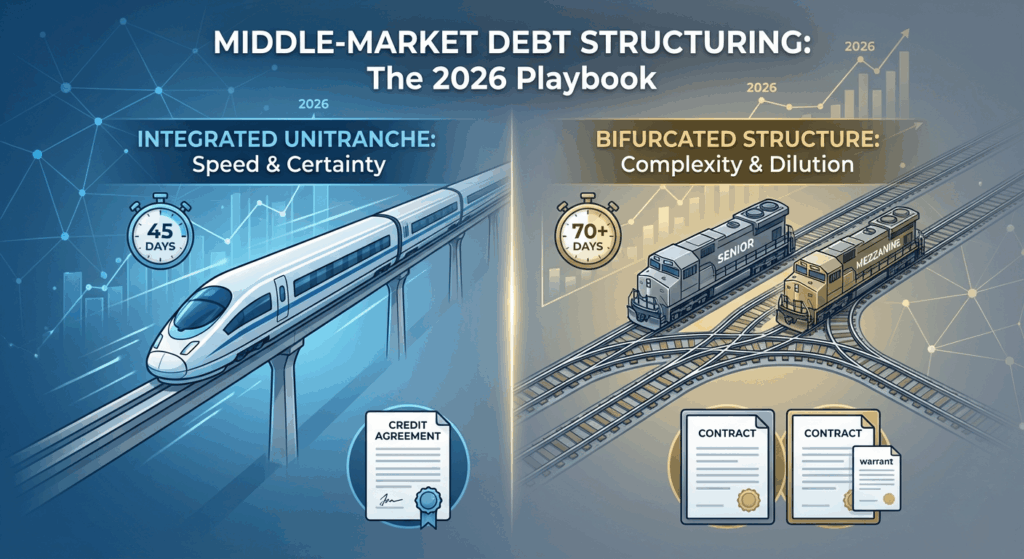
The Efficiency Premium: Why Unitranche Dominates the Middle Market
For private equity sponsors and middle-market CFOs, the financing decision in 2026 often narrows down to a binary choice: speed and certainty versus the lowest possible headline rate. While the syndicated loan market offers attractive pricing for large-cap issuers, the middle-market buyout landscape (specifically for deal sizes between $50 million and $500 million) has decisively shifted toward unitranche financing.
Data from 2025 indicates that unitranche volume in the U.S. middle market reached a record $210 billion, driven by the structure’s ability to compress closing timelines to a median of 45 days, compared to 70 days for traditional senior-mezzanine bifurcated structures.
This analysis breaks down the mechanics of the unitranche structure, compares it against the traditional senior-plus-mezzanine stack, and outlines current market terms for borrowers navigating the 2026 credit environment.
Deconstructing the Unitranche Mechanism
At its core, a unitranche facility creates a single debt instrument that blends senior and junior risk into one interest rate and one set of documents. To the borrower, the structure appears as a single loan from a single lender (or a small club) with a blended coupon.
However, the engineering behind the scenes is distinct. The capitalization of the loan is often split between a “First-Out” lender (typically a bank or low-cost institutional arm) and a “Last-Out” lender (typically a private credit fund). This relationship is governed by an Agreement Among Lenders (AAL).
Hypothetical Term Sheet Example
Consider a software company with $100 million Enterprise Value (EV) seeking $50 million in debt financing to fund a buyout.
- Facility Size: $50 million
- Structure: Single Unitranche Term Loan
- Pricing (Blended): SOFR + 550 basis points (bps)
- Leverage: 5.0x EBITDA
- Amortization: 1.0% per annum
- Documentation: One credit agreement, no inter-creditor agreement signed by the borrower.
In this scenario, the lenders might internally bifurcate the risk. A bank might take the first $30 million (First-Out) at SOFR + 350 bps, while a credit fund takes the remaining $20 million (Last-Out) at SOFR + 850 bps. The borrower implies sees the blended cost of SOFR + 550 bps.
Comparative Analysis: Unitranche vs. Senior-Mezz
The primary alternative to unitranche is the traditional bifurcated stack: a senior bank loan paired with junior mezzanine debt. Here is how they compare structurally and economically:
1. Execution Speed & Complexity
The senior-mezz structures require two separate credit agreements and a complex inter-creditor agreement that must be negotiated between the bank and the mezzanine provider. This friction lengthens the process to an average of 70 days. Unitranche removes the borrower from inter-lender disputes; the AAL is a private contract between lenders. This efficiency reduces closing time significantly, a premium many sponsors are willing to pay to secure a competitive auction.
2. Dilution & Equity Kickers
Mezzanine debt, sitting lower in the capital stack, typically demands a higher return profile, often achieved through Payment-in-Kind (PIK) interest and equity warrants (ranging from 1% to 5% ownership). Unitranche facilities in 2025 and 2026 rarely include warrant coverage, preserving the sponsor’s equity upside. While the cash coupon on unitranche is higher than senior debt, the lack of dilution can make the “all-in” cost of capital competitive.
3. Covenants
Senior bank loans frequently impose maintenance covenants (e.g., maximum leverage ratios tested quarterly). If a borrower has a bad quarter, they risk default. Unitranche lenders generally offer more flexibility with “covenant-lite” structures or looser headroom, focusing on long-term enterprise value rather than quarterly fluctuations.
Current Market Terms (2025-2026)
Based on recent mandates and credit reports, the following terms define the current clearing market for middle-market deals:
- Pricing Spreads: SOFR + 475 to 575 bps for unitranche, compared to SOFR + 325-400 bps for pure senior debt.
- Loan-to-Value (LTV): Unitranche deals are underwriting up to 60-65% LTV, whereas senior banks often cap out at 40-50%.
- Upfront Fees: 1.5% to 2.0% of the facility amount.
- Closing Timeline: Median of 45 days from term sheet to funding.
Notably, deal sizes have expanded. “Mega-unitranche” facilities exceeding $2 billion became increasingly common in 2025, proving the structure can scale beyond the middle market.
Structuring Guidance for Operators & Investors
For Operators (Borrowers):
When negotiating a unitranche facility, focus on the “incremental” cost. While the blended rate is higher than senior debt, calculate the WACC relative to a Senior + Mezz stack that includes warrants. Often, the unitranche is cheaper when equity dilution is factored in. Additionally, verify the transferability clauses, ensure the debt cannot be sold to a competitor or distressed debt fund without consent.
For Investors (Lenders):
The Agreement Among Lenders (AAL) is the critical document. In a downside scenario, understand the “waterfall” of payments. First-Out lenders get paid first, but Last-Out lenders typically control the enforcement process (the “controlling class”) because they are most at risk. Ensure the voting rights align with the economic risk being taken.
Key Takeaways
- Speed Premium: Unitranche closes ~25 days faster than bifurcated debt, crucial for competitive M&A.
- Dilution Defense: Avoids the equity warrants common in mezzanine financing, preserving cap table integrity.
- Simplicity: One credit agreement and one agent (“one throat to choke”) simplifies post-close administration.
- Pricing Reality: Expect SOFR + 475-575 bps; higher than senior debt but competitive on a blended basis.
- Scale: The structure is no longer limited to small deals, with multi-billion dollar facilities now standard.


