
Why One Loan Now Does the Job of Three
If you have spent any time around middle-market dealmaking in the last five years, you have heard the word unitranche. It appears on term sheets, in fund marketing decks, and in the earnings calls of Business Development Companies (BDCs) from Ares Capital to Blackstone Credit. Yet despite its ubiquity, many operators seeking capital and investors evaluating private credit funds still cannot clearly articulate what a unitranche loan actually is, or why it matters which sleeve of one they hold.
The stakes are real. According to market data compiled by CT Acquisitions (July 2026), roughly 80% of lower-middle-market leveraged buyouts closed in 2025 used a private credit unitranche rather than a syndicated bank loan. That is not a niche instrument. It is the dominant financing architecture for a multi-trillion-dollar asset class, and understanding its mechanics is now table stakes for anyone on either side of the capital table.
What a Unitranche Loan Actually Is
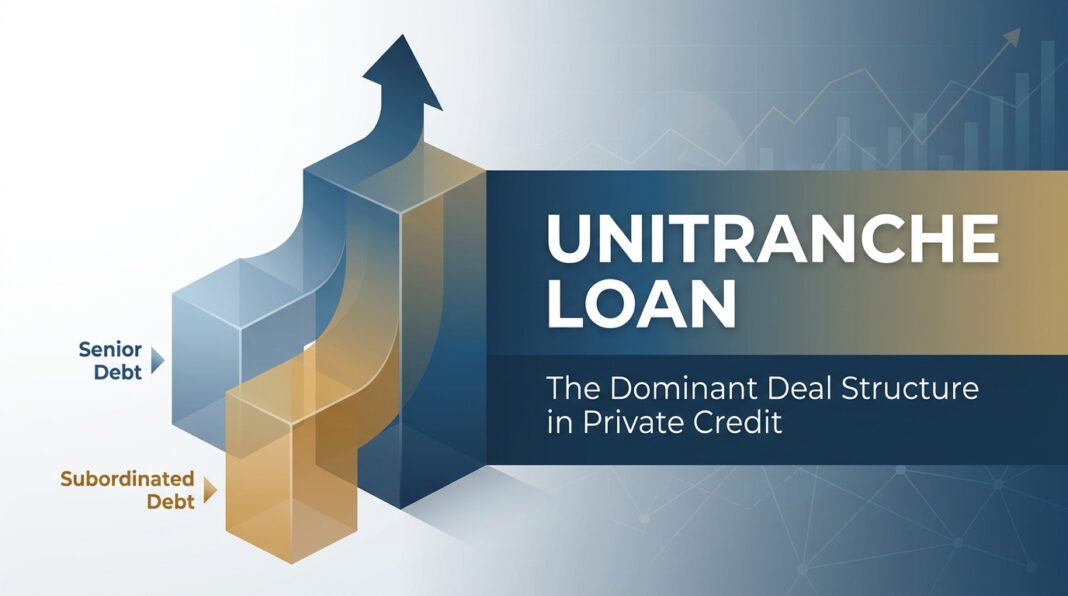
A unitranche loan is a single secured term loan that blends senior debt and subordinated debt into one instrument under one credit agreement. There is one lien package, one covenant set, one administrative agent, and one blended interest rate that the borrower pays. As Private Credit Hub explains, rather than arranging separate senior and mezzanine facilities with different lenders, different pricing, and an intercreditor agreement governing their relationship, a unitranche provides the entire debt package through a single lender or a small club.
The innovation that makes this possible is the Agreement Among Lenders (AAL): a private inter-lender contract that the borrower is typically not a party to. Mayer Brown (August 2026) describes how, within that single credit facility, lenders divide the exposure into a first-out tranche (which receives priority on repayment and earns a lower spread) and a last-out tranche (which absorbs losses first and earns a higher spread). The AAL governs the waterfall, voting rights, and enforcement remedies. The borrower sees none of it; they simply have one lender, one rate, and one set of documents.
Alternative Fortune (July 2026) frames the structural logic cleanly: a unitranche merges senior and junior risk into a first-lien wrapper, and it prices above a plain senior loan precisely because it is carrying that junior risk internally. The borrower pays a premium in spread for speed and certainty; the lender earns a blended yield that compensates for the full risk stack.
How the Math Works: A Concrete Example
Consider a sponsor-backed manufacturer with $15 million in EBITDA seeking $75 million in acquisition financing, a 5.0x leverage multiple. Under a traditional two-tranche structure, the deal might look like this:
- Senior secured term loan: $50M at SOFR + 3.50% (first-lien, priority claim)
- Mezzanine or second-lien: $25M at 12%–14% (junior claim, higher yield)
- Intercreditor agreement: Required between two separate lender groups
- Closing timeline: 8–12 weeks to negotiate two credit agreements and one intercreditor
Under a unitranche structure, the same $75 million is delivered as a single facility at a blended rate, in today’s market, approximately SOFR + 4.75% to SOFR + 5.50% for a mid-market deal. Per Lincoln International’s Q1 2026 private market data cited by Stirling Capital Group, current middle-market unitranche spreads run approximately S+4.75% to S+5.50% for deals in the $40M–$100M EBITDA range. With three-month Term SOFR near 3.69% as of June 2026, that translates to an all-in yield of roughly 8.44% to 9.19%.
The borrower pays a modest premium over what a standalone senior loan would cost, but in exchange eliminates weeks of intercreditor negotiation, reduces lender-group complexity, and gains execution certainty. As Private Credit Hub notes, sponsors use unitranche when speed, confidentiality, and execution certainty matter more than shaving 50–100 basis points off the coupon.
Inside the same $75M facility, lenders using an AAL might privately split the deal: one group holds the first-out $50M at SOFR + 3.75%, another holds the last-out $25M at SOFR + 7.00%. Both receive the blended rate from the borrower; the AAL waterfall redistributes economics between them. The borrower is shielded entirely from this internal arrangement.
Current Market Relevance
Unitranche has moved well beyond middle-market origins. Angel Investors Network (citing PitchBook, March 2026) reports that in early 2026, a Thoma Bravo-backed transaction secured a $4.815 billion unitranche loan: with Ares Capital as administrative agent and a 33-lender club that included Blackstone, Blue Owl, Apollo, and Oaktree. That single facility represents the scale the structure has reached.
The pricing environment heading into the second half of 2026 reflects a market recalibrating after a long run of tight spreads:
| Metric | Current Level | Source |
|---|---|---|
| Unitranche coupon spreads (mid-market) | SOFR + 4.75% to 5.50% | VRC Q2 2026 |
| All-in unitranche yield range | ~9.00% – 9.75% | VRC Q2 2026 |
| Average private unitranche coupon (end-2025) | ~9.00% | KBRA via Angel Investors Network, Feb 2026 |
| CDLI 20-year average annual return | 9.5% – 9.6% | Cliffwater, March 2026 |
| CDLI 20-year average annual credit loss rate | 1.01% | Cliffwater CDLI via Angel Investors Network, 2026 |
| Private credit AUM (start of 2026) | ~$1.7 trillion | Preqin 2026 Global Alternatives Report via CT Acquisitions |
The broader lending environment is reinforcing private credit’s relevance. The Federal Reserve’s April 2026 SLOOS reported that banks tightened lending standards for C&I loans to firms of all sizes in Q1 2026. KPMG’s analysis of the July 2026 SLOOS (August 5, 2026) notes that while standards stabilized in Q2, only about 16% of banks cited stronger C&I loan demand from large businesses, and just 4% for small firms. The gap between bank appetite and borrower need continues to create structural demand for non-bank solutions like unitranche.
Lord Abbett’s 2026 Midyear Outlook (June 2026) characterizes the current environment as a “lender-friendly reset”: spreads are wider, covenants are improving, and managers with dry powder can be more selective. Sikich’s Q2 2026 Credit Market Update (July 2026) adds that private credit has entered a more disciplined phase, with growing emphasis on underwriting quality as the market recalibrates.
Decision Framework: For Investors and Operators
For investors evaluating a private credit fund:
- Ask which sleeve: A fund holding last-out unitranche positions carries meaningfully different risk than one holding first-out. Both may be described as “senior secured” in marketing materials, the AAL determines the real hierarchy.
- Evaluate yield-to-risk honestly: As Alternative Fortune notes, unitranche prices above a plain senior loan because it carries junior risk inside the same wrapper. Whether that blended spread adequately compensates for last-out exposure is the key underwriting question, and not one answered by the word “unitranche” alone.
- Benchmark against the CDLI: The Cliffwater Direct Lending Index (CDLI) tracks approximately 21,000 U.S. middle-market loans totaling $549 billion. It returned 9.3% in 2025 and has averaged 9.5%–9.6% annually over 20 years with only one negative year (2008). Investors can use this as a baseline when evaluating manager-level claims.
- Demand manager-level transparency: Some BDCs disclose their unitranche concentrations clearly; others bury them. Scrutinize the schedule of investments for last-out designations before assuming all first-lien exposure is equal.
For operators and business owners evaluating financing options:
- Speed has a price, quantify it: Unitranche typically prices 150–200 basis points above a comparable syndicated senior loan. On a $50M facility, that premium costs roughly $750K to $1M per year. The question is whether the certainty of close and reduction in deal risk justifies that expense for a given transaction.
- Use it when complexity kills deals: Acquisitions with compressed timelines, contested processes, or complex collateral structures benefit most from unitranche’s single-document simplicity. The absence of intercreditor negotiation can meaningfully reduce closing risk.
- Understand the covenant package: Because private credit lenders hold the entire facility, they typically negotiate tighter covenants than bank syndicates. Lord Abbett notes that covenant documentation has improved further in 2026, meaning lenders have more early-warning triggers than in the 2021–2023 period. Operators should negotiate cure rights and financial covenant headroom carefully.
- Refinancing optionality matters: Unitranche facilities are harder to syndicate out than bank loans. Once in a private credit unitranche, operators may find limited flexibility to reprice without lender consent. Build that into long-term capital planning.
Key Takeaways
- Unitranche is an architecture, not a single product. It ranges from a simple straight loan to a bifurcated first-out/last-out structure with complex internal economics. Understanding which variant applies to a specific deal or fund changes the risk analysis entirely.
- The AAL is invisible to borrowers, but critical for investors. The Agreement Among Lenders governs who gets paid first, who controls enforcement, and who absorbs losses. Investors in private credit funds should ask managers to disclose their first-out versus last-out exposure explicitly.
- Current all-in yields of 9%–9.75% reflect a post-tightening environment. These levels sit roughly 250 basis points below the 2023 peak but remain above pre-2022 historical norms. The market has repriced, but spread compression from competition and bank re-entry is a dynamic to monitor.
- Bank lending context remains constructive for private credit. With the Fed’s 2026 SLOOS data showing continued C&I tightening in Q1 and only modest recovery in Q2, the structural demand gap between what banks will underwrite and what borrowers need continues to support non-bank lenders.
- Performance history is durable, but dispersion is widening. The CDLI’s 20-year average annual credit loss rate of 1.01% speaks to the asset class broadly, but the 2026 market has become more bifurcated, with capital flowing to higher-quality borrowers and weaker credits facing meaningfully wider spreads and tighter terms. Manager selection and underwriting discipline matter more now than during the accommodative 2020–2022 period.


