
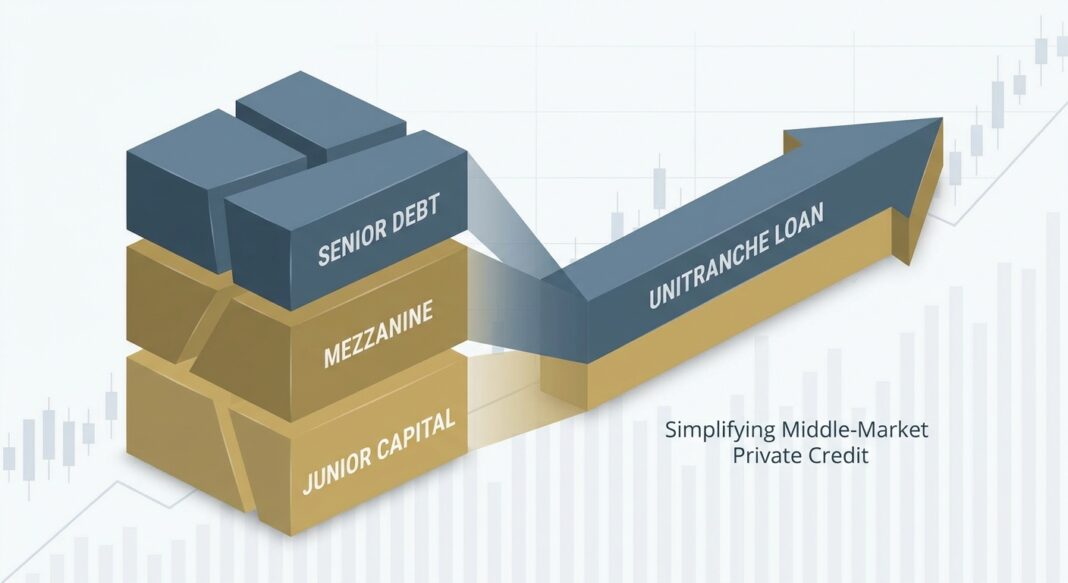
One Loan to Rule Them All
Walk into a traditional leveraged buyout and you encounter a maze of debt: a senior secured term loan from a bank, a revolving credit facility, a mezzanine tranche from a separate fund, and sometimes subordinated notes on top of that. Each layer comes with its own lender, its own legal counsel, its own intercreditor agreement, and its own closing timeline. For middle-market borrowers, companies with enterprise values typically between $25 million and $500 million: navigating that stack is expensive, slow, and often simply unavailable.
Enter the unitranche loan: a single-facility structure that collapses the entire debt stack into one instrument, one lender relationship, one credit agreement, and one blended interest rate. Since the 2008 financial crisis, unitranche has quietly become the dominant financing structure in private credit’s middle market. Understanding how it works (and where it fits in the current rate environment) is essential for both investors evaluating private credit funds and operators seeking growth capital.
What Is a Unitranche Loan?
A unitranche facility is a single-tranche acquisition or growth loan that merges what would otherwise be a senior secured term loan and a subordinated or mezzanine debt tranche into one unified instrument. The borrower signs one credit agreement, makes interest payments to one administrative agent, and manages one covenant package. Behind the scenes, however, the lender (or a lending syndicate) may split the economics between a first-out slice (which receives priority repayment and carries lower yield) and a last-out slice, which absorbs first-loss risk and commands a higher return. This internal division is governed by an Agreement Among Lenders (AAL) that is invisible to the borrower.
The mechanics matter because they explain the pricing. A pure senior secured loan to a middle-market borrower might price at SOFR + 400–500 basis points. A standalone mezzanine tranche for the same company might price at SOFR + 800–1,000+ basis points or carry a fixed double-digit rate. The unitranche blends these economics into a single spread, typically landing in the SOFR + 500–700 basis point range, depending on leverage, borrower quality, and market conditions. According to PipelineRoad Capital Glossary (2026), the blended rate is higher than pure senior lending but frequently lower in total cost than maintaining a separate senior/mezz structure once all fees, legal costs, and execution delays are accounted for.
How It Works: A Concrete Example
Suppose a private equity sponsor is acquiring a regional healthcare services business with $12 million in EBITDA at a 6.0x enterprise value multiple, implying a purchase price of $72 million. The sponsor contributes $27 million in equity (~37.5%) and needs to finance the remaining $45 million in debt.
Under a traditional two-tranche structure, the transaction might look like this:
- Senior Secured Term Loan: $30 million at SOFR + 425 bps (~8.1% all-in), from a regional bank
- Mezzanine Tranche: $15 million at 13.5% fixed, from a separate mezz fund
- Two sets of legal documentation, two closings, two ongoing lender relationships, and an intercreditor agreement between the senior and mezz lenders
Under a unitranche structure, the same $45 million is funded by a single direct lender at SOFR + 575 bps. With 3-month SOFR near ~3.7% as of mid-2026, per Capstone Partners’ Q1 2026 Middle Market Leveraged Finance Update, that translates to an all-in rate of approximately 9.45%. The borrower pays a 2% OID at close and a 2% call protection in year one, declining to par. One agreement. One closing. One phone call when something needs to be amended.
For the sponsor, the unitranche eliminates intercreditor negotiation risk, the scenario where a senior bank and a mezz fund disagree on how to handle a covenant breach or restructuring, leaving the borrower caught in the crossfire. According to CT Acquisitions (June 2026), unitranche total leverage typically reaches 4–6x EBITDA, and structures can close 30–45 days faster than equivalent syndicated alternatives, a material advantage in competitive M&A processes.
Current Market Relevance
Unitranche is not just a structural curiosity; it is the engine running most of middle-market private credit today, and the 2026 environment has only accelerated its dominance.
| Metric | Value | Source |
|---|---|---|
| Typical unitranche spread range (LMM, 2026) | SOFR + 500–700 bps | CT Acquisitions, Jun 2026 |
| 3-month SOFR (mid-2026 avg.) | ~3.7% | Capstone Partners, Q1 2026 |
| CDLI 2025 annual return | 9.3% | Cliffwater, Mar 2026 |
| CDLI 20-year avg. annual return | 9.5–9.6% | Cliffwater, Mar 2026 |
| Direct lending LBO deals priced below S+550 (Q1 2026) | 84.4% | PitchBook via Capstone, Q1 2026 |
| CDLI total assets tracked | ~$549 billion across ~21,000 loans | Cliffwater, Mar 2026 |
The banking backdrop matters here. According to the Federal Reserve’s July 2026 SLOOS, bank lending standards for C&I loans remained broadly unchanged in Q2 2026, while demand from large and middle-market firms strengthened. Critically, the April 2026 SLOOS revealed that banks reported tighter standards across all categories of non-depository financial institution (NDFI) loans over the prior year: including stricter covenants, higher risk premiums, and lower credit line maximums. This dynamic means that even as bank appetite improves for large-firm C&I loans, the structural displacement of banks from the middle market, the exact space unitranche occupies, is ongoing.
According to Capstone Partners (Q1 2026), spread pricing is expected to tick up 25–50 basis points for lower-quality credits and harder-to-finance sectors, suggesting that lenders with strong underwriting infrastructure are positioned to take share as weaker or redemption-constrained funds pull back. According to Ares Management’s 2026 Outlook, private credit has delivered returns 200–400 basis points above liquid-credit alternatives across multiple rate cycles, a premium that holds whether rates rise or fall, driven by the structural complexity premium unitranche lenders earn.
Decision Framework
For Investors Evaluating Private Credit Funds
When evaluating a unitranche-focused direct lending fund, investors consider:
- Seniority of the unitranche facility: Is the fund lending first-lien unitranche (secured against all assets) or does it hold last-out paper with subordinated risk? The AAL structure determines actual loss exposure.
- Leverage ceiling: Funds that underwrite to strict 4–5x EBITDA leverage caps historically show lower default and loss rates than those that push 6x+. The CDLI’s 20-year track record of averaging 9.5%+ annual returns with only one negative year reflects the discipline of senior-secured unitranche underwriting.
- Floating vs. fixed income benefit: Unitranche loans are floating-rate instruments tied to SOFR. With SOFR near 3.7% in mid-2026 and a 3.3% core PCE environment per ABF Journal (June 2026), elevated base rates continue to support strong income generation relative to fixed-rate instruments.
- Manager scale and origination network: Founderpath’s 2026 BDC analysis shows Ares Capital (ARCC) leading with over $6.6 billion in software sector exposure alone across 135+ companies, illustrating how scale enables diversification. Smaller, narrowly distributed managers carry concentration risk that investors should price carefully.
For Operators and Business Owners
For operators evaluating unitranche as a financing option, the framework centers on four questions:
- Is your deal size in the sweet spot? According to CT Acquisitions (June 2026), unitranche is optimal for enterprise values between $25 million and $200 million. Below that range, SBA or senior bank financing typically wins on cost. Above $300 million, the broadly syndicated loan (BSL) market often offers tighter spreads.
- Is execution speed a competitive advantage? In a contested M&A process, closing 30–45 days faster than a bank syndication can differentiate a bid. The certainty of close that a single direct lender provides often justifies a modest spread premium.
- Can your business service 9–11% all-in debt cost? At current rates, unitranche all-in yields of 9.5–11% require borrowers to model interest coverage ratios carefully. Businesses with stable, recurring revenue (SaaS, healthcare services, business services) are structurally better positioned than cyclical businesses with variable EBITDA.
- Do you value covenant flexibility? Unitranche facilities from private credit funds typically offer covenant-lite or maintenance-covenant packages that are more flexible than traditional bank covenants, reducing the risk of technical defaults during brief performance dips.
Key Takeaways
- Unitranche is the middle-market standard. The structure now dominates sub-$500M enterprise value leveraged finance, having grown from roughly $20 billion in annual issuance in 2015 to over $200 billion by 2025, per CT Acquisitions (2026).
- The blended rate is transparent; the economics behind it are not. The borrower sees one rate (SOFR + 500–700 bps), but the lender’s internal AAL determines whether first-out or last-out paper is being held, a critical distinction for investors evaluating actual risk exposure.
- Bank retraction is structural, not cyclical. The Fed’s April 2026 SLOOS confirmed tighter bank standards for NDFI loans across the board, the structural displacement that makes private credit unitranche necessary is accelerating, not reversing.
- SOFR elevation sustains income returns. With SOFR near 3.7% and unitranche spreads of 500–700 bps, all-in gross yields of 9–11% remain well above what public credit markets offer, consistent with the CDLI’s 2025 return of 9.3% and its 20-year average of ~9.5%.
- Execution risk cuts both ways. For investors, the spread widening of 25–50 bps expected in lower-quality segments (per Capstone Partners, Q1 2026) rewards disciplined underwriters. For operators, the convergence of elevated rates and lender selectivity means deal terms are tightening for weaker credits, making early engagement with lenders more important than ever.


