
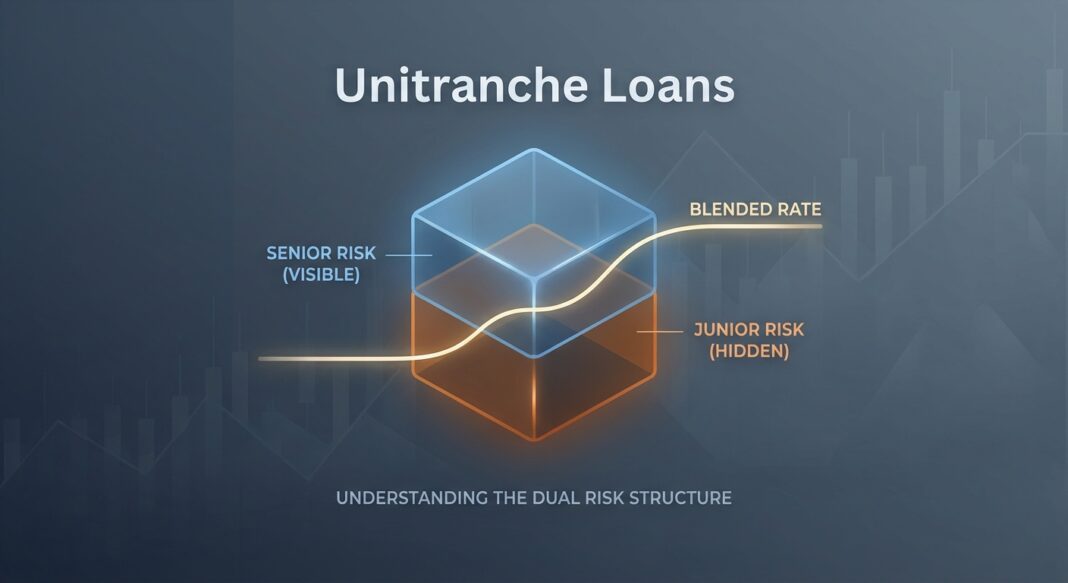
One Loan, One Rate, But Not One Risk Profile
Walk into most middle-market leveraged buyouts today and you will find a unitranche loan at the center of the financing. It has become the defining instrument of the private credit era: a single facility, a single lender or small club, and a single blended interest rate that compresses what used to be two or three separate negotiations into one clean closing. For business owners and private equity sponsors, the pitch is speed and certainty. For direct lenders, it is the ability to capture yield that once flowed to mezzanine funds while controlling the entire credit relationship.
But the simplicity visible to the borrower is, in a precise sense, an illusion. Behind the single credit agreement lies a carefully engineered internal risk split: one that determines who gets paid first in a workout, who controls enforcement, and who absorbs the first loss. Understanding how that split works is not optional knowledge for sophisticated capital markets participants. It is the foundational literacy required to evaluate what private credit actually sells.
This article decodes the unitranche structure from the inside out: how it is built, what it really costs relative to its predecessors, why it commands a spread premium over plain senior debt, and what the current market environment means for both investors allocating to direct lending funds and operators weighing unitranche against other financing options.
The Concept: One Facility, Two Risk Layers
A unitranche loan combines what used to be two separate credit facilities, a senior secured term loan (first claim on assets, lower rate) and a subordinated or mezzanine loan (junior claim, higher rate), into a single credit agreement carrying one blended interest rate. To the borrower, it looks and functions exactly like a single loan: one administrative agent, one set of covenants, one closing process.
The internal subordination, however, does not disappear. It is simply relocated. As Mayer Brown explained in July 2026, rather than creating two distinct tranches with separate credit agreements and intercreditor arrangements, the first-out/last-out structure achieves a form of internal subordination within a single credit facility. The governing document that creates this internal hierarchy is called the Agreement Among Lenders (AAL).
The AAL is a private contract among the lenders themselves, not the borrower, that establishes the waterfall payment schedule, allocation of fees and interest, enforcement control rights, and what happens when the borrower defaults. Per the American Bar Association’s 2025 analysis, because there is only one lien in a unitranche facility, the AAL, not an intercreditor agreement, dictates the economic and control rights of the various lender groups. Critically, in normal operating conditions, both first-out and last-out lenders receive their scheduled payments. The AAL’s priority structure only becomes determinative during stress or default.
This architecture gives the structure two distinct identities at once: from a security standpoint, it is first-lien debt; from a risk-and-return standpoint, it contains both senior and junior exposure blended into a single coupon.
How It Works: A Concrete Example With Real Numbers
Consider a private equity firm acquiring a software business with $20 million in EBITDA at a 12x multiple, a $240 million enterprise value. The sponsor contributes 40% equity ($96 million) and needs $144 million in debt financing at roughly 6.0x leverage.
Under the traditional two-tranche structure, that debt might be split as follows:
- Senior term loan (4.5x / $90M) at SOFR + 300 bps (approximately 8.3% all-in)
- Mezzanine loan (1.5x / $54M) at a fixed 13–14%, subordinated in priority
- Two separate negotiations, two closing timelines, two sets of lender counsel, and an intercreditor agreement governing the relationship between them
Under the unitranche structure, the same $144 million is funded in a single facility:
- One blended rate of approximately SOFR + 550 bps (roughly 10.8% all-in as of mid-2026), sitting between what the senior and junior pieces would have each charged
- The lender club privately splits this into a first-out piece (say, 55% of the loan at a lower effective rate) and a last-out piece (45% at a higher rate) via the AAL
- One closing, often completable in 4–6 weeks versus 8–12 weeks for a broadly syndicated deal
The borrower pays a spread premium versus a standalone senior loan, but captures material savings in execution time, deal certainty, and the elimination of mezzanine negotiation friction. As Alternative Fortune’s March 2026 analysis noted, a unitranche prices above a plain senior loan, roughly SOFR + 450 to 650 bps against SOFR + 250 to 350 bps for a plain first-lien term loan, because it is carrying junior risk inside the same wrapper. The premium buys a single lender, a fast close, and no syndication flex risk.
For the direct lender, the economics are equally deliberate. KBRA’s direct lending data, cited by Brinley Partners in February 2026, put the average private unitranche coupon at roughly 9.00% at the end of 2025, approximately 160 basis points above comparable broadly syndicated loans. That premium is the yield delivered to fund investors in exchange for providing committed, non-syndicated capital.
Current Market Relevance: The Unitranche in a Stress-Testing Environment
The unitranche is not merely a structural concept; it is being actively tested by a market entering its first real credit cycle as a mature asset class.
| Metric | Data Point | Source |
|---|---|---|
| Global private credit AUM | ~$3.2 trillion (mid-2026 est.) | PIMCO, June 2026 |
| Average unitranche coupon (end-2025) | ~9.00% (SOFR + ~450–475 bps) | KBRA / Brinley Partners, Feb 2026 |
| Median new-issue direct loan spread (end-2025) | 544 bps (down from 716 bps peak in March 2023) | McKinsey / Kroll StepStone, June 2026 |
| Bank C&I lending standards (Q1 2026) | Tighter for firms of all sizes; higher premiums on riskier loans, stricter covenants | Federal Reserve SLOOS, April 2026 |
| Largest single unitranche (March 2026) | $4.815B (WWEX/Auctane, Thoma Bravo-backed) at S + 575 bps; 33-lender club | PitchBook / Brinley Partners, March 2026 |
| Cliffwater Direct Lending Index net return (2025) | 9.3% net with 1.45% default rate | Cliffwater / Angel Investors Network, May 2026 |
Two structural forces are reshaping the unitranche market simultaneously. On the supply side, bank credit tightening is creating more demand for private alternatives. The Federal Reserve’s April 2026 SLOOS reported that banks tightened standards for all categories of non-depository financial institution loans, with significant net shares citing higher premiums on riskier loans, stricter covenants, and tighter collateralization requirements. Middle-market companies that cannot access investment-grade bank credit increasingly find unitranche their most practical path to scale financing.
On the pricing side, intense competition among lenders compressed new-issue spreads significantly. McKinsey’s June 2026 global private markets report documented that global median new-issue direct loan spreads fell from a peak of 716 bps in March 2023 to 544 bps by year-end 2025. That compression narrows the spread premium that last-out lenders earn for their subordinated exposure, a dynamic that warrants careful attention at the portfolio level. Lord Abbett’s mid-2026 outlook noted a positive shift emerging, however: new loans are increasingly carrying better credit structures (less leverage, more covenants, and tighter documentation) as deal flow expanded and lenders regained negotiating leverage.
Decision Framework
For Investors Evaluating Private Credit Allocations
When assessing a direct lending fund’s unitranche portfolio, investors consider several questions that go beyond headline yield:
- First-out vs. last-out exposure: Does the fund hold predominantly first-out paper (lower yield, senior repayment priority) or last-out paper (higher yield, subordinated in the AAL waterfall)? The distinction is critical to understanding true downside risk.
- Spread adequacy: As spreads compress toward 500–550 bps, investors evaluate whether the yield premium above broadly syndicated loans (historically ~150–160 bps) adequately compensates for illiquidity and junior risk embedded in last-out positions.
- Covenant quality: With the market historically trending toward covenant-lite structures, investors scrutinize whether individual loan agreements contain maintenance covenants that provide early warning of borrower deterioration, a particularly important protection in the current stress environment.
- Manager scale and workout capability: The AAL enforcement provisions matter most when a borrower defaults. Investors evaluate whether the manager has the legal infrastructure and workout experience to exercise first-out control rights effectively. As Brinley Partners noted in February 2026, large active unitranche lenders like Ares Capital, Blackstone Credit, Blue Owl, and Apollo-affiliated MidCap Financial manage these structures at scale, a capability that smaller platforms may lack.
For Business Operators Considering Unitranche Financing
Operators evaluate unitranche when one or more of the following conditions apply:
- Certainty of close is paramount: If a transaction has a tight timeline or a seller requires committed financing evidence upfront, a unitranche from a direct lender closes faster and without syndication flex risk, the risk that underwriters reprice a deal at closing if market conditions shift.
- Deal size is in the middle market: Unitranche has historically been dominant in transactions ranging from $50 million to $500 million in enterprise value, though it has now scaled to multi-billion-dollar deals. A March 2026 transaction involving a Thoma Bravo-backed merger used a $4.815 billion unitranche, evidence of how far up the size scale the structure has moved.
- Relationship flexibility matters: Because unitranche lenders hold their loans to maturity rather than syndicating them, borrowers often find them more willing to engage constructively on covenant amendments, PIK elections, or add-on financings over the life of the loan.
- The spread premium is affordable: The 150–200 bps premium over a traditional bank term loan is a real cost. Operators model whether the speed, certainty, and flexibility advantages justify that incremental interest expense relative to projected EBITDA growth.
Key Takeaways
- One loan, two risk layers: A unitranche combines senior and junior debt into a single credit agreement. The internal subordination, the first-out/last-out split, lives in the Agreement Among Lenders, invisible to the borrower but determinative in any default scenario.
- Borrowers pay for certainty, not discount: Unitranche pricing sits above standalone senior loans (roughly SOFR + 450–650 bps vs. SOFR + 250–350 bps for plain first-lien debt) because the blended rate includes junior risk. The premium purchases execution speed, certainty, and a single counterparty relationship, not cheaper capital.
- Spread compression is a real risk for last-out holders: With median direct loan spreads falling from 716 bps (March 2023) to 544 bps (end-2025), the yield buffer compensating last-out lenders for subordinated exposure has narrowed. Investors evaluate whether current pricing reflects that embedded risk adequately.
- Bank tightening sustains private credit demand: The Federal Reserve’s SLOOS data confirms banks continue tightening commercial lending standards and loan terms, reinforcing the structural demand for unitranche financing among middle-market companies that lack access to investment-grade credit facilities.
- Manager selection is structural, not stylistic: In a unitranche, the ability to enforce AAL rights in a workout is as important as the ability to originate deals. Investors and operators both consider platform scale, legal infrastructure, and workout track record when evaluating any direct lending counterparty.


