
One Loan. Two Risk Profiles. Everything Business Owners and Investors Need to Know.
Walk into a middle-market leveraged buyout today and odds are high the financing closes with a single loan document, one interest rate, and one administrative agent. No intercreditor fights. No layers of competing lenders haggling over collateral waterfalls. Just a clean, fast close, and a wire. That instrument is the unitranche loan, and it now dominates private credit deal-making the way syndicated loans once ruled Wall Street.
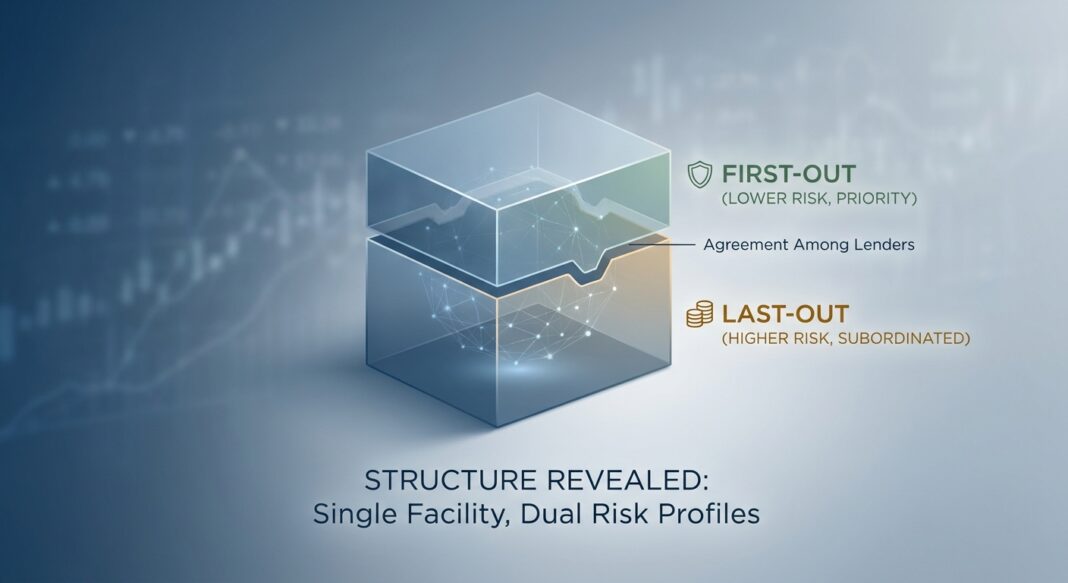
But simplicity on the surface is not the same as simplicity inside. Behind that single borrower-facing document, a private agreement among lenders quietly divides the facility into a first-out tranche: lower risk, lower yield, and a last-out tranche: higher risk, higher yield. The borrower typically never sees this agreement and has no say in its terms. Understanding how that internal architecture works is essential for any investor evaluating private credit funds, or any operator negotiating a unitranche facility for their business.
What a Unitranche Actually Is
Unitranche financing is a single secured credit facility in which two or more groups of lenders share the same security interest on a borrower’s collateral but agree privately on payment priority and economic allocation. According to Mayer Brown (August 2026), a common structure pairs a “first out” asset-based lending facility with a “last out” term loan facility, with the design intended to give first-out lenders reduced risk and return while giving last-out lenders increased risk and return, all within one streamlined facility for the borrower.
This internal division is documented in what practitioners call an Agreement Among Lenders (AAL): a highly bespoke, privately held document that governs payment waterfalls, enforcement control, and loss allocation between first-out and last-out lender groups. As Mayer Brown previously noted, first-out lenders typically hold the revolving credit portion while last-out lenders (predominantly private credit and direct lending funds) hold the significantly larger term loan portion.
Critically, a unitranche is not the same as a traditional first-lien/second-lien arrangement. In a first/second lien deal, two separate liens exist on the collateral governed by an intercreditor agreement between distinct secured parties. A unitranche achieves what Mondaq (August 2026) describes as “internal subordination within a single” credit facility: one lien, one agent, one borrower obligation, but two very different economic outcomes for lenders depending on where losses land.
How It Works: A Concrete Example
Imagine a private equity sponsor acquires a software-enabled services company for $100 million. The deal is financed with $40 million in equity (40% equity cushion) and $60 million in debt structured as a unitranche facility at a blended rate of SOFR + 500 basis points.
Behind the scenes, the AAL divides the $60 million as follows:
- First-Out Tranche, $15 million (25% of total debt): A bank or credit union provides a revolving facility. This lender gets paid first from any collateral proceeds. In exchange, it accepts a lower spread, say SOFR + 300 bps, and accepts tighter operational covenants in return for priority protection.
- Last-Out Tranche, $45 million (75% of total debt): A direct lending fund holds the term loan. This lender absorbs first-dollar losses once collateral is exhausted. In exchange, it earns a higher effective spread, roughly SOFR + 575 bps, to compensate for the subordinated risk profile embedded inside a nominally first-lien structure.
The borrower sees and pays one blended rate on the full $60 million. The complexity of who gets what in a default lives entirely in the AAL. According to Alternative Fortune (July 2026), unitranche facilities price above plain senior loans, approximately 450 to 650 basis points over the floating benchmark versus 250 to 350 basis points for traditional first-lien deals, precisely because the last-out component carries junior risk inside a first-lien wrapper.
What the operator is buying is not a lower coupon. It is speed, certainty of close, and one set of documents. What the lender is selling is structural simplicity in exchange for a meaningful spread premium.
Current Market Relevance
Unitranche structures are not merely popular; they are currently the defining deal architecture in middle-market private credit. Market data through mid-2026 tells a consistent story.
According to Valuation Research Corporation’s Q2 2026 Private Markets Update (July 2026), unitranche structures continue to dominate new issuance, with coupon spreads generally ranging from 4.75% to 5.50% and overall unitranche yields ranging between approximately 9.00% and 9.75%, down roughly 250 basis points from late-2023 peak levels near 11.5%–12.5%, but still well above the pre-2022 historical range of 7%–8%.
The broader market context matters for understanding why unitranche has consolidated its position. Northleaf Capital’s Q1 2026 Market Update (May 2026) observed that periods of market volatility typically see banks and liquid credit markets retrench, with private equity sponsors turning to private credit for greater execution certainty. Sikich’s Q2 2026 Credit Market Trends report (July 2026) confirmed this dynamic, noting that private credit entered a more disciplined phase in Q2 2026, with wider spreads and growing emphasis on underwriting quality as the market recalibrated.
The Federal Reserve’s own data reinforces the structural opportunity for private lenders. The Federal Reserve’s July 2026 SLOOS (August 2026) reported that bank lending standards for commercial and industrial loans remained basically unchanged in Q2 2026, while separately, the April 2026 SLOOS flagged that banks reported tighter standards across all categories of loans to non-depository financial institutions over the prior year, the very lending channel that private credit funds rely on for leverage. This means the bank-funded leverage available to private credit managers is more expensive and constrained, adding underwriting discipline to a market that needed it.
At the asset class level, PIMCO (June 2026) estimated global private credit AUM at roughly $3.2 trillion, comprised of approximately $2.4 trillion in drawdown funds and roughly $800 billion in semi-liquid vehicles. Preqin’s 2026 outlook (February 2026) projects that private credit AUM could more than double to $4.5 trillion by 2030, with unitranche direct lending remaining the core engine of that growth.
| Metric | Data Point | Source |
|---|---|---|
| Global Private Credit AUM | ~$3.2 trillion | PIMCO, June 2026 |
| Unitranche All-In Yield Range (Q2 2026) | ~9.00% – 9.75% | VRC, July 2026 |
| Unitranche Coupon Spread Range | SOFR + 4.75% – 5.50% | VRC, July 2026 |
| Bank C&I Lending Standards Q2 2026 | Basically unchanged (all firm sizes) | Fed SLOOS, August 2026 |
| Direct Lending Spread Widening (Q1–Q2 2026) | +25–50 bps on new issues | Sikich, July 2026 |
| Projected Private Credit AUM by 2030 | $4.5 trillion | Preqin via IQ-EQ, February 2026 |
Decision Framework: Investors and Operators
For Investors Evaluating Private Credit Funds
When a fund’s marketing materials describe a portfolio of “first-lien senior secured” loans, investors should ask whether those loans are unitranche facilities with a last-out component. The distinction matters enormously in a stress scenario. Key evaluation criteria include:
- First-out vs. last-out composition: What percentage of the portfolio’s unitranche exposure sits in last-out positions? Last-out is economically closer to mezzanine debt than to true senior secured lending, even though it carries a first-lien label.
- AAL control rights: Which lender group controls enforcement remedies? A last-out lender that cannot accelerate or take collateral without the first-out lender’s consent has materially weaker recovery options than a traditional first-lien lender.
- Spread premium adequacy: Investors consider whether the additional 150–200 basis points earned in last-out positions adequately compensates for the loss absorption risk relative to a pure first-out or broadly syndicated senior loan. As Lord Abbett’s 2026 Midyear Outlook observed, the second half of 2026 is likely to be defined by dispersion, favoring managers who focus on how loans are structured and how much free cash flow borrowers generate.
- Covenant quality: Hamilton Lane’s 2026 Private Credit Focus highlighted that stronger underwriting, lower leverage, and durable cash flows will be key to delivering income and downside protection in the current environment.
For Business Operators Evaluating Unitranche Financing
Unitranche is most advantageous for operators who prioritize deal speed and document simplicity over minimizing borrowing cost. Practical considerations include:
- Speed and certainty: A unitranche can close weeks faster than a bifurcated first/second lien deal requiring two separate intercreditor negotiations. For time-sensitive acquisitions or recapitalizations, this premium can be worth the higher spread.
- Covenant negotiation: Since the last-out lender bears the primary credit risk, operators should expect (and can sometimes negotiate) more borrower-friendly covenant packages in exchange for the spread premium the lender receives.
- Refinancing flexibility: Understand the AAL’s prepayment provisions. Some structures include call protection or make-whole premiums that make early refinancing expensive, even if credit markets improve.
- Relationship with the agent: The single administrative agent in a unitranche is typically the last-out lender. Operators evaluate the agent’s track record on amendments and waivers before signing, since this lender will be the primary point of contact through the life of the loan.
Key Takeaways
- One loan, two risk profiles: A unitranche presents a single borrower-facing obligation but contains an internal first-out/last-out hierarchy governed by a private Agreement Among Lenders that fundamentally determines recovery outcomes in distress.
- “First lien” does not always mean first loss protection: Last-out positions within unitranche facilities carry economics closer to junior debt, and investors should look past the first-lien label when assessing portfolio risk.
- Spread premium reflects real junior risk: Unitranche yields of 9.00%–9.75% in mid-2026 sit well above both traditional senior loans and pre-2022 levels, a reflection of the blended risk profile, not just base rate movement.
- Market conditions favor disciplined lenders in 2026: Wider spreads, selective capital deployment, and improving documentation standards are creating a more lender-friendly environment, but only for managers with strong underwriting discipline and the dry powder to be selective.
- Operators buy speed; lenders sell structural simplicity: The core value exchange in a unitranche is not a cheaper rate; it is a faster, cleaner close. Understanding this trade-off helps both borrowers and lenders negotiate with clear expectations.


